Immanuel Kant once claimed, “I had to deny reason in order to make room for faith.” In his Critique of Pure Reason, Kant argues that human reason is limited when it comes to knowing the divine, suggesting that faith and reason are fundamentally at odds. While his philosophy is brilliant in many respects, this notion of incompatibility forms a division that I believe does not truly exist.
At The Twin Tree Project, we aim to challenge this concept. Reason and faith are not adversaries—they are companions. In fact, faith, when nurtured and explored, can make one wiser, enriching reason itself. And to claim that a posteriori knowledge, knowledge derived from experience, creates an unscalable wall to faith? I propose the opposite: lived experience often brings us closer to the divine.
It was this very question—the relationship between reason, knowledge, and faith—that sent me full force into the work of Christopher Michael Langan and his Cognitive-Theoretic Model of the Universe (CTMU). The CTMU’s central premise is that reality and consciousness are not separate but deeply interconnected, forming a self-referential system that is simultaneously logical and divine. This framework doesn’t simply make room for faith—it requires it, presenting faith as an extension of logic rather than its antithesis.
The False Dichotomy: Reason and Faith
Kant’s assertion seems to rest on the idea that faith requires a leap into the unknown, necessitating the surrender of reason. It is true that faith involves believing in what we cannot see, but this does not mean it contradicts reason. Rather, faith expands reason, allowing us to transcend the limits of human understanding and explore the mysteries that logic alone cannot unravel.
CTMU posits that the universe itself is a kind of meta-cognition—a self-processing system in which logic and spirituality are two sides of the same coin. What Kant framed as a division is, in this view, an illusion. Reason is not the enemy of faith; it is its foundation. When we embrace this unity, we see that faith doesn’t require abandoning reason but rather embracing a higher, more inclusive logic.
I would go further to say that having faith makes one wiser. Why? Because wisdom is not simply the accumulation of facts or intellectual understanding—it is the ability to apply knowledge with discernment, empathy, and an awareness of higher truths. Faith invites us to see beyond the surface of our experiences and recognize the profound interconnectedness of all things.
This idea is central to CTMU, for example, where interconnectedness isn’t just a spiritual concept but a logical necessity. If reality is a unified system of self-referential meaning, then faith in that system—faith in its coherence, purpose, and beauty—is itself an act of wisdom. Faith fosters humility, which is essential to wisdom. It acknowledges that we don’t have all the answers and that the universe operates on levels we cannot fully comprehend.
A Posteriori Knowledge: A Bridge, Not a Barrier
Kant implied that a posteriori knowledge—knowledge gained through experience—somehow obstructs faith. But isn’t it often through our experiences that we come to believe in something greater than ourselves? The birth of a child, the beauty of nature, the resilience of the human spirit—these experiences can ignite our faith and deepen our understanding of the divine.
CTMU supports this view by framing experience as part of a self-referential feedback loop within the universe. Our individual experiences are not isolated events; they are threads in the greater tapestry of reality. Far from being a “titanium wall,” a posteriori knowledge is a bridge. It connects our tangible, earthly experiences to the intangible, spiritual truths that underpin them.
Reason and Faith: Two Branches of the Same Tree
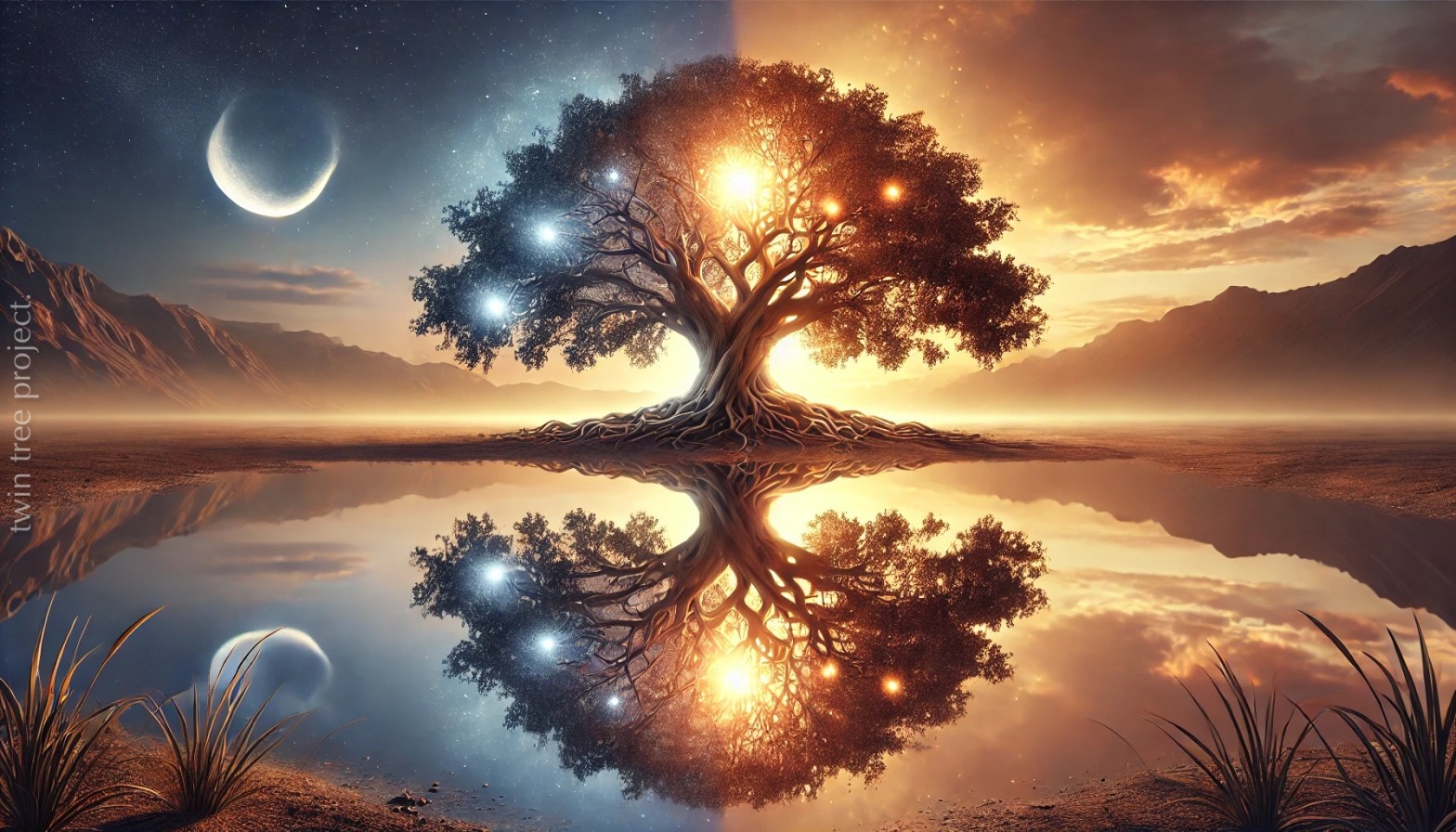
At the heart of this discussion is the idea that reason and faith are two branches of the same tree. One cannot thrive without the other. Reason without faith risks becoming cold and lifeless, detached from the deeper meanings of life. Faith without reason risks becoming blind and misguided, untethered from reality. Together, they create a balance—a harmony that allows us to seek truth with both our minds and our hearts.
This is the purpose of The Twin Tree Project: to illuminate the ways in which reason, knowledge, and faith are not separate or conflicting but beautifully interwoven. By exploring ideas like CTMU, we can show that reason and faith are not just compatible—they are inseparable.
Faith is not an escape from reason; it is an invitation to expand it. It challenges us to go beyond what we can see, touch, and measure, and to embrace the profound mysteries of existence with courage and humility. As CTMU suggests, reality itself operates on principles that transcend human understanding while remaining deeply logical. And as we embrace this harmony, we find that faith does not weaken our reason—it strengthens it, making us not only wiser but more whole.
So, to Kant, I would say this: there is no need to deny reason to make room for faith. Let them grow together, like two branches of the same tree, and discover the beauty and wisdom that lies in their unity.
 The Twin Tree Project