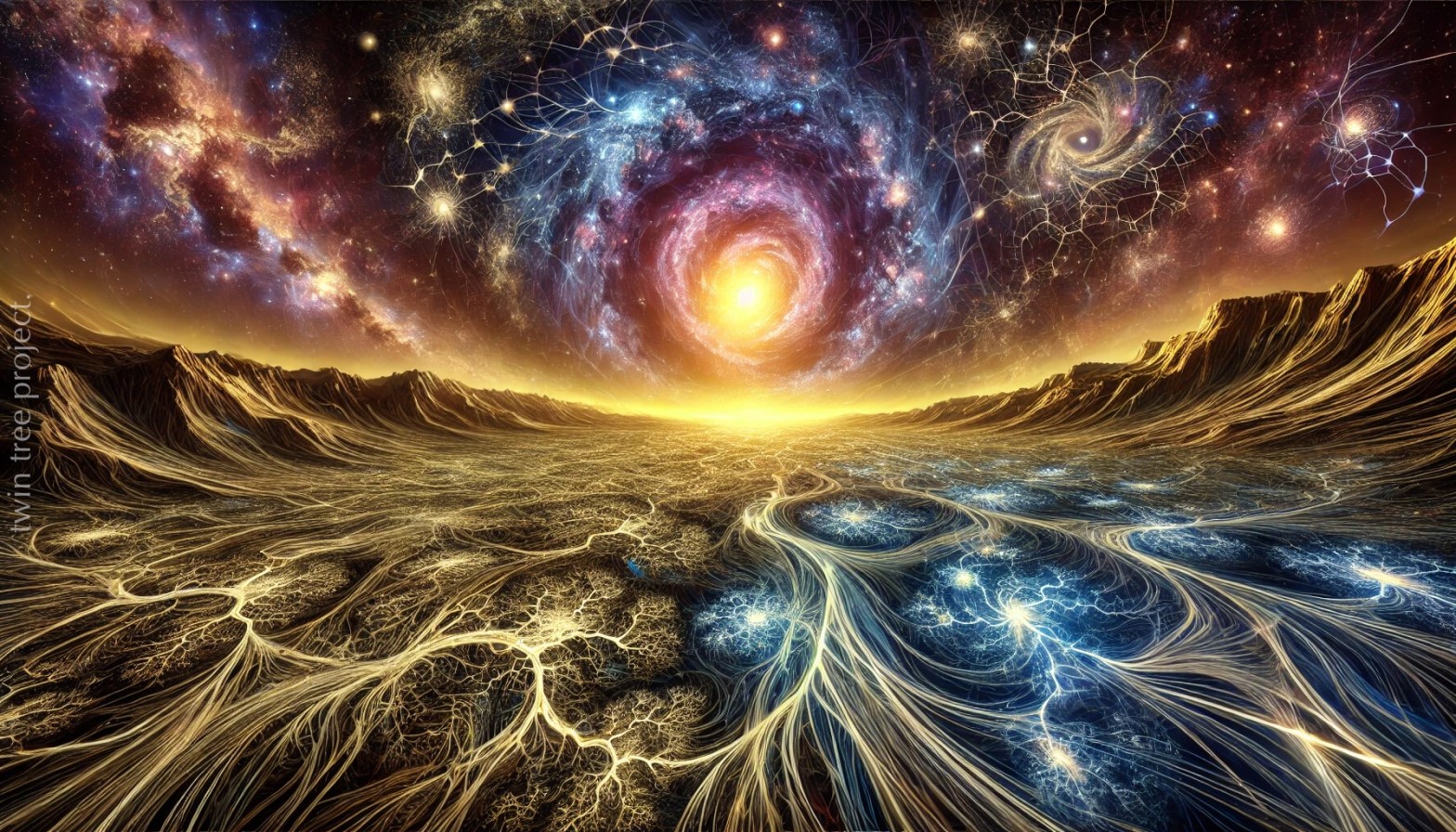
The universe is a masterpiece of complexity, from the intricate patterns in nature to the abstract workings of human thought. Yet, complexity is not random; it emerges from simple underlying principles. The Cognitive Theoretical Model of the Universe (CTMU) takes this concept further, suggesting that reality itself is an emergent system, evolving through self-reference and interaction. In this view, complexity is not only a feature of existence but a requirement for its continued evolution.
In our previous posts, we explored how the CTMU frames reality as a unified, interconnected system shaped by cognition and observation. This post builds on those ideas, examining how complexity arises and why emergence is central to the CTMU’s framework. As Christopher Langan explains in The Art of Knowing:
Emergence is not a byproduct of complexity; it is the very mechanism through which complexity is created and organized.
The Nature of Complexity
Complexity can be seen in everything from the formation of galaxies to the behavior of ecosystems. It describes systems composed of many interconnected parts, where the whole is greater than the sum of its components. The CTMU defines this as an emergent property—something that arises from the interactions within a system rather than being imposed externally.
Langan introduces the concept of SCSPL (Self-Configuring Self-Processing Language) as the mechanism by which complexity emerges. SCSPL operates through recursion, meaning that reality continuously evolves by reflecting on and reconfiguring itself. This process creates new layers of complexity while maintaining coherence with the underlying structure of reality.
This idea resonates with principles in science, such as the laws of thermodynamics. For example, in open systems like Earth, energy flows allow for increasing complexity over time, leading to phenomena like life and consciousness. In the CTMU, this is not a coincidence but a natural result of reality’s self-organizing nature.
Emergence and Consciousness
One of the most compelling examples of emergence is consciousness itself. How does a network of neurons give rise to thought, emotion, and self-awareness? The CTMU proposes that consciousness is not a separate phenomenon but an extension of the universe’s emergent complexity.
Langan writes in An Introduction to Mathematical Metaphysics:
Consciousness is the emergent interface between self and reality—a reflection of the universe’s capacity for self-recognition.
In other words, human consciousness mirrors the self-organizing principles of reality, making it both a product of and a participant in the universe’s ongoing evolution.
This perspective aligns with philosopher Terrence Deacon’s work on emergence in biological systems, where he notes:
Emergence involves the generation of something genuinely novel from interactions among parts, not reducible to their properties.
The CTMU expands on this by showing how emergence operates on every level, from the quantum to the cosmic.
Why Complexity and Emergence Matter
Understanding complexity and emergence in the CTMU reframes how we view evolution, both in the natural world and in ourselves. Complexity is not a sign of chaos or randomness; it is evidence of a deeper order. Emergence, in turn, highlights the universe’s capacity to generate novelty while maintaining coherence, ensuring its continuous evolution.
Christopher Langan puts it succinctly:
The complexity we observe in reality is not accidental. It is the signature of a system designed to grow, adapt, and create.
Why This Matters
Complexity and emergence reveal the universe’s capacity for growth, adaptability, and innovation. By recognizing these principles, we can better understand our place in the grand design of existence. The CTMU reminds us that we, as conscious beings, are not separate from the universe’s emergent processes but active participants in them.
When we embrace this perspective, we see our own complexity—not as a source of confusion, but as a testament to our role in the universe’s ongoing evolution. It challenges us to ask: How can we contribute to this process? How can we align ourselves with the emergent principles that drive reality forward?
 The Twin Tree Project
2 thoughts on “Complexity and Emergence in the Cognitive Theoretical Model of the Universe (CTMU)”