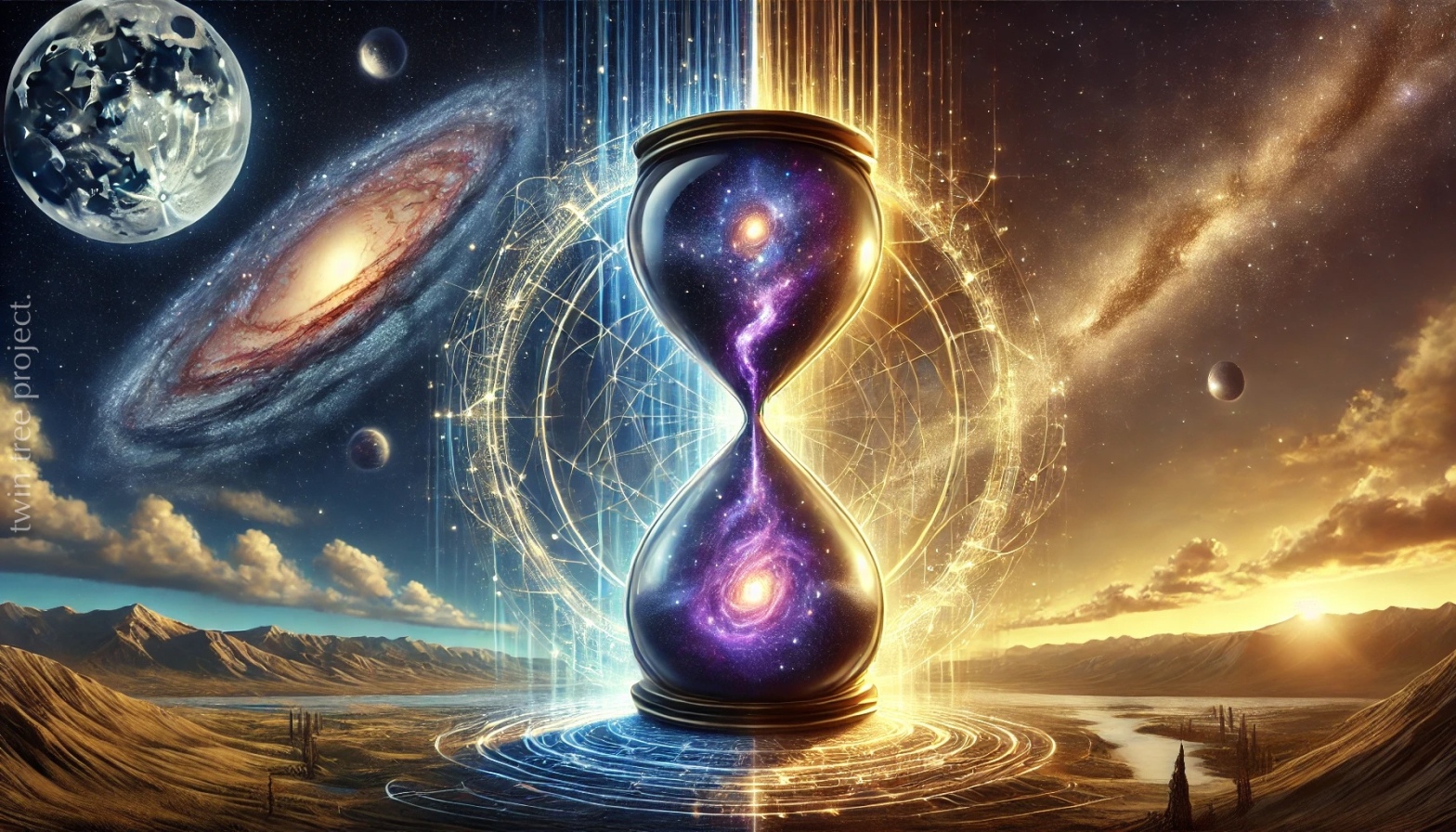
Time governs every aspect of our lives, from the steady ticking of the clock to the grand cycles of celestial motion. Yet, its nature remains one of the greatest mysteries of existence. Is time a fundamental aspect of reality, or is it merely a construct of perception? The Cognitive Theoretical Model of the Universe (CTMU) offers a unique perspective, suggesting that time is both real and illusory, arising from the self-referential nature of reality.
In previous posts, we’ve explored the CTMU’s insights into cognition, interconnectivity, and emergence. Today, we turn our attention to time, diving into its role within the CTMU framework and its implications for understanding reality. As Christopher Langan writes in An Introduction to Mathematical Metaphysics:
Time is not an external dimension but an intrinsic property of self-processing reality—a measure of internal consistency within a self-configuring system.
Time as an Intrinsic Property
Traditional views of time treat it as an independent dimension in which events occur sequentially. The CTMU challenges this by defining time as an intrinsic aspect of reality itself. In this view, time emerges from the recursive processes of the universe, which continually reconfigures itself to maintain consistency.
Langan’s concept of SCSPL (Self-Configuring Self-Processing Language) provides the foundation for understanding time in the CTMU. According to this model, time is a byproduct of reality’s self-processing dynamics. As the universe evolves, its “state updates” create the appearance of linear progression, even though all states coexist in a unified framework.
Physicist Carlo Rovelli, author of The Order of Time, shares a complementary perspective:
The distinction between past, present, and future is only a stubbornly persistent illusion.
While Rovelli approaches time through the lens of quantum mechanics, his ideas resonate with the CTMU’s assertion that time is a relational property rather than an absolute one.
The Illusion of Sequential Time
One of the most profound implications of the CTMU’s treatment of time is that linearity—the idea that events occur in a strict sequence—is an illusion. Instead, all states of reality exist simultaneously within a unified whole. Time, as we experience it, is a perceptual artifact, arising from our position within reality’s self-referential structure.
This idea aligns with the concept of block universe theory in physics, which suggests that past, present, and future coexist in a single, unchanging spacetime structure. The CTMU expands on this by introducing the notion of “telic recursion,” a process through which reality selects its own states in alignment with its overarching purpose. Time, in this sense, is a way of organizing these states to create the appearance of continuity.
Time and Human Experience
While the CTMU redefines time as an intrinsic and recursive property of reality, it does not dismiss its significance to human experience. In Langan’s view, time is the medium through which consciousness navigates reality, allowing it to perceive, reflect, and evolve.
In this sense, time is both a tool and a constraint. It enables us to process information sequentially, making sense of our environment and our place within it. Yet, it also limits our ability to perceive reality as it truly is: a timeless, interconnected whole.
This duality mirrors the ideas of philosopher Henri Bergson, who distinguished between “clock time” (measurable and sequential) and “real time” (subjective and experiential). The CTMU bridges these perspectives by showing how time emerges from the interplay between perception and reality’s self-referential structure.
Why This Matters
Understanding time as both an illusion and a reality transforms how we view our existence. It challenges us to think beyond the linear constraints of past, present, and future, encouraging us to see ourselves as part of a timeless, interconnected system.
Christopher Langan sums it up eloquently:
Time is the interface between cognition and reality—a tool for navigating existence, but not its ultimate measure.
By recognizing time’s dual nature, we gain a deeper appreciation for our role in the grand design of reality. It reminds us that while our experiences unfold in time, our true essence transcends it, connecting us to the eternal structure of the universe.
 The Twin Tree Project
One thought on “Time in the Cognitive Theoretical Model (CTMU): Illusion, Reality, or Both?”