
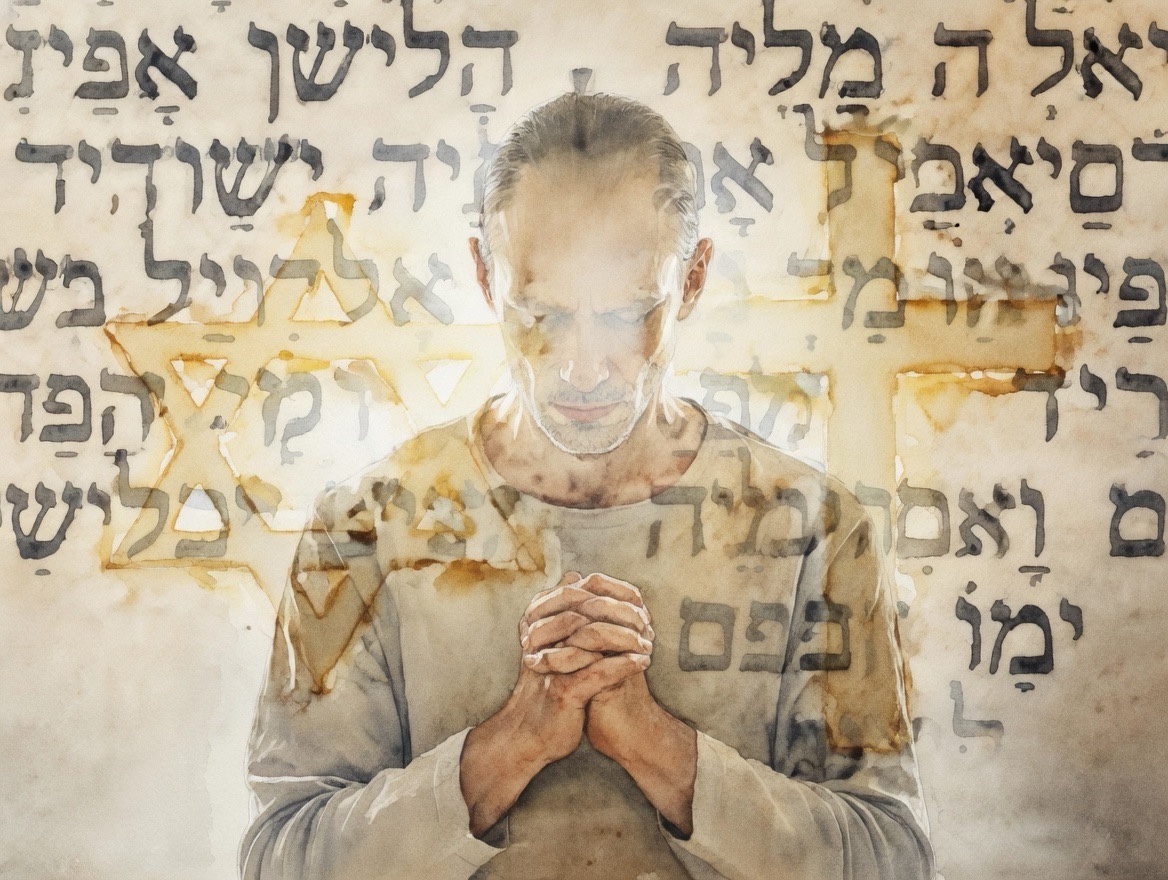
I was meditating when I heard it. Or felt it… Or received it… I’m not always sure how to describe the way the Holy Spirit communicates, but this was clear enough that I reached for something to write with. I couldn’t keep up with every word, but the core of it landed:
If you have turned your back on Israel, if you hate Jewish people, then you hate your own Savior. Jesus didn’t find fault with Jewish leadership and Jewish rabbis during His time on earth because He disagreed with Judaism. He did so because those leaders were making a mockery of His Father’s temple and of the spiritual law.
I had to sit with that for a long moment, because it was so obviously the truth.
Jesus was Jewish. Born Jewish, raised Jewish, circumcised on the eighth day, present at Passover, literate in Torah. His mother was Jewish, his disciples were Jewish, his earliest followers were Jewish. When he said:
You worship what you do not know; we worship what we know, for salvation is from the Jews. John 4:22
…he wasn’t offering a footnote. He was stating something central to the entire story.
So when Christians express contempt for Jewish people or turn their backs on Israel, they are sawing off the branch they’re sitting on. This has been a stain on the church for centuries. You cannot love the Savior and hate the people He came from. That’s not a nuanced theological position. That’s very simply, and very literally, a contradiction.
The second part of what I received is equally important: Jesus’ confrontations with the Pharisees and scribes were not a rejection of Judaism. They were a defense of it.
It is written, ‘My house shall be called a house of prayer,’ but you are making it a den of robbers. Matthew 21:13
That wasn’t an indictment of Israel. That was fire directed at corruption wearing religion as a costume. There’s a difference. There’s always been a difference.
An Honest Admission
That word came to me in the middle of meditation that was already thick with questions. Questions I’ve carried for a long time. Questions that don’t dissolve just because I believe that Jesus is who He said He is.
The Gospels present the same events in ways that don’t always align perfectly. Some call these contradictions; others see them as complementary perspectives from different witnesses with different emphases. To me, they feel blatant at times. Not in small details, but in significant ones. I’ve wrestled with this reality off and on all my life, but especially during pre-adolescent and adolescent years — the era of life when I genuinely thought my Sunday school teaching mother and deacon father might have been taken for fools.
I understand the explanations now, at least intellectually: Matthew writing to show Jesus as the fulfillment of Hebrew prophecy, Mark’s raw urgency, Luke’s careful historical method, John’s theological depth. Scholars and many believers harmonize these accounts successfully. For me, though, the tension still bites at times.
Take the last words of Jesus on the cross. Matthew and Mark record this:
My God, my God, why have you forsaken me? Matthew 27:46 / Mark 15:34
Luke records this:
Father, into your hands I commit my spirit. Luke 23:46
And John records this:
It is finished. John 19:30
Three different final moments. One man. Same event.
Or take the beginning of Jesus’ life. Matthew and Luke both tell a birth story, but they’re not the same story. Matthew gives us the Magi, the flight to Egypt, Herod’s slaughter of the innocents. Luke gives us the census, the manger, the shepherds in the field. Mark skips the birth entirely and picks up with a baptism in the wilderness. John doesn’t bother with any of it; instead, he opens before time itself:
In the beginning was the Word, and the Word was with God, and the Word was God. John 1:1
Four accounts of the same person. Four entirely different on-ramps.
And then there’s Paul.
I love Paul’s theology. I genuinely do. But I’d be lying if I said I’ve never hit a wall with him.
I do not permit a woman to teach or to have authority over a man. 1 Timothy 2:12
Women should be silent in the churches. 1 Corinthians 14:34
I’m a woman who thinks, writes, and believes she’s been given something to say. Those words are hard to sit with, and I’m not going to pretend they aren’t.
The restrictive passages have been debated for centuries. Some see them as timeless church order; others as culturally specific to particular church situations, or even later additions not original to Paul. I don’t have a clean, final answer. But I hold both sets of texts together and keep asking:
When Scripture seems to pull in opposite directions, is the distortion in the text, or in the layers of religion and institution pressed over it across centuries?
Resolutions?
So what do I do with all of this?
I could do what a lot of people do: decide that the contradictions prove the whole thing is unreliable and walk away, or decide not to look too closely and keep moving without ever sitting in the tension. Neither of those works for me. I don’t think either of them is honest.
Here’s what I’ve done, what I’ve come to, imperfectly, and continue to work through:
Instead of just throwing away all the versions of Scripture I’ve poured over for decades and saying, “to hell with it, if there is really even a hell,” I chose to sit with my faith. To sit with God, and to invite Him to show me the truth. I read books upon books about theology and history and I studied as many aspects and perspectives of Scripture as I could manage.
In studying psychology, which was my chosen career path and at the time completely unrelated to my spiritual path (I have to chuckle at that now), I found that generally speaking, four independent witnesses rarely give identical accounts. In regard to the Gospels, if they did, historians would be suspicious. Identical testimony tends to suggest coordination, not truth.
Matthew wrote for a Jewish audience and wanted to show Jesus as the fulfillment of Hebrew prophecy. Mark wrote quickly and urgently, and his version is widely accepted to likely be the earliest gospel. It was raw and immediate. Luke was a careful historian who interviewed eyewitnesses. John was writing theology in the shape of a life.
None of them were filing a report. They were testifying. And testimony carries the perspective, the emphasis, the context of the person giving it. That doesn’t make them wrong. It makes them human. Which, if you think about it, is exactly what God has always worked through.
On Paul and women, the tension doesn’t fully resolve, but it complicates itself. Romans 16 has Paul greeting Junia as “outstanding among the apostles” and naming multiple women as co-workers in the gospel:
Greet Andronicus and Junia, my fellow Jews who have been in prison with me. They are outstanding among the apostles, and they were in Christ before I was. Romans 16:7
And then there’s this:
There is neither Jew nor Greek, slave nor free, male nor female, for you are all one in Christ Jesus. Galatians 3:28
The restrictive passages have been debated seriously by scholars for a long time. Some argue they’re culturally specific to a particular disordered church situation, others that certain passages may be later additions not original to Paul at all.
I don’t have a clean answer. But I have a framework that helps: when Scripture seems to work against itself, it’s worth asking whether the distortion is in the text or in the layer of religion and institution that was pressed down over it across centuries. That framework has served me before. It still does.
Closing Thoughts
I want to close today with something I think gets lost in a lot of Christian conversation about doubt and tension: not everything resolves in this life.
Some questions are going to travel with you all the way to the end and only get answered on the other side of it. That’s not a failure of faith. That’s what faith actually is: not the absence of tension, but the decision to keep walking in the middle of it.
The word I received didn’t come because I had everything figured out. Far from it, in reality. In fact, it came when I had opened my mind yet again to reconsideration. It came while I was sitting in the questions, and maybe that’s the point.
Maybe God isn’t waiting for you to have clean theology before He speaks. Maybe He meets you in the wrestling, the same way He met Jacob.
So Jacob called the place Peniel, saying, “It is because I saw God face to face, and yet my life was spared.” Genesis 32:30
I don’t have all of this resolved. I’m not sure I’m supposed to. But I know what I heard in the quiet. And I know it was true. That’s enough to keep going.
So I leave you with this:
What tensions are you carrying right now? What questions won’t let you go? Bring them into the quiet. Sit with them. See what God whispers when you stop trying to force an answer.
Sometimes the wrestling itself is where the encounter happens.
 Twin Tree Project