
I said in the previous post that I question things, including the Bible. I meant it. I don’t accept something just because a pastor or any other “authority” said it, and I don’t reject something just because a critic did. I go look. I research. I study.
When it comes to scripture — especially when I’m in a season of wrestling with certain passages, certain tensions, certain things that don’t sit easy — going and looking is exactly what I do. I’ve compiled many notes over the years, and I’d like to share what I found as a follow up to the previous post.
A Preface: The “Accepted” Canon versus the Bigger Picture
The Holy Bible most of us grew up with — 66 books, Old and New Testament — is actually only one version of a much larger body of sacred texts and manuscript traditions. For example, the Apocrypha, a collection of books included in Catholic and Eastern Orthodox Bibles but removed from Protestant canons largely during the Reformation, represents one significant divergence.
Then, there is the Ethiopian Orthodox Bible, widely considered the oldest complete Christian Bible, contains 81 books — including texts like 1 Enoch and Jubilees not found in Western canons at all, despite the fact that Jude 1:14-15 directly quotes 1 Enoch in the New Testament. There is also the Septuagint — the Greek translation of the Hebrew scriptures completed roughly 250 to 100 BC — was the version most widely used by the early church and is the source of most Old Testament quotations found in the New Testament.
The Dead Sea Scrolls, discovered between 1947 and 1956 in the caves of Qumran, provided manuscript evidence dating as far back as 250 BC — confirming much of the textual transmission we rely on today, while also revealing variations from later standardized texts and surfacing additional documents outside any recognized canon. This is territory I’ve been sitting with since I was a teenager, studying alongside my father. After he passed, I found myself going back through his journals and notes — years of his own wrestling with the questions the institutional church often preferred to leave unanswered. Many of those questions started here.
All of that deserves its own deep look, and we’ll get there eventually. For today, though, we’re staying with the 66-book canon most people know — because even within those bounds, there’s more than enough to sit with.
The Holy Bible: Three Continents, Fifteen Centuries, One Story
We have a tendency to think of the Holy Bible as a single-origin document. One culture, one region, maybe a few generations of writers passing the scroll around. That’s not what it is.
The 66 books of the Protestant Bible, across its translations and revisions, were composed across three continents over approximately 1,500 years by more than 40 authors who, for the most part, never met each other, never collaborated, and in many cases didn’t know the others existed.
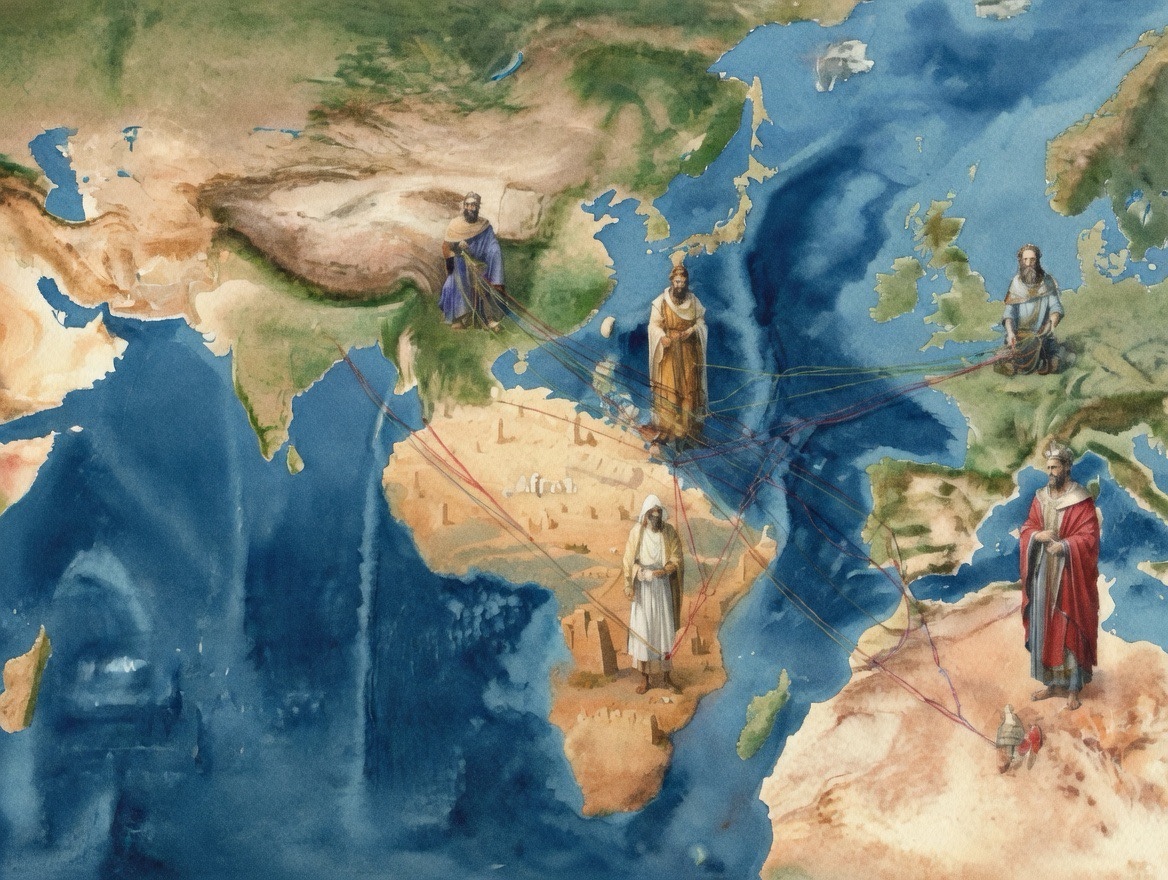
For ease of understanding as much as reference, here is a map of this statement:
Asia. Ezekiel wrote from Babylon (modern-day Iraq) around 593 to 571 BC. He was a priest writing in exile after Nebuchadnezzar’s conquest of Jerusalem. Daniel also wrote from Babylon, beginning around 605 BC. These men were captives in a foreign empire, writing in the middle of one of the most disorienting national catastrophes in Israel’s history.
Africa. Moses composed the first five books (Genesis through Deuteronomy, what Jewish tradition calls the Torah) while leading somewhere between one and two million people through the Sinai wilderness, which is geographically part of the African continent. The book of Job, possibly the oldest book in the canon, is set in the land of Uz, likely in the region of modern-day Arabia or northern Africa. Jeremiah, who wrote around 600 BC, ended up in Egypt after the fall of Jerusalem, continuing to write there.
Europe. Paul wrote his letter to the Philippians from a Roman prison, likely in Rome itself, around 61 to 63 AD. That’s Europe. He wrote Ephesians, Colossians, and Philemon from chains as well. John wrote Revelation from the island of Patmos (off the coast of modern Turkey, which straddles Asia and Europe) around 95 AD, also in exile under Roman persecution.
Three continents. Three languages: Hebrew, Aramaic, and Greek. The oldest portions of the Old Testament were written in classical Hebrew. Parts of Daniel and Ezra shift into Aramaic — the trade language of the ancient Near East, and the language Christ Himself spoke. The entire New Testament was written in Koine Greek, the common language of the Roman Empire.
For the sake of clarity and consistency, I’d like to point out here a reality of the previous point: Koine Greek was used across the New Testament rather than Aramaic because the mission had expanded beyond Jewish Palestine to the entire Roman world, and Greek was the only language that could reach it.
I used to question this, but as I became more educated I came to understand that writing in Aramaic would have confined the message to a regional audience. The authors wrote for reach. Koine Greek was the “lingua franca” of trade, governance, and communication from Rome to Egypt to Asia Minor. It was the language most likely to cross every border the gospel was headed toward.
Who These People Actually Were
The authorial range of the Bible alone is staggering. David was a shepherd and accomplished musician who became a king and wrote roughly half the Psalms from around 1000 BC in Jerusalem. Amos, writing around 760 BC, was a shepherd and fig farmer from Tekoa who explicitly says he was not a professional prophet — just someone God called out of a field.
Moses is described as having been educated in all the wisdom of Egypt, a prince-turned-fugitive-turned-leader. Matthew was a tax collector, despised by his own people as a Roman collaborator. Luke was a physician and the only Gentile author in the New Testament, writing with the precision of someone trained in observation and documentation.
Peter was a fisherman. Solomon was the wealthiest king in the ancient world. Jeremiah was a priest who wept so persistently he’s called the “weeping prophet.” Paul was a Pharisee who had been actively overseeing the execution of Christians before his Damascus road encounter.
These are not people who were always what we would consider “good,” much less “holy” — David arranged a man’s death to cover his own sin, Paul was overseeing executions before his Damascus road encounter, and Moses was a murderer in exile before God called him back. It is not likely these people would have sat down together and agreed on anything. And yet…
Threads and The Through Line
When you read the Bible as a single document — not as isolated books, not cherry-picked verses, but as a continuous narrative — one story runs from Genesis through Revelation without breaking:
Creation. Fall. Promise. Rescue. Restoration.
That’s the arc. And it doesn’t waver across authorship, continent, century, or language. But it’s important to get more specific, because the surface level of “one story” doesn’t do justice to what’s actually happening in the text.
The Seed Thread. In Genesis 3:15, immediately after the fall, God says to the serpent:
I will put enmity between you and the woman, and between your offspring and hers; he will crush your head, and you will strike his heel.
Theologians call this the protoevangelium — the first gospel — a promised one from the woman’s line who will be struck but will ultimately crush the adversary. That’s Genesis. Moses writing in the wilderness, roughly 1400 BC.
Now follow it forward. Isaiah, writing in Jerusalem around 700 BC, describes a servant figure in chapter 53:
He was pierced for our transgressions, he was crushed for our iniquities; the punishment that brought us peace was on him, and by his wounds we are healed.
He goes on:
He was led like a lamb to the slaughter.
Isaiah is writing seven centuries before the crucifixion. He never met Moses. He is on a different continent from Paul.
Then you get to Galatians 4:4, Paul writing from the Roman world around 48 to 55 AD:
But when the set time had fully come, God sent his Son, born of a woman, born under the law, to redeem those under the law.
Born of a woman. The seed thread, now fulfilled.
Revelation 12 picks it up again — the woman, the child, the dragon — imagery that directly echoes Genesis 3:15, written by John roughly 1,500 years after Moses and half a world away.
One thread, no committee.
The Lamb Thread. In Genesis 22, when Abraham is about to sacrifice Isaac, he tells his son:
God himself will provide the lamb.
Isaac asks where the sacrifice is. That’s around 2000 BC, if we’re taking the traditional dating of the patriarchs. Then the Passover lamb in Exodus 12 — no broken bones, blood on the doorposts, death passes over. Leviticus establishes an entire sacrificial system built on blood atonement:
For the life of a creature is in the blood, and I have given it to you to make atonement for yourselves on the altar. Leviticus 17:11
Now John the Baptist in the first chapter of the Gospel of John — a completely different author, centuries later, entirely different genre — sees Jesus and says:
Look, the Lamb of God, who takes away the sin of the world. John 1:29
And then, Revelation 5 — John’s vision near the end of the canon: a Lamb, looking as if it had been slain, standing at the center of everything.
Genesis to Revelation. Different authors, different centuries, different continents. One lamb.
The Prophecy Thread. This one gets specific in ways that are hard to dismiss. Psalm 22 was written by David around 1000 BC. It opens:
My God, my God, why have you forsaken me?
These are the exact words Jesus quotes from the cross in Matthew 27:46 and Mark 15:34. The same psalm (22) describes:
They pierced my hands and my feet… Psalm 22:16
and
They divide my clothes among them and cast lots for my garment… Psalm 22:18
Crucifixion as a method of execution hadn’t been invented yet when David wrote that. John 19:23-24 records the soldiers casting lots for Jesus’ clothing and specifically notes it fulfilled what was written in Psalm 22.
Micah 5:2, written around 730 BC:
But you, Bethlehem Ephrathah, though you are small among the clans of Judah, out of you will come for me one who will be ruler over Israel, whose origins are from of old, from ancient times.
Matthew 2:1 opens with the birth of Jesus in Bethlehem. Micah had been dead for over 700 years.
Zechariah 11:12-13, written around 520 BC, records thirty pieces of silver being thrown to the potter in the house of the Lord — a specific, almost oddly precise detail in the middle of a prophetic passage. Five hundred years later, Matthew 26:15 records Judas agreeing to betray Jesus for exactly thirty pieces of silver, and Matthew 27:3-10 describes that same money being thrown into the temple and used to purchase a potter’s field.
The specificity across five centuries, between two authors who had no contact with each other, is the kind of detail that stops you mid-read if you’re paying attention.
Zechariah 9:9:
See, your king comes to you, righteous and victorious, lowly and riding on a donkey.
Matthew 21:5 quotes this directly in the Palm Sunday account.
These are not isolated coincidences. Taken individually, any one of them might be dismissed. Taken together — across fifteen centuries, three continents, and authors who never shared a room or a conversation — they form something that resists easy explanation.
A donkey in a prophecy written five centuries before Palm Sunday. Thirty pieces of silver down to the potter’s field. A lamb from Genesis to Revelation. A crushing of the serpent’s head promised in the same breath as the fall itself.
The threads don’t just run parallel. They converge. And they converge on the same person, told by people who had no way of knowing they were all telling the same story.
A Word on Variations
I want to be honest here, because I’ve wrestled deeply with this and I think it matters.
There are places in scripture where accounts differ. As I referenced in the previous post, the Gospels don’t always agree on sequence. Matthew and Luke’s infancy narratives have different emphases. The last words of Jesus from the cross vary across the Gospel accounts. Paul and James have a tension on faith and works that has occupied theologians for centuries.
These are real. I’m not going to smooth them over. But here’s the distinction I keep landing on, and it’s worth repeating here:
Variation in perspective is not the same as contradiction in through line. Four witnesses to the same event will notice different things. Luke the physician notices medical and social detail. John the mystic writes in cosmic, theological language. Matthew writes for a Jewish audience and laces his account with Old Testament fulfillment. Mark is blunt and immediate — the word “immediately” appears 41 times in his gospel alone.
What doesn’t vary is the core: who Jesus is, what he came to do, and where the whole story is going. On that, the through line holds.
The Text Itself
One more thing worth noting:
As previously noted, the Dead Sea Scrolls were discovered between 1947 and 1956 in caves near Qumran, with texts dated roughly 250 BC to 68 AD. They are relevant here for two reasons: they are the most significant manuscript discovery in modern history, and they cut both ways.
They included a nearly complete scroll of Isaiah — one of the most theologically significant books in the Old Testament — and when scholars compared it to the Masoretic text, the manuscript tradition used for most of our modern Old Testament translations, the texts were virtually identical despite being separated by roughly a thousand years of hand-copying. That’s the confirmation side.
But the Scrolls also surfaced variations from later standardized texts, and included documents that fell outside any recognized canon entirely — which is part of why they matter to the bigger conversation we’ll be having in a future post.
For now, the point is this: whatever you think about the origins of scripture, the transmission record is not what critics make it out to be. A thousand years of copying, and the thread held.
What Do You Do With This?
I’m not saying all of this settles every question. It doesn’t, it never will, and I’m not done asking mine. But here’s where I keep landing:
When you actually go look — not at what critics say about it, not at what defenders claim without digging in, but at the text itself, the history, the archaeology, the transmission record, the internal coherence — what you find is not what you were told to expect in either direction.
What you find is something that has no natural explanation for holding together the way it does. Forty-plus people across fifteen centuries and three continents, most of them writing in crisis — exile, dungeon, wilderness, chains — who had no idea they were contributing to the same document, and somehow produced one story with one thread and one ending.
No committee did that.
I keep asking questions. And I keep finding that the questions lead me deeper in, not further out.
Closing Thouhgts
This is where I am.
As I continue to point out, I still have questions and I expect I always will. But somewhere along the way I stopped seeing questions as a threat to faith and started seeing them as part of it. The kind of faith that can’t survive honest inquiry probably wasn’t built on much to begin with.
What I’ve laid out in this post is not a defense of religion. It’s not a defense of any institution, any denomination, or any tradition that has used scripture as a tool for control or division. It’s something simpler than that: an honest look at what scripture actually is, where it came from, and what it does when you put all of it together.
Forty-plus authors. Three continents. Fifteen centuries. Three languages. Writing conditions that ranged from royal courts to dungeons to wilderness wandering to Roman chains. People who never met, never collaborated, never knew they were part of the same story. And one thread running through all of it — unbroken, uncoordinated, and completely unreasonable by any standard metric of how literature works.
I’m not asking you to take anyone’s word for that. I’m asking you to go look. Read the threads. Follow the prophecies. Sit with the geography and the timeline and the sheer improbability of the coherence. Come to your own conclusions.
Mine keep leading me back to the same place, which was not to religion and not to an institution. It keeps leading me back to the Word itself, and to the One it’s been pointing toward all along.
We’re just getting started.
 Twin Tree Project