
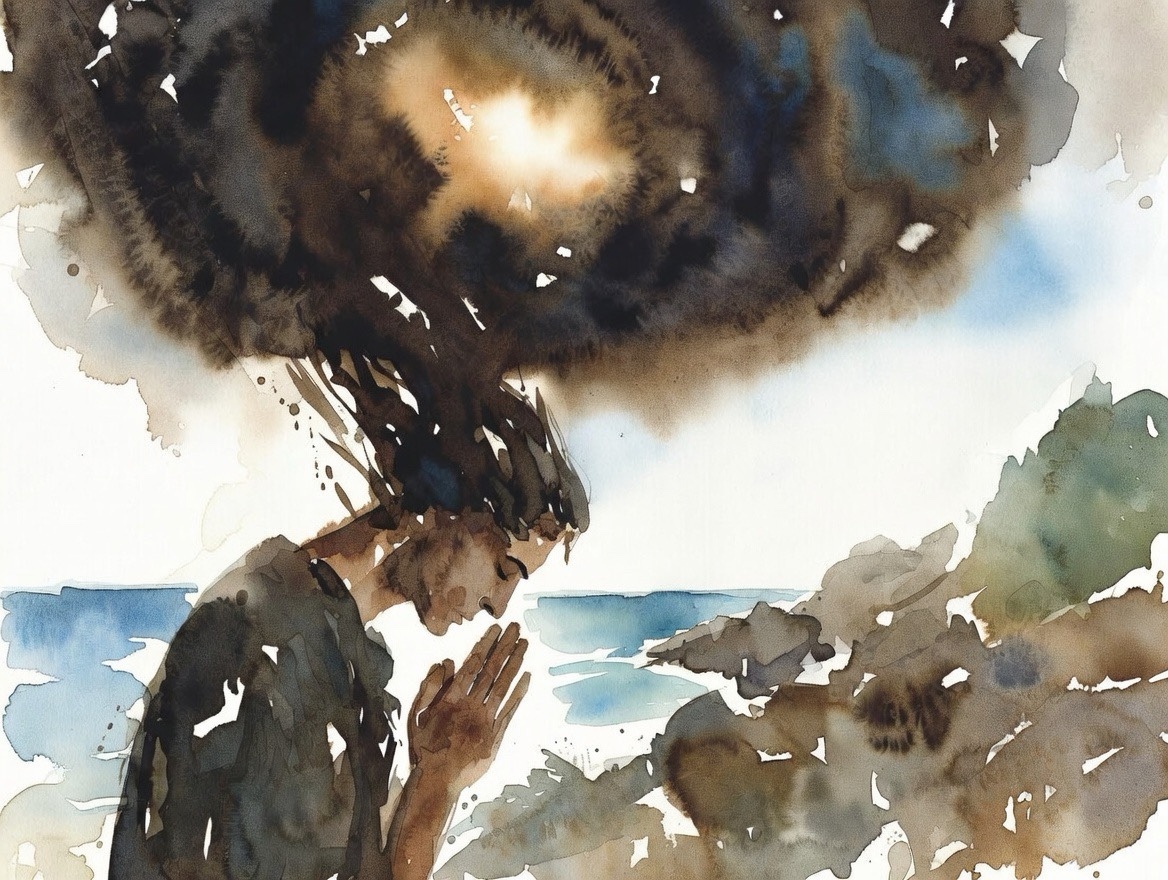
Over the last few weeks I’ve been putting words to things I’ve been sitting with for a long time — the tensions in Scripture, the history of the canon, the honest questions that surface when you actually read the texts instead of just citing them. Somewhere in the middle of all of that, a quieter question snuck up on me:
Why do I share any of this?
I haven’t been asked that question by someone else in a long time. This was, unexpectedly, me questioning myself. It wasn’t an accusation, per se. It was more like a genuine pause… because the honest answer matters. It matters to me, and probably to anyone deciding whether it’s worth reading.
Here’s what I know:
I’m not sharing anything I share because I have it figured out. I’m not sharing because I want to be right, or because I need an audience to validate a position I’ve already locked in. I share because what I believe, what I experience, even what I study and still question, is alive to me.
In fact, as I have grown, learned, and deepened not only my understanding and perception of Scripture, of faith, and of God, but also of myself, I have unpublished, revised, and even deleted specific posts. I have written entire posts dedicated to correcting myself (with a good one along those lines, regarding CTMU, coming soon).
Getting it right matters more to me than looking like I already had it right. I continue to correct my own stance, and therefore my own public shares of my experience and resulting perspective, because faith that can’t handle a hard question isn’t the robust, world-turning faith I find in Scripture. Instead, it becomes a fragile performance, and I have no interest in performing.
The Question of Why
That question was already floating in front of me when something else pulled it into sharp focus. I started noticing a pattern in online faith spaces that I think a lot of people feel but don’t always have words for. That’s how the Holy Spirit most often works in me — pattern recognition. I “chuckled as I buckled,” I like to say, because I knew God was about to take me on another adventure in discernment and understanding.
Where He took me was not exactly unexpected, but I have to admit it was momentarily disheartening. The pattern was this:
There’s a category of “teacher” — and I’m using that term loosely — who presents as a student of Scripture, who positions themselves as someone with depth, but whose actual engagement with questions looks less like seeking and more like territory defense. Someone asks something challenging about language, history, theology, and instead of leaning in, they go for the quick dismissal. The “gotcha.” The line that scores points with the crowd without actually addressing the question.
It’s not always wrong, exactly. Sometimes the line is even technically accurate. But accuracy in service of ego isn’t the same as truth in service of understanding, and when it comes from someone presenting as a teacher, it does something quiet and damaging: it tells the person asking that questions aren’t really welcome here.
The Holy Spirit gave me the message very clearly: That depth is a performance, not a practice.
That’s not what I want to be. I want to be questioned. Genuinely. I want to hear hard questions, ask them myself, sit with answers that are still forming, and be honest about the difference between what’s settled and what’s still in process. That’s what actual learning looks like. Learning is the point for me, exploring to gain depth of understanding as much as to enjoy myself. And it’s what I find modeled throughout Scripture itself… which, to be transparent, I think gets missed more than it should.
The Bible is not a book that discourages questions. It is full of them.
Examination
Scripture doesn’t just tolerate questions. It models them. In some cases, it explicitly commands them.
The Bereans didn’t passively receive Paul’s teaching. They “examined the Scriptures daily to see if what Paul said was true” (Acts 17:11). This wasn’t skepticism for its own sake, and it certainly wasn’t disrespect. Paul was an apostle, and yet that checking, that refusal to simply accept, is exactly what Scripture holds up as praiseworthy. That alone tells us something important about what God actually thinks of honest intellectual engagement.
Then there’s Isaiah 1:18:
Come, let us reason together…
This isn’t an invitation to receive. It’s an invitation to think alongside. “Reason. Together.” God is initiating a dialogue, not issuing a download.
Job questioned God. He didn’t do so politely, or with careful hedging, and God’s rebuke at the end wasn’t aimed at Job. It was aimed at the friends who defended God with easy, tidy answers that protected their theology more than they honored truth.
Jesus himself asked questions constantly. He frequently answered questions with questions, and rarely gave direct answers. He invited individual thought, because He knew that without individual exploration and depth of thought, true understanding would never come.
Jesus respects questions. And, He understands human doubt. He proves this to us when He honors Thomas’s very concrete, tactile doubt by showing up with evidence rather than a lecture on faith.
The “nail in the coffin” on the question of questioning is 1 Thessalonians 5:21. It doesn’t say “trust what you’re told.” It says:
Test everything. Hold fast to what is good.
That’s not a loophole. It’s the instruction itself.
The hammer that drove that nail in, for me, comes directly from Jesus in Matthew 7:7:
Ask, and it shall be given to you…
That includes wisdom and understanding, which comes very much from questioning and exploring. Examination is testing, and testing is examination. That’s a post in itself… another day and another time.
Theology
There is a difference between religious theology and biblical theology, and I think it’s worth the risk to name it. Religious theology is a system to be defended. It has edges, and those edges must be protected, and anyone who gets too close to them with a real question gets a deflection.
Biblical theology is a living thing. It has tensions, history, context, and a Spirit that moves through all of it. It can withstand scrutiny. It seems to invite it.
I’ve come to believe, and deeply so, that the truth doesn’t need to be defended. It sometimes needs to be explained, unpacked, contextualized, traced through its history and language — but it doesn’t need a bodyguard. If what you’re holding is actually true, honest questions don’t threaten it. They clarify it. The only thing that needs defending is a position that can’t survive contact with reality.
That’s why self-correction isn’t a weakness. Rather, it is faithfulness. The Holy Spirit doesn’t leave us where we are. Correction is part of the process, and if I’m not willing to be corrected, I’m not actually following anything; I’m just performing certainty. That applies to anyone claiming to teach or speak on behalf of Scripture.
The Bereans didn’t take Paul’s word for it, they checked. It wasn’t disrespect. It was exactly right. We should bring the same rigor to anyone who stands up and says they speak from the Word, whether they’re behind a pulpit or posting blogs or threads online.
So yes, I want to be questioned. Genuinely, honestly challenged. Not agreed with for the sake of not arguing, not managed, not given a quick “amen” that closes the conversation before it gets interesting. The real stuff lives in the friction, the wrestling, and the not-quite-resolved.
Jacob wrestled with God, after all… and walked away both limping and blessed. That seems about right.
The “Gotcha” Response
The fear underneath the “gotcha” response is one I recognize. There’s a worry that if one piece moves, everything falls. But that’s not faith. That’s a house of cards dressed up as a cathedral. Real faith is what’s left after the questions. Not instead of them.
Here’s what I’ve come to understand about the “gotcha” pattern: it’s not a spiritual response. Not even close. It’s a deeply human, psychological one.
When identity is tied to a belief system and being right about theology is part of who we are, how we’re perceived, or what gives us authority or platform, a challenging question stops feeling like an intellectual exchange. It registers as a threat. And the human brain responds to threats the way it always has: defend, deflect, neutralize… preferably quickly, before the damage spreads.
The gotcha response is ego protection wearing a scripture reference as a costume, not the Holy Spirit moving. The fruit of the Spirit — patience, gentleness, love that “rejoiceth in the truth” (1 Cor. 13:6) — none of that produces a dismissive one-liner designed to shut someone down. What produces that is pride. And pride is especially sneaky in religious spaces, because it can look exactly like conviction.
It can sound like boldness. But genuine spiritual conviction doesn’t flinch at hard questions, because it isn’t threatened by truth, it’s anchored in it. There’s a meaningful difference, and it tends to show. In fact, it shows very quickly to those who have embodied discernment.
Closing Thoughts
I’ll end this post with an invitation that may seem odd to many, but is heartfelt on my part:
If you’ve ever read something I’ve written and wanted to push back, ask harder, or say “but what about ____?” Please do. That’s not a threat to what I believe. It’s an invitation I’m genuinely extending. I am not here to argue for argument’s sake, to prove you wrong or to prove myself right. I’m not here to win anything.
I’m here to grow. I’m here because this is true and alive, and actually understanding it is worth every hard question it takes to get there.
 Twin Tree Project