
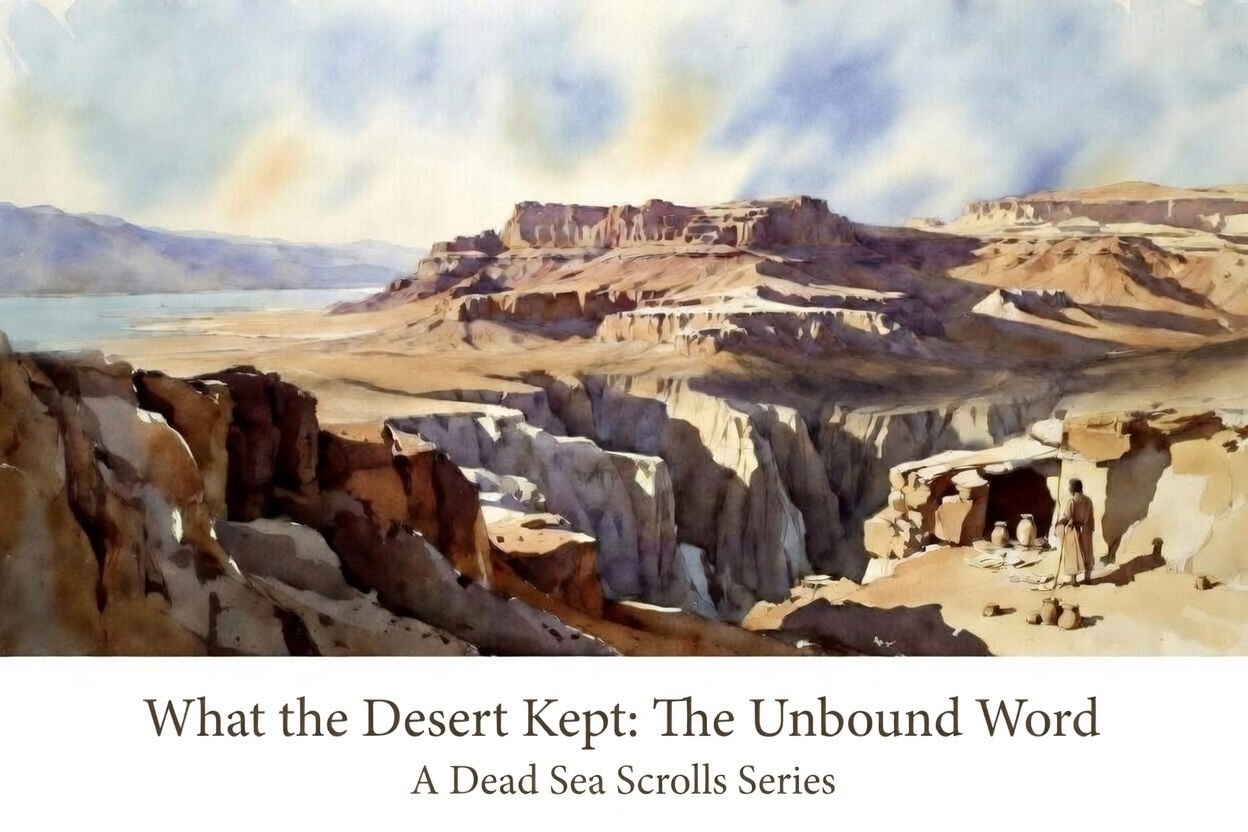
A note before we begin: This is Part 2 of a six-part series, What the Desert Kept: The Unbound Word. If you’re just joining us, you may want to start with Part 1 — The Discovery, where we covered how the Dead Sea Scrolls were found in the caves of Qumran in 1947, what they contain, and why their existence matters — not just historically, but for anyone who takes Scripture seriously.
A brief recap: In 1947, a Bedouin shepherd threw a stone into a cave near the Dead Sea and heard something shatter. What broke open wasn’t only a clay jar. For many of the scholars who would spend the following decades hunched over those fragments in dimly lit rooms, it was something far more interior.
The men who first handled the Dead Sea Scrolls were not blank slates. They were formed people — trained in seminaries, shaped by centuries of received theology, carrying the full weight of what they had already been taught to believe. They arrived at those parchments with their faith already built. And then they started to read.
What they found didn’t destroy Scripture. But it complicated the version of it that institutions had carefully handed down, and that is its own kind of earthquake. Some of them felt the ground shift and quietly set the feeling aside, pressing on with the academic work. Some were exhilarated, pulling harder at every thread. Some grew angry — not at the scrolls, but at the walls that rose almost immediately around them, because the resistance came quickly.
The official publication of the full corpus was delayed for decades, gatekept by a small international team, the broader scholarly world locked out, the public kept largely in the dark. Whether that delay was purely academic caution or something more protective of established theology, that debate hasn’t fully closed. What is certain is that these documents were real, verified, and ancient. And they raised questions that comfortable faith had not prepared anyone to hold.
This post is about what happens when those questions become personal. My father knew that feeling, and growing up with my father during the heat of this season in his life, so do I.
The Man in the Prayer Closet
My father wasn’t in a cave in Qumran. He wasn’t behind a university desk or on the international team. He was a man in Alabama with a Bible, a hunger that never quite quieted, and eventually, a prayer closet he disappeared into for long stretches of my early adolescence.
I didn’t understand it then, but I deeply felt the edges of it… and sometimes, they cut. His absence, his distraction, and the weight that seemed to follow him out of that room even when he left it were not just heaviness he carried. I felt overlooked in the way that children do when a parent is being consumed by something invisible. It would take me until after his death to understand what I had actually been witnessing.
God was refining him.
He will sit as a refiner and purifier of silver; he will purify the Levites and refine them like gold and silver. (Malachi 3:3)
The furnace my father sat in had a name. It was the same furnace the scholars sat in, the same one many believers are sitting in today: the furnace of finding out that the story is larger than anyone told you, and having to decide what to do with that.
The Questions He Couldn’t Put Down
My father wasn’t asking small things.
He wanted to know why the Western church’s canon looked the way it did, and why the Ethiopian Bible — one of the oldest and most complete in existence — preserved books that Rome had quietly set aside. He wanted to know what the book of Enoch said about the nature of angels, the origin of evil, and the world before the flood, and why a text quoted directly in the New Testament book of Jude had been excluded from the canon most Christians never thought to question. He wanted to understand the Maccabees — the history, the resistance, the in-between years that shaped the world Jesus walked into. And, when the Dead Sea Scrolls surfaced, he wanted to know what the oldest manuscripts of the Hebrew Bible actually said, compared to what the King James translators had worked from centuries later.
These weren’t questions designed to tear Scripture down. They were questions that took Scripture seriously enough to follow it all the way back. They were, it turned out, exactly the kind of questions that made certain institutions deeply uncomfortable.
The Missing Pieces
As far back as I can remember, my father talked about the church and its missing pieces. Not with contempt — at least not at first. There was wonder in it, and genuine longing. He believed the full story was there, that Scripture itself pointed toward a larger, deeper, older architecture of faith than what was being preached on Sunday mornings.
What he couldn’t reconcile was this: when pieces of that architecture surfaced — verified, ancient, undeniable — the institutional church’s most common response was rejection. The Dead Sea Scrolls had been found close to two decades before my father’s questions reached their peak. And still, the walls were up. Many who held positions of authority in the church weren’t willing to engage with what he called the new realities. That unwillingness drove him to Bible college.
He wanted to be closer to the work of understanding. He wanted to be around people asking the same questions. What he found broke something in him.
He found an institution that encouraged its students not to wrestle with the full complexity of Scripture, but to simplify it. They were taught to smooth it down, keep it agreeable, and avoid the friction of honest questions if it risked losing the room. He watched the music chosen deliberately to stir emotion before the altar call. He watched the framing of the tithe carefully constructed for maximum response. He recognized the architecture of manipulation, and he couldn’t un-see it.
Underneath all of it, he understood something that would stay with him for the rest of his life: this was why the church didn’t want the scrolls. Not because they were inauthentic. Because they were inconvenient. Because a congregation asking hard questions about canon, transmission, and suppressed texts is harder to manage than one that simply believes what it’s been handed.
He left, but he kept digging. He filled notebooks. Pages became outlines. Outlines became something that looked remarkably like a book no one had asked him to write. It had become a record of everything the church was missing and didn’t want to find.
What all of it produced, in the end, wasn’t a loss of faith. It was the shedding of a skin. Our family left denominational Christianity not in bitterness, but in clarity toward something gospel-rooted, Bible-based, and Spirit-led. A faith where the questions didn’t have to be hidden at the door. And somewhere in the middle of all of it, despite how invisible I often felt, he was directly and purposefully teaching me.
It was not by giving me his conclusions, but by refusing to hand me a pre-packaged faith. When I came to him with questions about Scripture or theology, which I did often, he would answer with everything he had. Thoughtfully, carefully, with the full weight of everything he’d studied and wrestled with. He would hold his Bible in front of me and I would watch his finger move across the page, lining the scriptures as he read them. Then he would show me his hand written notes, in much the same fashion. He would explain it to me in a way a child could process. And then, without fail, with every instance of my seeking, he would follow his answer with the same instruction:
Work out your own salvation with fear and trembling. Philippians 2:12
He was always careful to note that fear, in that passage, doesn’t mean what we feel when we’re frightened. It means dedication to caution. It means reverence, and awe. The kind of gravity you bring to something that genuinely matters. He wasn’t telling me to be afraid of God or afraid of questions. He was telling me that my faith was mine to build — and that building it deserved everything I had.
I didn’t fully understand the weight of that gift until long after he was gone, but the man whose absence had cut me was also the man who had quietly refused to let me outsource my own soul.
The Same Furnace
I didn’t set out to write this series as a personal reckoning. But that’s what this post, at least, has become.
The questions my father carried — about canon, about suppression, about the distance between institutional Christianity and the faith Scripture actually describes — didn’t stay with him when he died. They had already taken root in me. Not as inherited doubt, but as inherited reverence. He had spent years teaching me that the questions themselves were not the enemy of faith. They were the proof of it.
It took years after his death to look back at that season of his life and see it clearly. The prayer closet. The notebooks. The frustration. The shedding. What had felt like absence was formation — his, and quietly, mine. The refiner’s fire doesn’t announce itself. It just burns, and when it’s done, what remains is what was always real. But I didn’t truly understand what I’d inherited until six or seven years after he was gone, and only because God brought me to the end of myself first.
I was deep in alcoholism. In depression. In a fear-driven, bone-deep weariness of being alive. In a life driven by sin and the desire to be accepted by the people around me. The problem was, I was surrounded by people I couldn’t fully see, surrounded by people who engaged in conversations I couldn’t hear. God could see what I couldn’t — what was being said, what was being done, not only in their own lives but directly against mine. I was in the kind of darkness that looks like a life from the outside and feels like drowning from the inside.
And then God met me there.
It was not in a church. Not through a label or a doctrine or a membership card. It was on a cold, dark, wet drive home in the wee hours of the morning from the home of a “friend” who was everything but. God spoke to me in the kind of full, undeniable, no-other-explanation way that leads to a surrender of the same depth; the kind of surrender that strips everything false away and leaves only what’s real. God delivered me from the alcohol, from the depression, from the company that had been quietly working against me, all in an instant, all because I answered what I believed to be His call with a heart felt, soul deep prayer. A cry, really, for help and for safety and for healing.
When the smoke cleared — when I could finally breathe and think and see — I looked at everything my father had planted in me, and I understood it for the first time. I am a sinner saved by grace. There is no special advantage in what I carry, no elevated position, no claim to a closer seat. Only the mercy of a God who could see the path laid out for me even when I was doing everything in my power to walk away from and destroy it. The inheritance my father left wasn’t a library of answers. It was a hunger for truth, a refusal to outsource my soul, and an instruction given over and over at a Bible laid open on a table, with a finger moving across the page: work it out yourself, with everything you have.
My father’s questions had become my own — not as a burden, but as a compass. The scrolls were still waiting. The questions were still there. The difference was, this time, so was I. The scrolls didn’t create those questions and tensions for my father, or for me, or for anyone else. They just made them impossible to ignore. I finally had reason to follow and explore them, and no excuses left not to. God had spent years making sure I’d survive long enough to ask them too. I don’t think that’s a coincidence. I think that’s the point.
Closing Thoughts — What Remains
If you’ve read this far, something in this story is probably yours too. Maybe it’s a parent whose faith cost them something you didn’t understand until later. Maybe it’s a season you walked through that you weren’t supposed to survive, and you’re still making sense of what was planted in you before it.
Maybe it’s simply a question you’ve been carrying quietly — about canon, about church history, about the distance between the institution and the living Word — that you haven’t known what to do with. Regardless, you don’t have to know what to do with it yet. You just have to be willing to stay in the room with it.
My father never finished his book. But he finished something more important — the formation of someone who would one day be ready to ask the same questions and refuse to put them down. My father is gone. His notebooks are tattered, and missing pages, not unlike the scrolls themselves. His outlines are gone, but the hunger isn’t. And neither are the scrolls.
This series is my attempt to honor both the man who first handed me these questions and the documents that made those questions undeniable. We’re only at the beginning. There is much more desert to cross.
What the Desert Kept: The Unbound Word continues in Part 3 — What the Scrolls Complicate.
If these questions are yours too, I’d love to hear from you. The Word doesn’t need us to defend it. It just needs us to be honest with it.
 Twin Tree Project
One thought on “What the Desert Kept: The Unbound Word | My Father’s Questions”