
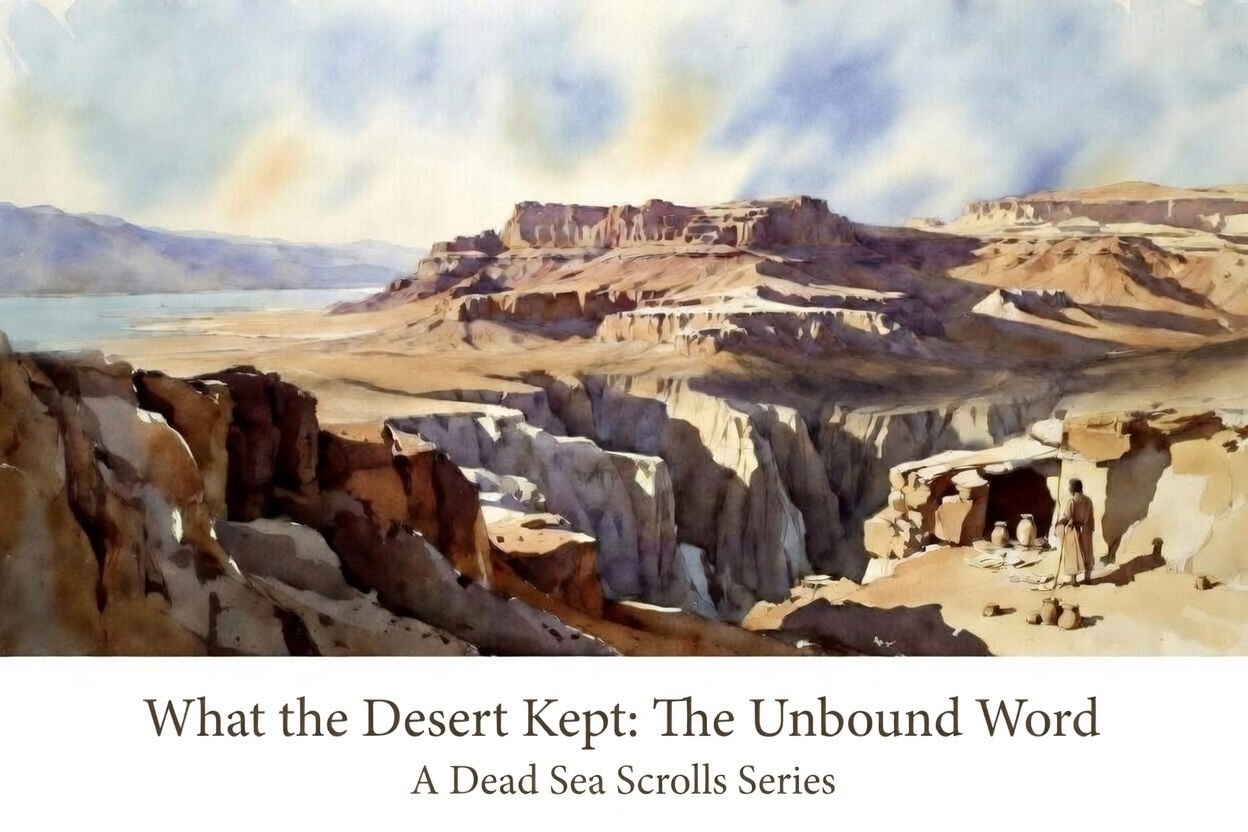
This is Part 4 of a six-part series. If you’re just joining, start with Part 1: The Discovery. Parts 2 and 3 are My Father’s Questions and What the Scrolls Complicate.
This post also grows directly out of two earlier Sunday Sessions posts: What I Heard in the Quiet, and What I’m Still Wrestling With and When You Actually Go Look – A Deeper Dive + Follow-Up. If you haven’t read those, I’d recommend starting there — because what I’m about to say assumes you know what I mean by “the thread.“
Before the Desert, There Were Questions
Not long before I started writing this series, I published two posts on a Sunday morning that came out of a meditation session and a long season of sitting with scripture honestly. In the first, I wrote about the word I received in the quiet about Israel and about Jesus’ Jewishness — and then turned around and admitted that I’ve wrestled with Gospel tensions all my life. The last words of Jesus. The birth narratives. Paul on women. Real things. Things I’m not going to pretend away.
In the second, I spoke about how I had gone and looked, and what had guided me. I dug into what scripture actually is — where it came from, who wrote it, under what conditions, and whether the coherence we find in it has any natural explanation. I laid out three threads: the Seed, the Lamb, and the Prophecy. Forty-plus authors. Three continents. Fifteen centuries. Three languages. Most of them writing in crisis — exile, dungeon, wilderness, chains — with no knowledge that they were contributing to the same document.
In the next to last section in the second, follow-up post, I said, “no committee did that.” That thread is what I’m bringing into the desert now. Because the Dead Sea Scrolls don’t just complicate things — yet they do complicate things, and I expressed this as plainly as I could in Part 3 — they also test the thread. And I want to tell you where it held.
What the Scrolls Put Under Pressure
If you read Part 3, you know the complications are real. The Qumran community used books like 1 Enoch and Jubilees as authoritative texts. These are books that didn’t make it into the canon most of us inherited. Their Isaiah scroll contains variants from what became the standardized Masoretic text. Their messianic expectations were plural: a priestly messiah, a royal messiah, possibly a prophetic figure, not a single unified portrait that maps cleanly onto Jesus of Nazareth.
These are not small things. I didn’t treat them as small things in Part 3, and I’m not going to treat them as small things here. But here’s what I kept coming back to as I sat with all of it: pressure is not the same as rupture.
A thread under tension is still a thread.
Where It Held: Transmission
First things first: the Great Isaiah Scroll:
Discovered in Cave 1 at Qumran in 1947, it is the oldest complete copy of a biblical book ever found and dates to roughly 125 BC. Before its discovery, our oldest Hebrew manuscript of Isaiah came from the Masoretic tradition, around 1000 AD. That is an eleven-hundred-year gap in the manuscript record. Critics had long argued that in a gap that wide, almost anything could have happened to the text.
When scholars compared the two, here is what they found: The texts were, for all practical purposes, the same. Not identical in every detail — there are variations, and honest scholars name them. But the theological content, the prophetic substance, the words that matter most: intact. A thousand years of hand-copying, by scribes who had no access to the scroll sitting in a cave in the Judean desert, and the text held.
Isaiah 53 — “he was pierced for our transgressions, he was crushed for our iniquities” — was already there. Unchanged. Waiting. The thread didn’t just survive the transmission. It survived it in the dark, without anyone tending it.
Where It Held: Fulfillment
The messianic plurality at Qumran is one of the things I find most genuinely interesting about the Scrolls, and also one of the things that, on first encounter, seems most destabilizing. The community expected multiple messianic figures. A priestly messiah from the line of Aaron. A royal messiah from the line of David. Some texts suggest a prophetic figure as well — an eschatological prophet in the mold of Moses. Their messianic imagination was not singular.
And then Jesus shows up in the Gospels as all of it, all at once. Priest, king, and prophet — not as a composite figure assembled from categories, but as someone the categories keep failing to contain.
The author of Hebrews spends considerable effort explaining his priesthood not through Aaron’s line but through Melchizedek, the priest-king from Genesis 14 who predates the Levitical system entirely. The royal line through David is there. The prophetic voice — “you have heard it said… but I say to you” — is unmistakable.
What Qumran expected in pieces arrived whole. Not because the church constructed it that way after the fact — the manuscript record is too early and too widely distributed for that argument to hold — but because the thread wasn’t following their categories. It was following its own. The plurality doesn’t fracture the thread. It shows you how much the thread was carrying.
Where It Held: The Edges
Then there’s the question of the fringe documents. The Qumran community treated 1 Enoch and Jubilees as authoritative. These books aren’t in most Western Bibles. They are in the Ethiopian Orthodox canon. Jude quotes 1 Enoch directly in the New Testament. The lines are not as clean as many of us were taught.
I want to be honest about something here: I don’t think the canon question resolves neatly. I’ve said that before and I’ll keep saying it. The boundaries of what got included and what didn’t were decided by councils and synods made up of human beings operating in specific political and theological contexts — and some of those contexts were not clean. I’m not going to pretend otherwise.
But here’s what I noticed when I read through the texts that didn’t make the Western canon: the through-line doesn’t fracture.
Creation, fall, promise, rescue, restoration. The arc doesn’t break in 1 Enoch. It doesn’t break in Jubilees. These texts breathe the same air as the canon they orbit. They are not telling a different story. They are circling the same one from angles the institutional church eventually chose not to include (for reasons worth examining, and that I intend to examine) but that don’t change what the core story is doing.
The thread held even where the edges were loose. That is not a small thing.
What That Means
Here is what I keep landing on: The thread didn’t survive because of councils. It didn’t survive because of the Reformation, or the printing press, or any institution that took it up and decided what to do with it. Those things are real and they matter, but some of them did genuine damage, which is a conversation for another post.
That said, the thread predates all of them, and it still stands, and holds. It was in the desert before any of them existed. It was in a cave in the Judean hills, wrapped in linen, sealed in clay jars, sitting in the dark for two thousand years. And when they opened those jars, the thread was still there.
Forty-plus authors had no idea they were contributing to the same story. The scribes who copied Isaiah had no access to the scroll at Qumran. The messianic categories at Qumran had no way of knowing the figure who would make them insufficient. And yet, one seed, promised in the same breath as the fall. One lamb, from Genesis to Revelation. One servant, pierced, in Isaiah — seven centuries before the cross. One through-line, holding across everything that tried to break it.
I’ll reiterate, no committee did that. No institution preserved it. It held on its own terms, in the dark, across fifteen centuries and the complexity and the variations and the complications — because that is apparently what it does.
Closing Thoughts — Still Asking
I want to close this post the way I closed those Sunday Sessions posts, because I haven’t moved from that posture and I don’t expect to:
I still have questions. The canon edges are still unresolved for me. The Gospel tensions are still real. Paul still says things I have to sit with rather than settle. I’m not done wrestling. But somewhere along the way, through those Sunday morning posts, through my father’s journals, and through the first three parts of this series, I stopped experiencing the questions as evidence against the thread and started experiencing them as part of how the thread works.
Jacob didn’t come away from Peniel with clean theology. He came away with a limp and a new name and the knowledge that he had seen God face to face and survived. The wrestling was the encounter. The tension was the point.
The Scrolls complicated things I thought I understood. They also confirmed things I wasn’t sure I could defend. Both of those are true at the same time, and I’m learning to hold both without needing one to cancel the other out. The desert kept something, and the thread is the most important part of what it kept.
We have two parts left in this series. In Part 5, “Where I Stand,” I’ll stop circling the evidence and tell you plainly where all of this has landed for me personally. Not as a conclusion to the questions, but as a position I’ve taken inside of them.
If this post stirred something for you — a question, a pushback, a recognition — I’d love to hear it in the comments. What did you expect the Scrolls to break that they didn’t? What are you still sitting with? Bring it. That’s what this space is for.
 Twin Tree Project
One thought on “What the Desert Kept: The Unbound Word | Where the Thread Held”