This post is Part 6 of a six-part series — the final part. If you’re just joining, here’s where we’ve been:
Part 1: The Discovery
Parts 2: My Father’s Questions
Part 3: What the Scrolls Complicate
Part 4: Where the Thread Held.
Part 5: Where I Stand
If you’ve walked with me through this series from the beginning, you’ve covered a lot of ground. We’ve explored a cave in Qumran and the shepherds who stumbled into it, through questions my father was asking long before most people knew what the Dead Sea Scrolls were, through what the scrolls complicate, what they confirm, and finally to where I personally stand.
This post is a very brief summary of everything we’ve covered in the posts above, and serves to cleanly close the series. My father passed the scroll to me, and now it’s time for me to close the loop and pass it on.
What the Work Confirmed
The archaeological and textual work on the Dead Sea Scrolls is, for the most part, done. The dating and authenticity have been established, and the Great Isaiah Scroll — the oldest surviving copy of that book by a thousand years — matches the Isaiah we carry in our Bibles with remarkable fidelity. For anyone who ever feared that centuries of copying had quietly corrupted Scripture into something unrecognizable, the scrolls offered a clear answer: the transmission was careful, and the text held.
That part of the conversation has been settled.
What Won’t Be
The theological and philosophical conversation the scrolls opened up, however, won’t be settled anytime soon. Maybe it isn’t supposed to be.
What do we do with the fact that Enoch and Jubilees were found in that same cave, shelved alongside Isaiah by a community who treated them as sacred? What do we make of the messianic plurality in the Qumran texts (the priestly messiah, the Davidic messiah) and how they ultimately converge and collapse into One in Jesus? What does canon mean, who decided it, and does the Spirit’s witness to a text carry weight alongside a council’s vote?
These aren’t questions that destabilize Scripture. What they destabilize is a shallow relationship with Scripture. From my perspective, I think that’s the point. A faith that can’t survive honest examination probably needed, and still needs, to be examined. The questions don’t lead away from God; they lead deeper into what it actually means to trust Him. A closed fist around every answer isn’t faith. It’s fear dressed up as certainty.
Where My Father Was
My father started asking these questions long before they were popular or safe. He was a deacon, then a pastor, and pastors aren’t always encouraged to think out loud about things that might unsettle a congregation. But he thought out loud anyway. He wrote his thoughts in the margins of books and in journals, and he voiced them in long conversations with a close friend, and with me, his teenage and then adult daughter, who had very little idea at the time how deeply those conversations would take root.
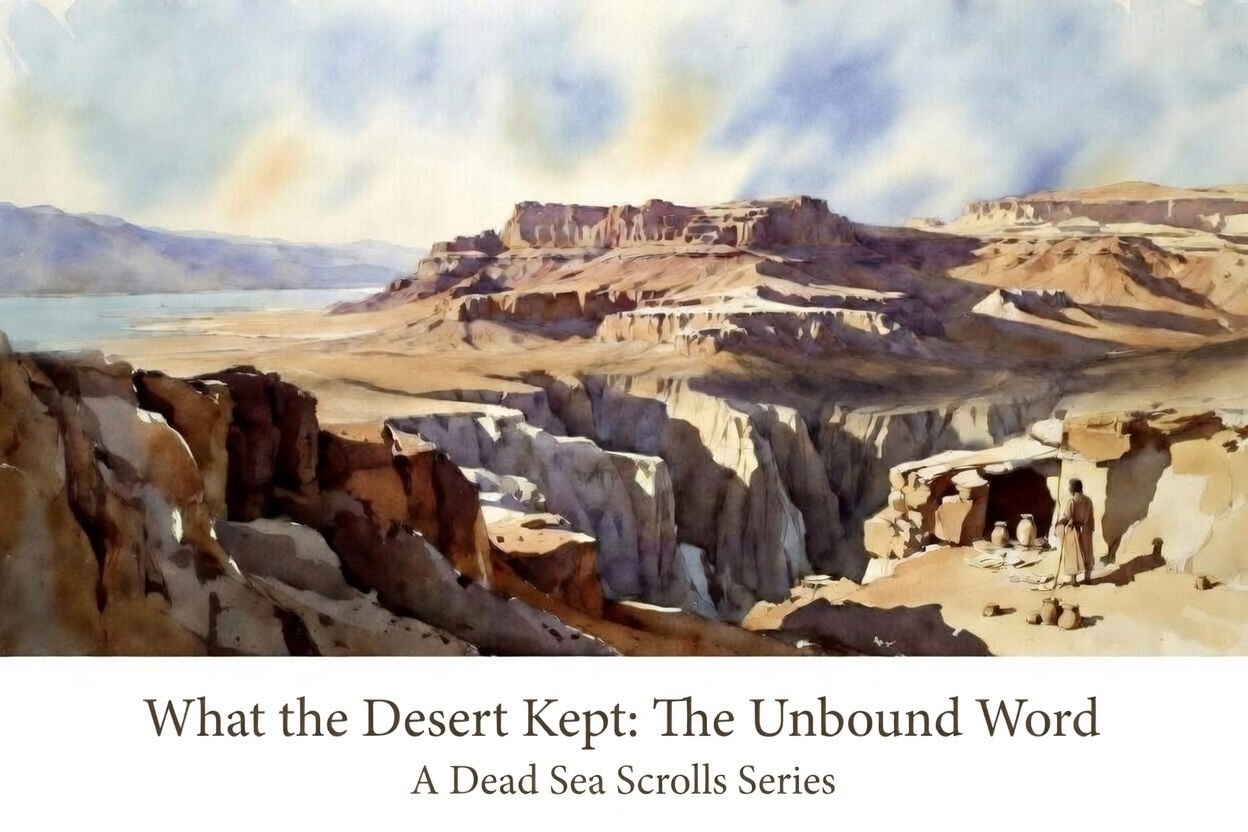
My father wanted to know what the desert kept. He was not afraid of what he’d find; he trusted that the Word was strong enough to hold up under honest examination. He believed that real faith — the only kind worth having — could sit with hard questions and still land on Christ, and he was right.
Where I Picked It Up
I came back to his journals six years after my father was gone. I’ve not hidden that after he died, I fell into deep struggle. It was through his life’s work that God gave me a focal point as I traversed the mangled path back to sobriety. They cemented the restoration of my faith. The scrolls weren’t just an intellectual exercise for me; they were part of coming back to life.
His notes, his questions, the things he circled and argued with in the margins — they gave me a deep and very tangible understanding of something I hadn’t fully seen when he was alive: what he modeled wasn’t certainty dressed up as faith. It was actual faith. The kind that doesn’t require a closed fist around every question. This series has been a continuation of that. Not a crisis, but a conversation picked back up.
The scrolls didn’t shake my faith. They shook loose some of the institutional scaffolding I’d confused with faith, and what was underneath was sturdier than I expected. The text held. Christ still stands apart from every messianic category the Qumran community imagined. The ekklesia Jesus meant is still not the institution that has so often distorted him.
Where We Go From Here
The scrolls will keep being studied. New fragments will surface for us, and scholars will keep arguing. The theological questions raised in that desert will outlast all of us. That’s not a problem. Continued wrestling with ongoing questions is the nature of living engagement with a living Word.
What I offer you from this series isn’t a tidy set of conclusions, but a posture of asking the hard questions and sitting with tension without collapsing it prematurely in either direction. Trust that Scripture can hold scrutiny, because the evidence suggests it can. Don’t let an institution’s discomfort with questions become your discomfort with questions.
My father passed that unbound scroll to me.
I’m passing it to you.
Whatever the desert kept, it kept it for a reason. And we are still — all of us — in the middle of finding out why.
Closing Thoughts
Thank you for walking this series with me. Whether you’ve been here from Part 1 or stumbled in somewhere along the way, I’m grateful you took the time to explore this with me. The Dead Sea Scrolls are just one layer of a much larger onion, if you will, and the peeling away at layers of that onion is a conversation I intend to keep engaging with. There’s no shortage of territory worth examining when it comes to faith, history, Scripture, and the way we engage with all of it honestly.
The loop of the scrolls may be closing for this series, but the door to exploration is still open. I hope you’ll stick around.
 Twin Tree Project