

Dinosaurs are (still) FAKE!! I had forgotten this, until someone recently tried to convince me of this alternate reality by explaining that they can’t possibly be real because they’re not in the Bible.
You may be asking yourself a number of questions right now, or quietly judging… and that’s fair for any logical but spiritually minded/bible-based foundation of belief. But this is nowhere near a new claim. I’ve heard this argument many times through the years, and plenty of variations of it.
It’s been a while since I’ve engaged with it directly, but since the debate is apparently still going strong, I thought I’d share the reality I’ve come to understand as the true one through my own research.
Welcome to Did You Know? — a new on-going, open ended series where we pull back the curtain on the things that look like contradictions but are actually just gaps in translation, time, and context.
Here’s the thing about the dinosaur argument: the Bible does reference creatures that match the description of dinosaurs. The reason the word “dinosaur” never appears isn’t because dinosaurs didn’t exist. It’s because the word itself didn’t exist… yet. Once you understand that, a lot of other things start to make sense too.
“Dinosaur”
Dinosaur /di·no·saur/ /ˈdīnəˌsôr/
noun: dinosaur; plural noun: dinosaurs
- a fossil reptile of the Mesozoic era, in many species reaching an enormous size. “experts believe the plant-eating dinosaurs grew to about 35 feet in length”
- a person or thing that is outdated or has become obsolete because of failure to adapt to changing circumstances. “the software company, not long ago seen as a dinosaur of the tech industry, has in recent months overtaken its younger peers”
Origin: mid 19th century: from modern Latin dinosaurus, from Greek deinos ‘terrible’ + sauros ‘lizard’.
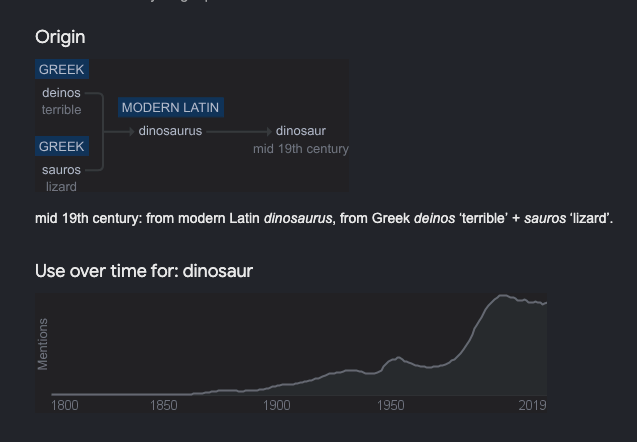
The argument about dinosaurs not existing is clearly a ridiculous stretch, and it generally begins with a single statement from a less-than-biblically-or-theologically-educated yet self-proclaimed religious person hitting us with: “Dinosaurs can’t be real because they’re not in the Bible.” There is a very good reason for that, and it’s easy to explain.
Here’s how the key exchange in the argument usually goes:
“The word ‘dinosaur’ never appears in the Bible.”
“That’s correct. Do you know why?”
“Because the Bible never talks about dinosaurs?”
“No — it’s because the Bible was written before 1840.”
That’s actually the whole answer, in itself.
Here’s the explanation: The term “dinosaur” wasn’t coined until 1841 (see definition and graphic above), when British paleontologist Sir Richard Owen created it from the Greek words deinos (terrible) and sauros (lizard). The Bible, written thousands of years before Owen named anything, obviously couldn’t use a word that hadn’t been invented.
That’s not a gap in the Bible. That’s just how time works.
So the question isn’t why isn’t the word dinosaur in the Bible — the question is what word did they use instead?
Dragons Aren’t What You Think
After explaining the issue surrounding why the term “dinosaur” isn’t in the bible, the argument usually continues with:
“So they had no words to describe a dinosaur?”
“Yes, they did. They referenced them as ‘dragons.’”
*person stares blankly, processing*
“Well, the flying dragon you’re probably thinking about? That probably didn’t exist. But the word ‘dragon’ was literally just the term for these gigantic reptilian creatures.”
“And the Bible talks about dragons?”
“Yeah, a lot.”
“Okay, but that doesn’t necessitate that it was actually talking about dinosaurs. It could have been referencing some kind of external mythology and incorporating it into Christian mythology.”
“There is no such thing as Christian mythology. Christianity is 100% true.”
The answer to “what word did they use?” is dragon, and not the fire-breathing, treasure-hoarding creature from your favorite fantasy novel. Historically, “dragon” was simply the term for large, fearsome reptilian creatures. The word comes from the Greek drakon, meaning a large serpent or sea monster. It was a category, not a specific creature.
The Bible references dragons in multiple places — Psalm 91:13, Isaiah 27:1, Revelation 12, and others — and those references weren’t reaching into mythology. They were using the vocabulary available to describe something real and enormous.
As for the “Christian mythology” argument: that’s a separate conversation worth having on its own. But within this one, it doesn’t hold. Because the Bible doesn’t just name these creatures. It describes them — in detail.
Enter Job: The Behemoth
The conversation continues:
“I’ve heard most people believe that was in reference to a hippopotamus.”
“That’s absolutely not true — and just a really bad common misconception. Have you ever seen the tail of a hippopotamus?”
“It’s like a weird little flap.”
“Does that sound like it’s the size of a cedar tree?”
“No.”
“There you go.”
The clearest example of biblical creature description is in Job 40:15–24, where God himself is the one describing a creature called behemoth:
Look at Behemoth, which I made along with you and which feeds on grass like an ox. What strength it has in its loins, what power in the muscles of its belly! Its tail sways like a cedar; the sinews of its thighs are close-knit. Its bones are tubes of bronze, its limbs like rods of iron. (Job 40:15–18)
The tail “sways like a cedar.” A cedar tree. Massive.
Some commentators have tried to argue this refers to a hippopotamus. With all due respect to the hippopotamus, have you seen the tail of a hippo? It’s a small, stubby flap. There is no honest reading of “tail like a cedar” that ends at hippopotamus. The description fits something much larger, much more structurally powerful. It fits something in the category of a massive sauropod dinosaur.
The Leviathan
Another “creature” in the Bible that can be considered a reference to dinosaurs is the Leviathan. It’s described in the book of Job.
Its back has rows of shields tightly sealed together… Its chest is hard as rock, hard as a lower millstone… Nothing on earth is its equal — a creature without fear. (Job 41:15, 24, 33)
When you point that out, the conversation will likely continue as follows:
“Okay, well how is the leviathan described?”
“Gigantic, extremely hard bones described as being like metal armor, made of scales.”
“Scales?”
“Yeah — because dinosaurs were just gigantic reptiles.”
Scales like armor. Bones like iron. Nothing on earth its equal. This is not a crocodile, though that’s the other common deflection. The scale and the description push far beyond any creature most of us encounter in a nature documentary.
Bonus Round: Unicorns
I always think I’m already having a good time this far into the “dinosaurs in the Bible” conversation… but a lot of times, the debater brandishes what they think is a hidden weapon. It usually goes something like this:
“You said that Christianity is 100% true and therefore not mythology?”
“Yes, that is correct.”
“OK, well, what about unicorns?”
“The term unicorn is not in modern translations of the Bible, but the animal it was referencing — that is real.”
“Well, what is it?”
“Basically a rhino.”
“But African rhinos actually have two horns.”
“Yeah, but there’s one found in India that has a single horn — and that has been referred to as a unicorn, which literally just means ‘one horn.’”
“How do we know it was talking about that and not some kind of a pegasus?”
“Because if we look at a dictionary from before 1840, we literally see the term unicorn there to describe a rhinoceros unicornus.”
It’s true. The word “unicorn” appears in older Bible translations like the KJV, and it trips people up every time. There are many examples (Deuteronomy 33:17, Job 39:9–10, Psalm 22:21, Psalm 29:6, Isaiah 34:7), but Numbers 23:22 is probably the cleanest and most straightforward:
God brought them out of Egypt; he hath as it were the strength of an unicorn.
The creature being referenced is the rhinoceros unicornus, the Indian rhinoceros, which has a single horn. Pre-1840 dictionaries literally define “unicorn” as a rhinoceros, and when translators encountered the Hebrew word re’em, they rendered it “unicorn” because that was the accepted English term for a single-horned creature at the time.
Not a pegasus. Not a fairy tale horse. A rhino.
Same principle as the dinosaur: the creature is real. The word just looks different to us now because language has shifted.
Why This Matters
The Bible wasn’t written in a vacuum, and it wasn’t written in modern English. It was written by real people in real languages describing real things, and then translated across millennia, cultures, and linguistic shifts. Most of the time, the frustration and confusion isn’t coming from the text itself. It’s coming from the gap between the world the text was written in and the world we’re reading it in. That gap is real, but it’s also navigable, and that’s what Did You Know? is for. Not to argue, not to score points, but to close the gap a little at a time.
That matters because a lot of the “gotcha” arguments leveled at Scripture share the same root problem: they approach an ancient text with modern assumptions and then declare the text wrong when it doesn’t match. The word “dinosaur” didn’t exist. The word “unicorn” meant something different. The creatures described in Job had names that don’t survive in our everyday vocabulary. None of that is a flaw in the Bible. It’s just the nature of language across time.
When something looks like a contradiction or a myth, it’s worth asking a different question before assuming your modern take automatically disproves Scripture. That question is: Is this a problem with the text, or a problem with my assumptions about the text?
Context doesn’t just clear up confusion, it dissolves it entirely. What looked like a gap turns out to be a translation shift. What looked like mythology turns out to be a description of something real, named differently across time. More often than not, a little context clears a lot of confusion and completes a really confused and muddy perception.
Closing Thoughts
This series came out of a simple frustration — one I’ve carried for a long time and probably you have too. There are arguments floating around out there, some well-meaning and some not, that treat the Bible like a document full of errors just waiting to be exposed. And a lot of people, especially those who value ancient literature, or are still finding their footing in faith, encounter those arguments and walk away more frustrated or confused than they need to be.
I don’t have all the answers. Nobody does. But, I’m often (if not always) intrigued when it comes to these types of debates — and not just regarding Scripture. I’ve done enough digging over the years to know that a lot of what looks like a contradiction, whether in Scripture or not, dissolves the moment you understand the context behind it. I hope that’s been true here, and I hope it continues to be true as this series grows.
What arguments have you heard? What questions are still sitting with you? Drop them in the comments. Your favorite “gotcha” might just be the next topic.
 Twin Tree Project