
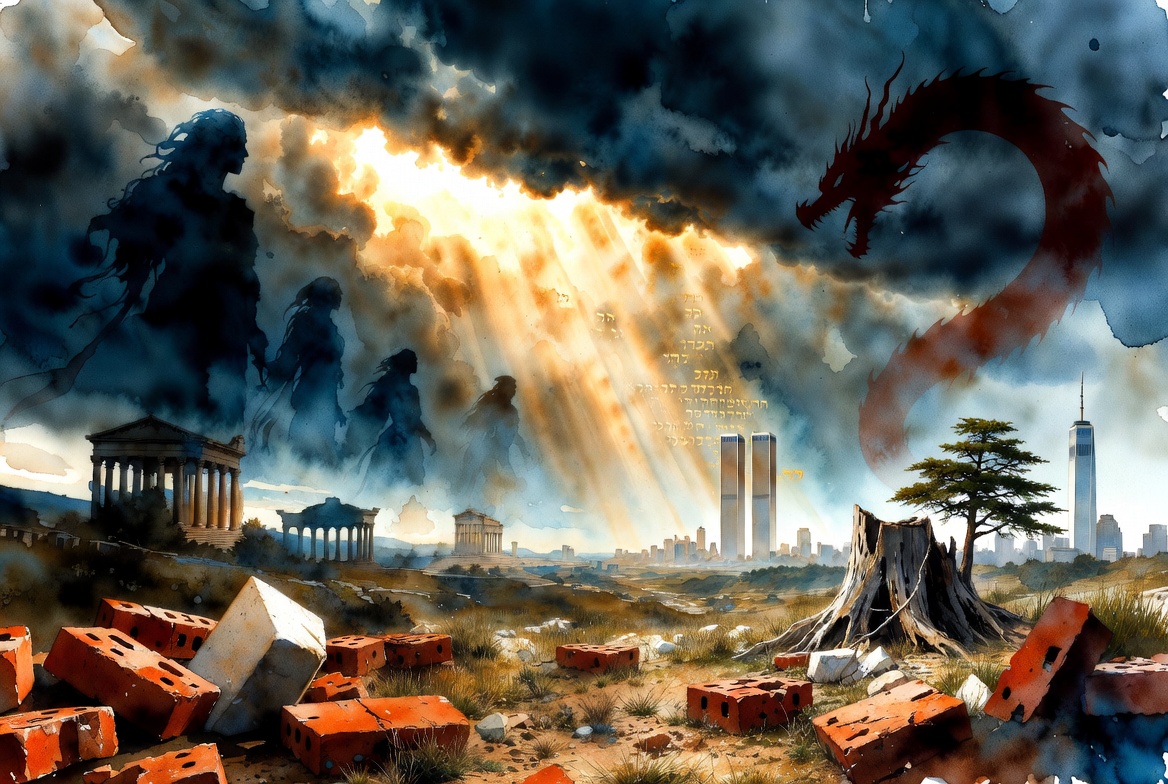
If you have read my post Why I Believe We Are Living in the End Times — and Why I’m Unbothered by Those Who Think I’ve Lost My Marbles, you already know that one of the layers I find most compelling in making that case is the work of Jonathan Cahn. That post covers a great deal of ground, and I made the decision to keep the treatment of Cahn’s work condensed there so as not to overwhelm the larger argument. This post exists because the material deserves more space than a summary can give it.
Cahn is a Messianic Jewish rabbi, author, and teacher whose research centers on ancient biblical patterns that appear to be repeating in the modern world with a precision that is difficult to attribute to coincidence. What follows is my full engagement with five of his books: The Harbinger, The Mystery of the Shemitah, The Return of the Gods, The Avatar, and The Dragon’s Prophecy. I have studied each of them in depth across multiple Bible translations and reference tools including Strong’s and Dake’s. I am not presenting his work as infallible interpretation or as a replacement for Scripture. What I am doing is taking it seriously, as scholarship that engages both the biblical text and the historical record with genuine rigor, and asking you to do the same.
If you have not read the main post yet, I would suggest starting there. This one will make more sense with that foundation underneath it.
The Harbinger: Nine Ancient Warnings
In The Harbinger, Cahn opens with a thesis that is either remarkable or one of the most elaborate coincidences in literary history. His own words frame it best:
In the last days of ancient Israel, nine harbingers appeared in the land, warning of national calamity and coming destruction… The same harbingers of warning, the same nine signs of a nation under judgment, have now manifested on American soil… all nine of them, and in precise and eerie detail. And those involved in their reappearing had no idea of the mystery or their part in fulfilling it.
The nine harbingers are rooted in Isaiah 9:10, a single verse that records Israel’s defiant response to the first wave of Assyrian attack, a response that was not repentance but declaration:
The bricks have fallen, but we will build with dressed stones; the sycamores have been cut down, but we will replace them with cedars. (Isaiah 9:10)
This was not a verse of mourning. It was a vow, a national proclamation of defiance in the face of divine warning, a declaration that the nation would rebuild on its own strength rather than return to God. I have spent enough time in Scripture to know that this pattern, the pattern of warning followed by defiance rather than repentance, is one of the most consistent and heartbreaking threads in Israel’s history. It is also, I would argue, one of the most recognizable threads in ours.
Cahn identifies nine specific elements within this response and the surrounding context, and traces each one to documented events in America following September 11, 2001. The first harbinger is the breach, the lifting of the hedge of protection. In ancient Israel it manifested in 732 BC when the Assyrians were allowed to strike the land. Cahn writes:
It was a wake-up call to a civilization that had grown so hardened and deafened to the call of God that nothing else would get through to it. It was a warning and a call to return.
America’s first harbinger, he argues, manifested on September 11, 2001, when the hedge was lifted and an enemy struck in a way that had not been possible before. I was an adult on that day. I remember exactly where I was and what it felt like to watch it unfold in real time. Most of us who lived through it remember the days immediately following, the strange stillness, the flags, the genuine national grief and the question underneath all of it: how did this happen? Cahn is offering a framework for that question that goes deeper than geopolitics or intelligence failures.
The second harbinger is the terrorist, the enemy from the east. The Assyrians were, in the ancient world, what we would today call a terrorist force: brutal, targeted, and ideologically driven. The parallel Cahn draws to the perpetrators of 9/11 requires very little elaboration, and I think most readers will feel the weight of it without needing me to spell it out further.
The third harbinger is the fallen bricks, the physical evidence of destruction. Isaiah 9:10 opens with them: the bricks have fallen. The fallen bricks of the Twin Towers are the most visually unmistakable fulfillment in the sequence, and the one that most people, even those skeptical of the broader argument, tend to pause on. There is not much interpretive distance to cross here. The image in the ancient text and the image from that morning are, in the most literal sense, the same image.
The fourth harbinger is the tower, the defiant rebuilding. Israel declared it would build higher and stronger in the face of judgment rather than repenting. The One World Trade Center, officially named the Freedom Tower, is the American fulfillment, a monument to resilience that carries, in Cahn’s reading, the same spirit of national defiance. Whether that spirit was intentional or simply the natural response of a wounded nation is its own question, and honestly not one I think has a simple answer. What matters to Cahn’s argument is not the intent behind the rebuilding but the pattern it completes.
The fifth harbinger is the hewn stone, the gazit stone of Isaiah 9:10, a stone cut from the mountain and laid as a foundation of defiant rebuilding. On July 4, 2004, a massive cornerstone was formally laid at the site of the Freedom Tower. The event was ceremonial, public, and widely covered, and for those familiar with the Isaiah 9:10 pattern, the symbolism was not subtle.
The sixth harbinger is the sycamore. Isaiah records: the sycamores have been cut down. At the corner of Ground Zero stood a sycamore tree that had grown there for years. On September 11, 2001, it was struck by debris from the falling towers and destroyed. The stump was preserved and is still there today. I want to sit with this one for a moment, because this is the harbinger that I think stops even the most skeptical reader. This is not a matter of interpretation or theological framing. There was a sycamore tree. It was destroyed on September 11, 2001, by the physical debris of the collapse. The stump was kept. You can look it up, look at the photographs, and visit the location. It happened whether anyone was looking for it or not.
The seventh harbinger is the erez tree, the cedar of Isaiah 9:10, the stronger tree planted in place of the fallen sycamore. In 2003, a conifer officially named the Tree of Hope was planted at Ground Zero to replace the fallen sycamore. The symbolism of the replacement was explicit and intentional, though those involved had no awareness of the prophetic parallel they were enacting. That detail is worth holding onto as the pattern continues to unfold.
The eighth and ninth harbingers are perhaps the most striking of all. The eighth is the utterance: the vow of defiance spoken aloud by national leaders. The ninth is the prophecy: the formal, public pronouncement of the ancient words themselves. And this is where the documented record becomes genuinely difficult to explain away.
On September 12, 2001, Senate Majority Leader Tom Daschle addressed Congress on behalf of the nation and closed his remarks with these words:
The bricks have fallen down, but we will rebuild with dressed stone; the fig trees have been felled, but we will replace them with cedars.
He was quoting Isaiah 9:10, word for word, as a declaration of national resolve, with no awareness that he was pronouncing the ancient vow of judgment over the land. On September 11, 2004, Senator John Edwards quoted the same verse at a 9/11 memorial. In 2009, President Obama echoed the spirit of the declaration when addressing Congress and later when signing a beam at the Freedom Tower. None of these men were students of biblical prophecy making a deliberate theological statement. They were reaching for words that felt appropriately defiant and resolute, and in doing so they were, unknowingly, completing a pattern that had been established nearly three thousand years earlier.
Cahn’s conclusion is measured but pointed:
When the leaders of a nation utter the ancient vow of defiance, they are, without realizing it, pronouncing judgment on the land… The prophecy had been fulfilled.
Nine harbingers. Nine documented fulfillments. All rooted in a single verse from a prophet writing in the eighth century BC. None of the people involved had any awareness of the pattern they were enacting. I have read a great deal of material that attempts to explain away or debunk Cahn’s argument, and while I think healthy skepticism is always appropriate, I have not found a competing explanation that accounts for all nine points with the same coherence. At some point, the cumulative weight of documented specifics has to be reckoned with honestly.
I will leave you to sit with that.
The Shemitah: The Seven-Year Cycle
The Harbinger traces nine specific warning signs, and The Mystery of the Shemitah zooms out to reveal a deeper rhythmic pattern beneath them. Cahn’s framework here is rooted in Leviticus 25 and the Mosaic law of the seventh year, the Sabbath year given to Israel as both a gift and a requirement. Every seven years, the land was to rest, debts were to be canceled, and financial accounts were to be wiped clean. The climax of this cycle fell on a specific date: the 29th of Elul, the final day of the Hebrew civil year, the appointed day of release and nullification.
Cahn describes it this way:
The Shemitah is the seventh year, the Sabbath year… It is the year of release, the year when the land rests, debts are canceled, and financial accounts are wiped clean. The word Shemitah itself means ‘the letting fall,’ ‘the letting collapse’… No nation can defy the ways and will of Him who is its source of blessings and expect those blessings to continue. Without Him as the foundation, the blessings will be removed and that which has been built up… will collapse.
What makes this more than an interesting theological footnote is what he documents next. I want to be clear that I am not someone who reaches for supernatural explanations when natural ones are available. I follow evidence. I cross-reference sources. I use Strong’s and Dake’s when I study Cahn’s work, because I want to know whether the biblical foundations he is building on actually hold. They do. And what he documents in connection with the Shemitah cycle is the kind of thing that, once you see it, is genuinely difficult to set aside.
As noted in my thoughts on The Harbinger, September 11, 2001 marked what Cahn identifies as the breach, the lifting of America’s hedge of protection. What the Harbinger section documents in terms of physical signs and prophetic parallels, the Shemitah adds a financial dimension. On September 17, 2001, when the markets reopened, the Dow Jones suffered its largest single-day point drop in history up to that time. That date was the 29th of Elul, the biblical day of financial nullification. Cahn writes:
The greatest financial collapse in American history up to that day took place on Elul 29, the biblical Day of the Shemitah… And that day was the 29th of Elul.
Seven biblical years later, on September 29, 2008, the collapse that triggered the global financial crisis occurred on the same date. The Dow fell 777 points in a single day, its most significant single-day drop of a generation, on the biblical date of nullification, exactly seven years after the previous record collapse. Cahn notes the additional detail that the opening bell that morning refused to ring, and the 777-point figure carried the number Scripture consistently associates with completion and divine fullness.
This is what’s important to hold onto here: the two most dramatic single-day financial events in modern American history, occurring precisely on the ancient appointed day, exactly seven years apart. I remember both of those days. I remember the atmosphere surrounding them, the shock, the sense that something foundational had shifted. Looking back at them now through this lens, with the specific calendar dates laid out side by side, gives me a different kind of pause than the events themselves did at the time.
Cahn does not stop there. He documents a recurring seven-year rhythm across decades of major financial turning points:
The greatest financial turning points, peaks and long-term collapses of the past forty years have taken place within the biblical Shemitah… The years were 1973, 1980, 1987, 2000, 2007… Every single one of them is on the seven-year cycle… Not only that, every single one of them happens at the time of the Shemitah.
He is careful to note that not every Shemitah year produces a single-day crash on Elul 29, but the predominant pattern is one of markets peaking and reversing into long-term decline or collapse during the Shemitah year itself, with the most striking examples hitting the precise nullification date. When I look at that list of years and set it against my own memory of what was happening in the country during each of those periods, the pattern does not feel like a reach. It feels like something that was there all along, waiting to be noticed.
His framing of the warning dimension carries the same spirit as The Harbinger:
The Shemitah can bring blessing or judgment. To a nation that has turned against the God of its foundation and driven Him out of its life, the Shemitah comes as a sign of judgment that specifically strikes that nation’s source of blessings and sustenance, its financial and economic realms… It was a shaking, a wake-up call, an alarm… It could have only transpired by the moving of an unseen hand. Its complexity combined with its precision remains nothing short of mind-boggling.
I have no competing explanation for the precision of these dates. I am not sure one exists.
The Return of the Gods and The Avatar: The Empty House
In The Return of the Gods (2022) and its follow-up The Avatar (2025), Cahn takes the framework established in The Harbinger and The Shemitah and asks a deeper question: when a nation turns away from God, what exactly rushes in to fill the space it left behind?
His answer is rooted in something Jesus said long before America existed. In Matthew 12:43-45, Jesus describes what happens when an unclean spirit leaves a person, wanders, and returns to find the house empty and swept clean:
For when an unclean spirit comes out of a man, it roams through waterless places looking for rest but doesn’t find any. Then it says, I’ll go back to my house that I came from. And returning, it finds the house vacant, swept, and put in order. Then it goes and brings with it seven other spirits more evil than itself, and they enter and settle down there. As a result, that man’s last condition is worse than the first. That’s how it will also be with this evil generation. (Matthew 12:43-45)
Cahn scales this principle beyond the individual to the national level:
The same principle that applies to a man also applies to a nation, a culture, a civilization. When a nation that once knew God turns away from Him, it does not remain neutral. It becomes an empty house… swept clean of the presence of God. And an empty house does not stay empty.
What fills it, according to Cahn, is not merely cultural drift or secular ideology. It is something older and more purposeful than either of those things. I have spent a lot of time reading, researching, and observing the arc of American culture over the last several decades, and one of the things that has always struck me is how inadequate our usual explanations are. We reach for sociology, political theory, media influence, economic anxiety. And while none of those things are irrelevant, they do not fully account for the speed, the totality, or the specific shape of what has changed. Cahn offers a different framework entirely:
When a nation turns away from God, it does not simply become secular or neutral. It becomes vacant. And that which is vacant will not stay vacant. The house will be filled… The gods will return.
From The Return of the Gods:
It will never stay empty. It will become indwelled by something else, something other than God. It will become inhabited by the gods… America has turned away from God and now follows after the gods. To what then will it lead? It must as well, in the end, lead to destruction.
He also identifies what the return of many gods does to truth itself, and this particular observation stopped me cold the first time I read it:
When you take away God, everything becomes God. Anything becomes God… Where there is God, there is truth. But where there is more than one god, or many gods and Baals, the door is open for many truths, conflicting truths, and thus no truth.
I have written in the full end times post about about the collapse of shared truth, about the way tribal reflex has replaced honest reasoning, about the epidemic of people choosing a side and then reverse-engineering the evidence to support it. I have watched this happen in real time, in comment sections, in newsrooms, in pulpits, in friendships. Cahn’s argument is that the fragmentation of truth is not a side effect of the internet or partisan politics. It is what happens spiritually when the anchor is removed. That is a harder thing to dismiss than it might initially sound.
Cahn also identifies three specific principalities, what he calls the Dark Trinity, as the primary forces that dominated pagan civilizations and have now re-entered the West with what he describes as striking fidelity to their ancient patterns. The first is Baal, the Possessor. Cahn writes:
When Baal came to Israel, it was a turn to materialism… Baal was the god of this world, carnal physical sensuality, materialism… One of the signs of Baal’s subversion of a culture is that the culture will turn away from objectivity to subjectivity.
I think about how thoroughly we have moved, as a culture, from asking what is true to asking what is true for me. From objective standards to personal narrative as the highest authority. From shared moral frameworks to the idea that anyone who challenges your self-defined truth is committing a kind of violence against you. This did not happen overnight, and it did not happen by accident. Cahn’s argument is that it has a name, and that name is ancient.
The second is Molech, the Destroyer. Cahn connects him directly to the abortion culture:
The child sacrifices demanded by Molech… the offering up of children… The spirit of Molech is the spirit that demands the sacrifice of the innocent, the destruction of the unborn.
This is an uncomfortable statement for many, and as such I want to be straightforward here. I am not using this as a political argument, and I am not interested in the culture war version of this conversation. What I am interested in is the honest question Cahn is raising: whether the same spiritual dynamic that once demanded the lives of children on literal altars is operating now under different language and different justifications. I think that question deserves a serious answer rather than a reflexive one, whatever your starting position.
The third is Ishtar, the Enchantress and Transformer. Cahn writes:
Ishtar, the goddess of sexual immorality, the goddess of the sacred prostitute… Her return brings sexual chaos, the blurring of male and female, the war against the biblical order of sexuality… The month of June possessed by the goddess of pride and parades.
What I find most striking about this particular parallel is not any single cultural moment but the pace of it. The breadth and the speed with which entire frameworks around identity, biology, and sexuality have shifted within a single generation is, by any historical standard, extraordinary. Cahn is not making a culture war point here. He is looking at an ancient spiritual pattern, identifying its specific fingerprints, and asking whether what we are seeing is the same thing wearing a modern face. I think it is a reasonable question.
The Avatar (2025) extends this further into the political realm. Cahn argues that in the ancient world, kings and queens functioned as living embodiments of the deities they served, avatars through which divine forces moved and ruled. His argument is that this principle has not disappeared. It has returned. He writes:
The avatars have returned… Could the ancient god-kings and goddess-queens, the avatars, be returning to enter the political realm, our national stage, to take over and rule?… The American Avatar, instrument of the gods and their agenda.
He documents how certain modern leaders, aware of it or not, appear to function as living embodiments of these ancient principalities, manifesting their agendas with a consistency that he argues is too precise to be coincidental:
In the ancient world, kings and queens were avatars of the gods they worshiped… Now the avatars have returned, manifesting through leaders on the American political stage who have lived in the image of an ancient deity from birth.
His closing warning across both books is clear:
The nation is hanging in the balance… If the house is not filled with the presence of God, the gods will return, and the last state will be worse than the first.
As much as I support freedom of belief, religion and speech in America, America was not founded as a pagan nation. I believe that deeply, and I also believe it matters. But I think the more pressing question, the one I keep returning to, is not what America was founded as but what it is becoming, and whether those of us who recognize the pattern have the courage to say so clearly, not in the language of political tribalism, but in the language of genuine spiritual discernment.
The Dragon’s Prophecy: The Ancient Adversary
In The Dragon’s Prophecy: Israel, the Dark Resurrection, and the End of Days, Cahn does something that the previous books build toward but do not fully name. He identifies the force behind the patterns, and in doing so reframes not just American history but the whole of human history as a single, ongoing spiritual conflict with a consistent author on the opposing side. His opening frame sets the lens for everything that follows:
There is more to the world than what we see with our eyes… Behind the events we witness is an unseen spiritual war that has been raging for millennia. The Dragon is not a myth or a metaphor. It is the ancient adversary, the one Scripture calls Satan, operating with purpose, strategy, and unrelenting fury against everything God has declared holy.
The biblical anchor is Revelation 12:
I saw a great red dragon… This great dragon was cast out, that ancient serpent called the devil and Satan, who deceives the whole world. (Revelation 12:3,9)
Cahn traces the Hebrew words tanim and tannin, translated variously as dragon, serpent, and monster, used throughout the Old Testament against ancient enemies of Israel including Pharaoh and Nebuchadnezzar, forward to the Greek drakon in Revelation. His argument is that the same spiritual force has been operating through human vessels and empires across the full span of recorded history, wearing different faces in different eras but never deviating from a single underlying agenda:
The Dragon does not act randomly. It targets with specificity… Its nature is opposition and destruction, standing against existence itself and pursuing the negation of creation… Evil exists in defiance of existence.
What Cahn stresses across the book is that this is not a force that rests between its appearances in history. The methods change. The goal does not:
The Dragon’s war has never stopped. It has simply adapted its methods to each era while pursuing the same fundamental goal: the destruction of everything God has declared holy, Israel, the church, the Word, the family, and the image of God in human beings.
Those four targets are worth keeping in mind as you scroll through the news on any given morning.
Cahn is specific about why Israel sits at the center of the assault, and his reasoning is worth sitting with carefully:
The very existence of the Jewish people is a witness testifying to the existence of God… The Dragon, as the accuser of our brethren and father of lies, ensures the Jewish people are the most slandered and falsely accused in history… This ancient hatred, described as orgidzo, fury, wrath, violent passion, manifests in schemes of murder and destruction, from Pharaoh to Hitler.
He connects this directly to October 7, 2023, noting that the Hamas attack occurred on a biblical holiday, and that the attackers named their operation Tufan, meaning flood, which is the same image used in Revelation 12 of the dragon casting a flood after the woman. Cahn’s reading is that the terminology was not incidental or accidental. It was ancient language surfacing in a modern moment, and whether the people using it knew that or not is almost beside the point.
One of the book’s most striking arguments involves what Cahn calls the dark resurrection. Just as God brought Israel back as a nation after millennia of absence, a miracle with no parallel in human history, the Dragon would orchestrate an anti-resurrection in response. Cahn writes:
Just as God brought forth the resurrection of Israel as an ancient nation into the modern world, the Dragon, as the dark mimic, would orchestrate an anti-resurrection. This would involve raising up Israel’s ancient archenemy, a people long vanished, to nullify Israel’s miracle and take its place.
He applies this to the rebirth of ancient Philistia in Gaza and to entities like Hamas as what he calls little dragons, vessels executing a strategy larger and older than any of them.
The scope of the assault, in Cahn’s framework, extends well beyond Israel’s borders and into territory most Western Christians are not accustomed to thinking of in these terms:
The war is not only with Israel… it is also with the church… and if you are in the image of God, the enemy wars against you as well… The assault on Scripture, on the sanctity of human life, on the definition of family, on the biological reality of the image of God, these are not independent trends.
When you set that beside the cultural landscape of the last two decades and look at it honestly, the argument is harder to dismiss than it might initially seem. Cahn draws it to its logical conclusion:
The global hostility toward Israel is not, at its root, merely political. The worldwide persecution of the church is not merely cultural friction… They are coordinated expressions of a single ancient strategy, now pressing toward what the prophetic texts describe as its final phase.
It is not a comfortable framework. But for those of us who have been watching these things converge and found ourselves unable to explain the convergence through ordinary lenses, it gives what otherwise looks like unrelated chaos a recognizable and ancient shape.
Cahn does not end without hope. He returns to Revelation 12:
They overcame him by the blood of the Lamb. (Revelation 12:11)
And his own words carry the same assurance that has sustained the people of God through every version of this battle across every century it has been fought:
No matter how loud the Dragon roars, no matter how fierce the battle looks, he is not greater than the power of God.
That has always been true. Nothing happening right now changes it.
Why Cahn’s Work Matters in This Context
I want to be honest about why I include this material and what I am and am not asking of you in presenting it. I am not asking you to treat Jonathan Cahn as a prophet, or to receive his books as Scripture, or to agree with every interpretive choice he makes. Cahn himself is careful on this point. His work is research, documentation, and pattern recognition rooted in the biblical text. It is an invitation, not a demand.
What I am asking is that you consider the possibility that the patterns he documents, rooted in Scripture, traceable through the historical record, and visibly present in current events, represent something more than coincidence or creative reading. Cahn frames his observations as alignments that are “too precise to be coincidence,” carrying what he describes as an “eerie precision” when measured against the biblical template. Time and again he concludes:
None of this is coincidence.
The biblical foundation for this kind of pattern-seeking is not speculative. God Himself declared it:
Remember the former things of old, for I am God, and there is no other; I am God, and there is none like me, declaring the end from the beginning and from ancient times things not yet done. (Isaiah 46:9-10)
He declared the end from the beginning. He encoded the patterns. That means they are there to be found, not by those who are desperate to find them, but by those who are willing to look carefully, honestly, and without the prior commitment that nothing unusual could possibly be there.
Cahn’s work, whatever its limitations, invites exactly that kind of looking. And what you find when you accept that invitation is, at minimum, worth your time.
Closing Thoughts
If you made it to the end of this post, you covered a lot of ground. I want to close by being honest about something.
I did not write any of this in fear. I studied it the way I study anything I take seriously: carefully, across multiple sources, with a strong preference for being wrong over being dramatic. What I found, when I looked carefully, was material I could not honestly dismiss. So I did not dismiss it.
What Cahn’s work does for me, taken in full, is not raise my alarm level. It lowers it. When you understand that what we are watching is not chaos but an ancient pattern pressing toward a known conclusion, the confusion that tends to generate anxiety starts to lose its grip. The framework does not make the events less serious. It makes them less surprising. And there is a meaningful difference between those two things.
The biblical text does not ask us to be afraid of what is coming. It asks us to be awake to it, and to stand upright when it arrives, because the arc of this story — the one encoded in the patterns, sealed in the prophecies, and running all the way to the last pages of Revelation — does not end in the Dragon’s favor. It never has.
That is what I carry out of these five books and the years of study that led to them. Not dread. Not certainty about every detail or every timeline. Just a settled, clear-eyed confidence in the One who declared the end from the beginning, and who has not lost track of a single thread.
Whatever you do with what you have read here, I hope you hold it in that frame.
 Twin Tree Project