
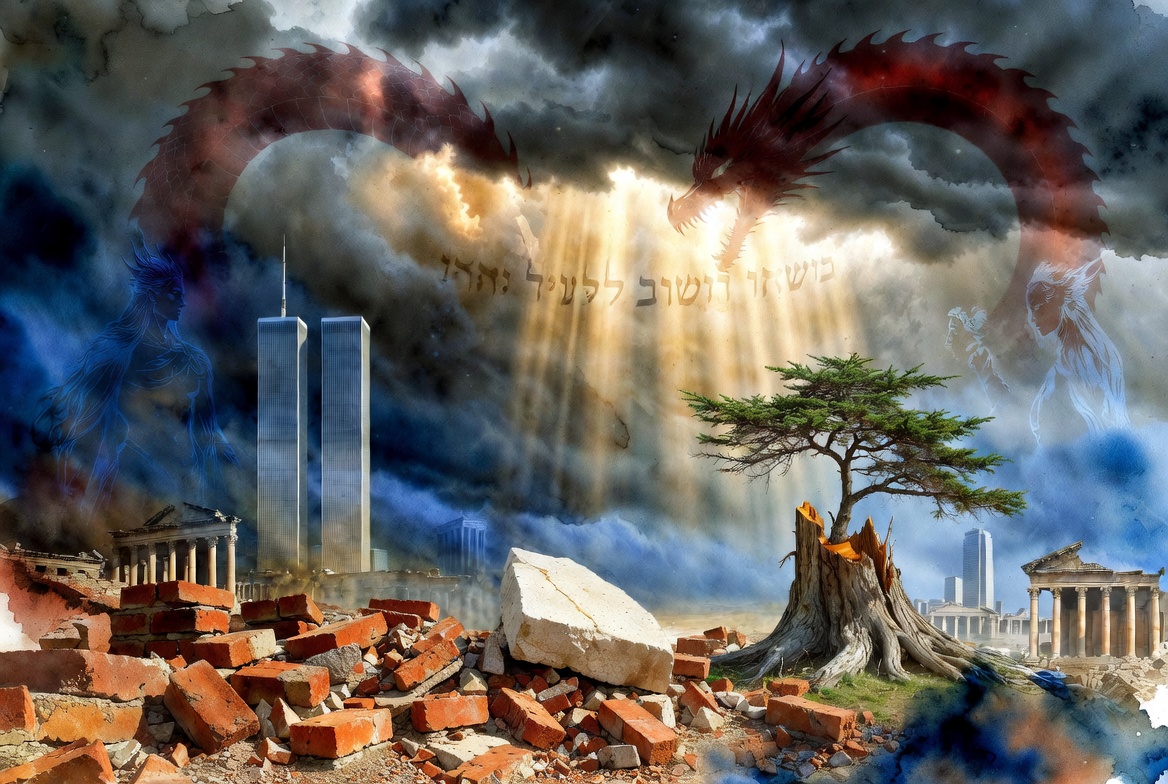
I want to be upfront with you before you read a single word of what follows in this post: I’m not writing this to argue with anyone, convert anyone, or win a debate. I’m writing this because I’ve had this conversation — in pieces, in fragments, in comment sections and living rooms and quiet exchanges with people who are genuinely asking questions — enough times now that I felt it was time to put the whole of it in one place. Something I could point to. Something complete.
This is what I believe, and why I believe it. That’s it. What you do with it is entirely your business.
A fair warning: This post is long. Intentionally, necessarily long.
The subject demands it. I’ve also, for the first time in my writing life on WordPress, gone deeper into formatting than I normally do — anchor links, a table of contents, footnotes — because a post meant to be a reference deserves to actually function like one, and you deserve that tool. I’ve done my best with it. If something doesn’t work quite right, extend me a little grace but make me aware of it so that I can repair/correct it. We’re all learning as we go.
One more thing before we dive in: if you’ve already decided that anyone who believes we’re living in the end times has lost their marbles — I understand. It wasn’t that long ago that I felt the same. I used to roll my eyes, jump to immediate defense (especially with my mother, may she rest in peace), and raise an eyebrow too. You’re welcome to keep reading anyway. I’m not offended, and I think you might find it’s a more layered conversation than the sandwich-board-guy-on-the-corner version you’ve probably been handed. You are welcome here. And if you’ve come here already nodding your head, welcome to you, too. Let’s all talk about what we’re actually seeing.
Either way — pull up a chair. This one’s going to take a minute.
Defining “End Times”
“Let’s start at the very beginning — a very good place to start.” —Maria, The Sound of Music (Julie Andrews, 1965 — and if you don’t know what that is, I’m so sorry, and also please go watch it immediately)
Before we can talk about whether we’re living in the end times, we have to talk about what that phrase actually means — because if your mental image involves a wild-eyed man on a street corner holding a sandwich board, a Hollywood rapture scene with people vanishing out of their cars, or a televangelist sweating through his suit and pointing at a chart, I completely understand why you’d roll your eyes, click off of this post and keep scrolling.
That caricature is real. It’s also not what we’re talking about here.
What It Is
The term “end times” — or more precisely, eschatology, from the Greek eschatos meaning “last” — refers to the biblical study of the final events of human history as God has described them: the culmination of the age, the fulfillment of prophecy, and the return of Christ. It’s not a fringe concept invented by doomsday preppers. It’s woven through the Old and New Testaments alike, addressed by the prophets, by Jesus himself, and by nearly every major New Testament writer.
The problem isn’t the subject. The problem is what we’ve done to it.
What It Isn’t
It isn’t Harold Camping setting a date, getting it wrong, setting another date, and getting that wrong too. It isn’t the Left Behind film series, though God bless whoever greenlit those very entertaining films from Tim LeHaye’s novels. It isn’t a personality type, a political affiliation, or a symptom of anxiety dressed up in Scripture. And it is absolutely, categorically not a reason to quit your job, sell your house, or go live in a bunker.
The date-setting alone has done enormous damage to this conversation. Jesus said plainly — and I mean plainly, in words even a child can read — that no one knows the day or the hour. Not the angels. Not even the Son, in His earthly ministry. (Matthew 24:36). Anyone who has ever handed you a specific date has already disqualified themselves. That’s not me being harsh. That’s just reading the text.
What gets lost in all the noise is that the biblical writers weren’t primarily writing to terrify people. They were writing to prepare them. There’s a significant difference between a weather forecast and a threat. One is information. One is meant to help you make wise decisions with what you know.
Why Getting the Definition Right Matters
It’s important to get the definition right because the caricature is a door that closes before the conversation even begins.
When most people hear “end times,” they immediately sort the speaker into a category: fringe, fearful, gullible, or just a little unhinged. And honestly? Given some of what’s been done in the name of biblical prophecy, I can’t entirely blame them. The misuse has been loud, embarrassing, and sometimes genuinely harmful.
But dismissing the subject entirely because of its worst representatives is the same logical error as dismissing all of science because of bad scientists, or all of medicine because of bad doctors. The abuse of a thing doesn’t unmake the thing.
If we can agree to set the caricature aside — just for the length of this post — and look at what the biblical text actually says, and then look at what the world actually looks like right now, I think the conversation gets a lot more interesting.
The Lens I’m Using
I want to be transparent about how I’m approaching this, because I think it’s fair for you to know. I’m coming at this as someone who takes Scripture seriously. I do not consider Scripture to be a magic book, or a weapon, but a living document with internal logic, historical context, and a remarkable track record of saying things that turned out to be true. I’ve spent years studying it, not just reading it. There’s a difference.
I’m also coming at this as someone who loves research, history, philosophy, and pattern recognition. I find the intersection of ancient text and modern event genuinely fascinating — not in a conspiracy-theory way, but in the way that any intellectually honest person finds it fascinating when something predicted a long time ago appears to be unfolding in real time.
And, I’m coming at this without fear. That part is important. This isn’t doom-scrolling dressed up in Bible verses. If anything, understanding the biblical framework for what’s happening has made me less anxious, not more… because it means none of this is chaos. It’s not random. There’s a through line, and I know where it ends.
That’s the lens. Keep it in mind as we go.
The Biblical Framework: What Were We Told to Watch For?
Before we get to the signs themselves — and we will get there, in detail — it helps to understand where the framework comes from. Because this isn’t a modern theory pieced together by people with too much time on their hands. The biblical writers laid this out a long time ago, with a specificity that is either remarkable coincidence or exactly what it claims to be.
I’ll let you decide which.
Jesus Said So First
If you’re going to take any of this seriously, start here: the Olivet Discourse. It’s found in Matthew 24, Mark 13, and Luke 21 — three separate accounts of the same conversation, in which the disciples asked Jesus directly:
What will be the sign of your coming, and of the end of the age?
He answered them at length, and in plain language.
He listed specific things to watch for — and we’re going to go through each of them in the next section. But what matters here is the source. This isn’t a prophet speaking in metaphor from a distant century. This is Jesus, in direct conversation, responding to a direct question, giving a direct answer. If you take His words seriously in any other context, it’s worth taking them seriously here too.
Daniel: The Long View
Daniel is one of the most remarkable documents in the biblical canon, and one of the most controversial, precisely because it’s so specific. Written in the 6th century BC, it describes the rise and fall of empires with an accuracy that has led some scholars to argue it must have been written after the fact. The theological position, of course, is that it was written before, which is rather the whole point.
For our purposes, what matters about Daniel is the architecture it provides: the concept of appointed times, the sealing of prophecy until “the time of the end,” the rise of a final world power, and the promise of deliverance. Daniel 12:4 in particular deserves its own moment:
But you, Daniel, roll up and seal the words of the scroll until the time of the end. Many will go here and there to increase knowledge.
We’ll come back to that one.
Ezekiel: The Nation That Came Back
If you want a single piece of biblical prophecy that is difficult to explain away, it’s Ezekiel 37. The vision of the valley of dry bones — a vast field of scattered, dead bones that are called back together, covered with flesh, and breathed into life — is explicitly interpreted within the text itself as referring to the house of Israel:
These bones are the whole house of Israel. (Ezekiel 37:11)
Israel ceased to exist as a nation in 70 AD when Rome destroyed Jerusalem and scattered the Jewish people across the world. It was reestablished as a nation in 1948 — nearly 1,900 years later. There is no modern historical parallel to a people maintaining their ethnic, cultural, and religious identity across that span of time, returning to the same land, and reconstituting as a sovereign nation. None.
We’ll talk more about 1948 (and 1967) in the signs section, because both dates matter enormously.
Isaiah: Woven Through Everything
Isaiah is long, layered, and worth a post series of its own (which I may eventually write). For the framework as we’re exploring it now, what matters is that Isaiah is saturated with end-times imagery: the day of the Lord, the restoration of Israel, judgment on the nations, the coming of the Messiah and His ultimate reign.
Many of Isaiah’s prophecies have dual fulfillment, meaning they spoke to an immediate historical situation and to something further out on the horizon. That dual fulfillment pattern is important to understand because it’s a feature of biblical prophecy, not a bug. It doesn’t mean the prophecy failed the first time. It means it had more than one address.
Revelation: The Architecture
I’m not going to take you through Revelation verse by verse in this post. Like Isaiah, that would be a separate series. What I want to establish here is simply the framework:
Revelation is the culmination of the prophetic thread that runs through the entire Bible. It draws from Daniel, Ezekiel, Isaiah, Zechariah, and the Olivet Discourse, and it brings them into a final convergence. It describes a series of events (seals, trumpets, bowls) that unfold before the return of Christ. It describes a global economic system, a world government, a final conflict centered on Israel, and ultimately the establishment of God’s kingdom on earth.
Revelation is dense, it is extremely symbolic in places, and people have disagreed about its interpretation for centuries. I hold some of it with open hands. But the broad architecture — that history is moving toward a defined culmination — I hold with both.
2 Timothy 3: The Culture Checklist
Paul’s second letter to Timothy contains one of the most uncomfortably current passages in the New Testament. He writes:
But mark this: There will be terrible times in the last days. People will be lovers of themselves, lovers of money, boastful, proud, abusive, disobedient to their parents, ungrateful, unholy, without love, unforgiving, slanderous, without self-control, brutal, not lovers of the good, treacherous, rash, conceited, lovers of pleasure rather than lovers of God — having a form of godliness but denying its power. (2 Timothy 3:1-5)
Read that list slowly. Then open any social media platform. I’ll wait.
Daniel 12:4: Knowledge and Motion
We come back to Daniel one more time, because this single verse deserves its own moment.
Many will go here and there to increase knowledge. (Daniel 12:4)
As noted, Daniel was written in the 6th century BC. For most of human history, the sum total of human knowledge changed slowly — almost imperceptibly — from generation to generation. A person born in the year 1000 AD lived in a world that functioned almost identically to the one their great-grandparents knew.
That is no longer true. The last hundred years have produced more technological advancement than the previous several thousand combined. We carry devices in our pockets that access the sum total of human knowledge in seconds. We travel distances in hours that once took months. Knowledge is not just increasing. It is accelerating, and it is doing so at a pace we in the “modern” age can barely keep up with. Whatever Daniel meant by that verse, we are living inside a description that fits.
The Signs — One by One
Jesus was specific. The prophets were specific. And specificity, as any good researcher knows, is either the mark of someone who knew what they were talking about — or someone who got extraordinarily lucky. Over and over again. Across centuries. Written by dozens of different authors in different countries, different languages, and different historical contexts.
I’ll let you do the math on that one.
What follows is a working list of the signs described in Scripture, matched against what we can observe in the world right now. This isn’t cherry-picking. This is pattern recognition. And the pattern is hard to ignore.
Wars and Rumors of Wars
You will hear of wars and rumors of wars, but see to it that you are not alarmed. Such things must happen, but the end is still to come. Nation will rise against nation, and kingdom against kingdom. (Matthew 24:6-7)
Wars have always existed, so this sign requires some context: Jesus wasn’t simply predicting that conflict would continue. He was describing a specific escalation pattern of persistent, overlapping, global. Not one war, but many, simultaneously, with more always on the horizon.
As of 2026, active armed conflicts exist on virtually every continent. Russia and Ukraine. Israel and Gaza, Hezbollah, and Iran’s proxies. Sudan. Myanmar. The South China Sea. North Korea’s continuous provocations. Iran’s nuclear ambitions. The rumors are as loud as the wars themselves, and the geopolitical conditions feeding them show no signs of de-escalation. If anything, the alliances forming and fracturing right now are moving pieces into positions that students of biblical prophecy find very familiar.
We aren’t just hearing rumors of wars. We’re watching the architecture of something larger taking shape in real time.
Earthquakes, Famines, and Pestilences
There will be famines and earthquakes in various places. All these are the beginning of birth pains. (Matthew 24:7-8)
There will be great earthquakes, famines and pestilences in various places, and fearful events and great signs from heaven. (Luke 21:11)
The phrase “birth pains” is important here. Jesus wasn’t describing isolated events, but a pattern of increasing frequency and intensity. Anyone who has witnessed a birth knows that contractions don’t stay the same. They get closer together. They get stronger. That’s the image He chose deliberately.
I must note here that Scripture repeatedly uses Israel as the mother in this metaphor, and Isaiah 66:7-8 connects that imagery directly to Israel’s rebirth as a nation:
…Who has ever heard of such a thing? Who has ever seen such things? Can a country be born in a day or a nation be brought forth in a moment? Yet no sooner is Zion in labor than she gives birth to her children.
Israel was declared a nation on May 14, 1948, in a single day. Isaiah wrote that over 2,700 years earlier. We’ll return to 1948 shortly.
Global seismic activity has been increasingly and measurably documented in both frequency and intensity over the past several decades, especially and steadily increasingly since the re-emergence of Israel as a nation in 1948. Famine currently affects hundreds of millions of people worldwide, driven by conflict, climate instability, and economic collapse in vulnerable regions. And pestilences? In 2020, the entire world shut down. Whatever your position on the origins or handling of COVID-19, the reality of a global pandemic that paralyzed every nation on earth simultaneously is not something previous generations experienced. The infrastructure for exactly that kind of event — and the global response mechanisms it produced — is now permanently in place.
Birth pains don’t stop once they start. They escalate until the thing being born arrives.
The Gospel Reaching All Nations
And this gospel of the kingdom will be preached in the whole world as a testimony to all nations, and then the end will come. (Matthew 24:14)
This is one of the signs that (in my opinion) doesn’t get talked about enough, possibly because it’s actually good news rather than a warning. Jesus said the gospel would reach every nation before the end — and by virtually every measurable standard, we are closer to that fulfillment than any previous generation in history.
The Bible has been translated into over 3,600 languages. Wycliffe Bible Translators and similar organizations are actively working on the remaining languages with no Scripture at all. The internet has carried the gospel into closed nations where missionaries cannot go, into places like North Korea, into Iran, into remote regions that were unreachable a generation ago. Christian satellite television and radio broadcasts reach into some of the most restricted nations on earth. The Great Commission isn’t complete, but the trajectory is unmistakable.
It is worth consciously considering that this sign is described as a precondition, not just a parallel event. The end comes after this is fulfilled. Which means the work of spreading the gospel isn’t separate from eschatology. It is woven directly into it.
The Rise of Deception and False Prophets
Of all the signs Jesus listed, this is the one He returned to most repeatedly and most urgently. That should be interpreted as Him loudly telling us something. At no point did He warn more repeatedly or more urgently than on this particular sign.
Watch out that no one deceives you. For many will come in my name, claiming, ‘I am the Messiah,’ and will deceive many. (Matthew 24:4-5)
Many false prophets will appear and deceive many people. (Matthew 24:11)
For false messiahs and false prophets will appear and perform great signs and wonders to deceive, if possible, even the elect. (Matthew 24:24)
The deception Jesus described isn’t limited to people literally claiming to be the Messiah. It encompasses anyone speaking in His name, with His language, with His imagery, or with His authority, while leading people somewhere He never intended them to go. That category is, in 2026, enormous.
We have prosperity gospel preachers promising health and wealth in exchange for donations. We have prophets who called elections wrong and simply moved on without accountability. We have entire movements built on political identity dressed in Christian clothing, where the flag and the cross have become interchangeable symbols. We have deconstruction pipelines — some genuine, some manufactured — designed not to refine faith but to dismantle it entirely. And we have an internet that amplifies all of it instantly, globally, and without filter.
And then there is the very specific category of date-setters, which we touched on earlier but deserves a concrete example here. In the late summer of 2025, a man known as Brother Joseph went viral with urgent rapture predictions that spread with alarming speed. He first named September 24 and 25, 2025 as the dates. People quit their jobs. People sold their belongings — which, as I noted at the time, never quite made sense to me, because if you’re going up in the rapture, what exactly are you going to do with the cash? Why do you need it? I digress…
The predicted date came and went. Rather than acknowledge the error, Brother Joseph doubled down, citing discrepancies between the Gregorian calendar we use today and the Hebrew calendar referenced in Scripture. His “corrected” prediction was that the rapture would occur on October 7-8, 2025. That date came and went, too.
It is important to pause here and note that October 7-8 was not a random choice. October 7, 2025 marked the two-year anniversary of the Hamas attacks on Israel — one of the most prophetically significant events of our generation — and it fell at the opening of Sukkot, the Feast of Tabernacles, in 2025. These are genuinely meaningful dates. That’s exactly the point.
This is how false prophets and false teachers operate most effectively. It is not by making things up wholesale, but by taking real signs, real dates, and real prophetic significance and weaving them into a framework that feels credible because parts of it genuinely are. And it works. Not just on the theologically naive or the spiritually immature. It works on seasoned Christians with deep biblical foundations, people who love the Word, who know the Word, and are watching carefully and earnestly for His return. The desire to see clearly can become a vulnerability when someone skilled at deception knows how to speak your language.
There has been, to my knowledge, no genuine accountability and no apology from Brother Joseph.
This is precisely what Jesus warned about. Not a fringe case. Not ancient history. 2025. And, today.
Love Growing Cold / Moral Inversion
Because of the increase of wickedness, the love of most will grow cold. (Matthew 24:12)
This verse is short, and devastating.
Jesus didn’t say the love of a few would grow cold, or the love of the wicked, or the love of people who were never really committed to begin with. He said the love of most. The majority. And He tied it directly to an increase in wickedness, not as a cause but as a condition. Wickedness as an environment. When wickedness becomes the water everyone swims in, love becomes harder to sustain.
Look around, with an open heart and mind. We live in an era of performative outrage and genuine indifference existing side by side. People will march for a cause on Saturday and scroll past a neighbor’s suffering on Sunday. Online cruelty has been normalized to the point where it barely registers. Families are fractured over political identity. Children are growing up in an attention economy specifically engineered to keep them agitated, isolated, and consuming. Loneliness is at epidemic levels by every measurable standard, in the most connected era in human history.
I do not write this from a cynical perspective. This is observable. It is simply the reality of what we see when we take a look around.
The Greek word used here for love is agape — the highest form of love, the selfless, others-centered, sacrificial kind. Not romantic feeling. Not tribal loyalty. The kind that costs something. Jesus said most people’s capacity for it would erode. Not disappear overnight. Grow cold. Gradually. Almost imperceptibly. Like a fire that isn’t fed.
We don’t have to look far to see it.
The Falling Away — Apostasy
Don’t let anyone deceive you in any way, for that day will not come until the rebellion occurs and the man of lawlessness is revealed. (2 Thessalonians 2:3)
The Spirit clearly says that in later times some will abandon the faith and follow deceiving spirits and things taught by demons. (1 Timothy 4:1)
For the time will come when people will not put up with sound doctrine. Instead, to suit their own desires, they will gather around them a great number of teachers to say what their itching ears want to hear. (2 Timothy 4:3-4)
The Greek word translated “rebellion” or “falling away” in 2 Thessalonians is apostasia — from which we get the word apostasy. It means a deliberate departure. A turning away. Not doubt, not questioning, not wrestling with hard things, but a wholesale abandonment of the faith.
Doubt is not apostasy. Questioning is not apostasy. I want to be clear about that, because honest wrestling with Scripture is not what’s being described here. What’s being described is a mass departure, and we are watching it happen in real time.
Church attendance in the Western world has been in documented freefall for decades, accelerated sharply by COVID, and has not recovered. I have to be transparent on this topic, because I, too, have fallen away from regular church service and organized religious involvement. That said, the fastest growing religious category in America is “none” — no affiliation, no belief, no framework.
The framework is so often, these days, false doctrine. There is a difference in falling away from what you know in your spirit is false doctrine, and that is not “wrong.” Because of this, an entire movement has emerged called deconstruction, which at its best is genuine, honest, faith-refining work. But, at its worst, it is a pipeline out of Christianity dressed in the language of authenticity and healing. Awareness of the difference requires discernment, and discernment requires exactly the kind of biblical grounding that is increasingly rare.
Meanwhile, what remains of institutional Christianity in many places has drifted so far from Scripture that it barely resembles the thing it claims to be — affirming whatever the culture affirms, rejecting whatever the culture rejects, with a Bible verse occasionally stapled to the outside for appearances. Paul described it precisely: teachers gathered to say what itching ears want to hear.
This is not a new problem. It is a problem that has reached a scale that is new.
Israel’s Restoration — 1948
We established the prophetic foundation for this in the Biblical Framework: Ezekiel’s valley of dry bones, Isaiah 66:7-8, the promise of return. Here, I think it is important to look at what actually happened.
On May 14, 1948, David Ben-Gurion read the Israeli Declaration of Independence. Eleven minutes later, the United States recognized the new state. Within hours, five Arab nations declared war on a country that had existed for less than a day. The nation that wasn’t supposed to exist survived — and has continued to survive — against odds that defy purely military or political explanation.
Nearly 1,900 years of dispersion. Persecution, inquisition, pogrom, genocide. And yet — the same people, the same land, a restored language, a reconstituted nation. In a single day. Exactly as the prophets described.
There is no historical parallel. None. This is what biblical prophecy fulfilling itself looks like in real time. Not symbolically. Not metaphorically. On a calendar, with a datestamp.
Locked. Clean and exactly right.
Moving to Jerusalem Restored to Israel — 1967. Drafting now:
Jerusalem Restored to Israel — 1967
They will fall by the sword and will be taken as prisoners to all the nations. Jerusalem will be trampled on by the Gentiles until the times of the Gentiles are fulfilled. (Luke 21:24)
Jesus said Jerusalem would be under Gentile control until a specific appointed time. For nearly 1,900 years, that’s exactly what it was. It was controlled at various points by Rome, the Byzantine Empire, the Crusaders, the Ottoman Empire, and Britain. Jewish people had no sovereignty over their own holy city.
On June 7, 1967, during the Six-Day War, Israeli paratroopers entered the Old City of Jerusalem and reached the Western Wall. Defense Minister Moshe Dayan stood at the Wall and said simply: “We have returned to the holiest of our Holy Places, never to part from it again.”
Jerusalem was back in Jewish hands for the first time in roughly 1,897 years.
The phrase Jesus used — “the times of the Gentiles” — implies a specific period with a specific end. June 7, 1967 is the date most students of biblical prophecy point to as that fulfillment. Not a metaphor. Not a theological abstraction. A Tuesday in June, with soldiers and a wall and a declaration that carried the weight of two thousand years behind it.
The Nations Turn Against Israel
I will make Jerusalem a cup that sends all the surrounding peoples reeling. All the nations of the earth will be gathered against it. (Zechariah 12:3)
I will gather all nations and bring them down to the Valley of Jehoshaphat. There I will put them on trial for what they did to my inheritance, my people Israel, because they scattered my people among the nations and divided up my land. (Joel 3:2)
The prophetic picture is consistent and specific: in the end times, the nations of the world do not rally around Israel. They turn against her. And what we are watching unfold in real time, on the world stage, is exactly that.
Since the Hamas attacks of October 7, 2023 — the deadliest single-day massacre of Jewish people since the Holocaust — the response of much of the Western world has not been unambiguous condemnation. It has been negotiation, equivocation, and in many cases, open hostility toward Israel’s right to defend itself. The International Criminal Court issued an arrest warrant for Israeli Prime Minister Benjamin Netanyahu in November 2024. The International Court of Justice entertained a genocide case against Israel brought by South Africa. Spain, Ireland, and Norway formally recognized a Palestinian state in May 2024.
The United Kingdom followed. The UN Human Rights Council, which has historically passed more resolutions condemning Israel than every other nation on earth combined, continues its pattern without interruption. It’s even happening across North America. It’s happening in Canada, under influence of King Charles, but also in the United States, especially in New York City, under Mamdani, — whose election has triggered fears of a significant exodus from the city (with pre-election polling showing nearly a million New Yorkers ready to leave).
But, most importantly, there is the spiritual dimension of what is happening in Europe — the appeasement, the accommodation, and in some cases the outright embrace of Islamist ideology by Western leadership. The Monarchy has always had the charge of defending the Church of England, and even with its flaws in eschatology, it matters. King Charles III, even before his coronation and throughout his public life, has expressed a deep personal admiration for Islam — attending mosques, speaking warmly of Islamic civilization, and positioning himself as a bridge between the West and the Islamic world. In isolation, interfaith dialogue is not the problem. The problem is when that posture translates into a geopolitical blindness toward the very real and stated goal of groups like Hamas, Hezbollah, and the Iranian regime — the elimination of Israel.
We already wrote about this in the context of Zechariah 2:8 — whoever touches Israel touches the apple of God’s eye. That is not a metaphor open to diplomatic revision. It is a warning. And the leaders of nations who have spent decades cultivating relationships with regimes that openly call for Israel’s destruction are not operating from a position of wisdom. They are operating from exactly the kind of spiritual blindness the prophets described.
The world is lining up. The sides are becoming visible. And the nation at the center of it all is the same nation that was scattered for 1,900 years, came back in a day, and was never supposed to survive in the first place.
Ezekiel 38–39: The Gog-Magog Coalition
This one deserves its own section, because Ezekiel didn’t speak in metaphor or generalities. He gave names.
Written around 571 BC, Ezekiel 38–39 describes a future military coalition descending on a restored Israel — a nation gathered back from the nations, living in relative peace — and God Himself intervening to stop it. No human army saves Israel in this passage. God does. Directly. Dramatically. Undeniably.
The names Ezekiel listed were peoples and territories known in his time. But mapped against ancient geography and modern national boundaries, those names land somewhere very specific.
The Coalition — and Who They Are Today
Ezekiel wasn’t vague. Here’s what he listed, and where scholars — across centuries of geographic and historical study — place them today:
Magog / Gog: Gog is described as a ruling prince; Magog is the territory he governs. Most scholars identify this with the ancient Scythian regions north of Israel — what is now Russia and parts of Central Asia. Ezekiel 38:15 is specific: the attack comes from the far north. Draw a straight line north of Jerusalem on a map. You land in Russia.
Persia: This one requires zero interpretation. Ezekiel named Persia directly. In 1935, Persia officially renamed itself Iran. The same nation, the same geography, the same people — now the loudest voice in the world calling for Israel’s elimination.
Cush (Ethiopia) and Put (Libya): North Africa and the Horn of Africa. Both regions have seen growing anti-Israel alignment and increasing radical Islamist presence.
Gomer and Beth-togarmah: Widely identified with Turkey and surrounding Turkic peoples. Turkey, once a NATO ally with normalized ties to Israel, has shifted sharply under Erdoğan toward hostility and pan-Islamic regional positioning.
Meshech and Tubal: Associated with regions within modern Turkey and southern Russia.
The coalition Ezekiel described 2,500 years ago looks, in broad strokes, like the alliance currently assembling in real time.
The 1979 Pivot Nobody Should Ignore
Here’s what makes Iran particularly striking in a prophetic context: before 1979, Iran was not Israel’s enemy. Under Shah Mohammad Reza Pahlavi, Iran and Israel had diplomatic relations, intelligence cooperation, and trade. Iran was one of the only Muslim-majority nations in the region with genuine ties to Israel.
Then came the Islamic Revolution.
In 1979, Ayatollah Khomeini seized power, declared Israel an illegitimate state, and repositioned Iran as its most committed ideological enemy. Within a single year, a cooperative relationship became a declared holy war. That’s not just politics. That’s a prophetic door swinging open on a hinge.
Since then, Iran has funded Hamas. Funded Hezbollah. Built a missile program pointed at Israel. Launched direct drone and missile attacks. Sent proxies into every available corridor. And the language from Iranian leadership has never softened — the elimination of Israel is not a negotiating position. It is a stated mission.
Ezekiel named Persia as part of the coalition that would one day come against a restored Israel. Persia became Iran. And Iran has spent nearly five decades doing exactly what the text anticipated.
Where We Are Right Now
The Gog-Magog war, in its full Ezekiel-described form, has not happened yet. The text describes a scale of divine intervention that stops the coalition in its tracks — a seven-month burial of the dead, weapons burned as fuel for seven years. That has not occurred.
But the coalition is forming. It is so very clear.
Russia and Iran have deepened their alliance through the ongoing Ukraine conflict — weapons exchanges, military cooperation, shared strategic interests in destabilizing the West and isolating Israel. Turkey has drifted. African alignments are shifting. The pieces Ezekiel named aren’t theoretical anymore. They’re on the board.
I’m not saying this war is tomorrow. I’m saying the lineup exists in a way it never did before 1948, before 1979, before now.
A note on the previous point: When I was a teenager studying these chapters with my father, the idea of a Russian-Iranian-Turkish coalition moving against a restored Israel felt like ancient imagery being projected into an impossible future. Now, it reads like a foreign policy briefing. The text didn’t change. The world caught up to it.
Persecution of Christians Globally
There is a tendency, in comfortable Western spaces, to speak of Christian persecution in the past tense. It is often framed as something that happened in the Colosseum — something history resolved. It hasn’t been resolved. It has accelerated.
Jesus was direct about this:
Then they will deliver you up to tribulation and put you to death, and you will be hated by all nations for my name’s sake. (Matthew 24:9)
And again:
If the world hates you, know that it has hated me before it hated you. (John 15:18)
This wasn’t metaphor. It was an intentional, pre-known warning. A forecast. And the forecast is being fulfilled at a scale most people in the West have simply never been told about.
The Numbers Are Not Small
According to Open Doors USA, one of the most widely cited organizations tracking Christian persecution globally, more than 360 million Christians currently live in places where they face high levels of persecution or discrimination. That figure has grown steadily year over year.
Every year, thousands of Christians are killed specifically for their faith. Churches are burned. Pastors are imprisoned. Families are driven from their homes. In some regions, converting to Christianity is punishable by death under law.
Again, as noted with so many things touched on in this post, this is not fringe. This is happening at industrial scale, largely in silence.
Where It’s Happening
North Korea consistently ranks as one of the most dangerous places on earth to be a Christian. Practicing faith privately can mean imprisonment in a labor camp. This is not just true for the individual; it includes three generations of the individual’s family.
Nigeria has seen thousands of Christians killed in recent years, predominantly in the Middle Belt region, where Fulani militants and Boko Haram have systematically targeted Christian farming communities. The violence rarely makes international headlines proportional to its scale. In late 2025, the Trump administration re-designated Nigeria as a Country of Particular Concern, citing severe religious freedom violations, and threatened to cut all foreign aid if the killing of Christians continued. Trump has described the situation as an “existential threat” and ordered the Pentagon to prepare contingency military options. Congress has continued advancing legislation conditioning U.S. aid on Nigeria’s protection of Christian communities. The coverage has been minimal. The reality has not been.
China has intensified crackdowns on unregistered churches, demolished crosses, surveilled congregations, and imprisoned pastors. This is part of a broader campaign to bring all religious expression under state control. There is much underground activity of Chinese believers, even at the risk of their own lives. More understand the truth than fall for the brainwashing.
Iran, Afghanistan, Somalia, Libya, Pakistan, and Sudan are another example. Across the Muslim-majority world, Christians face legal persecution, social ostracism, violence, and in some cases execution. Conversion from Islam to Christianity remains a capital offense in several countries.
India, too, has seen a sharp rise in anti-Christian violence in recent years, often carried out by Hindu nationalist groups and frequently underreported. As of late 2025, twelve Indian states have enacted anti-conversion laws — so-called “Freedom of Religion Acts” — which carry imprisonment penalties and are broadly applied against Christian and Muslim leaders. Critics and religious minorities have documented consistent targeting under these laws, and legal definitions are loose enough that activities as basic as sharing the gospel or promising salvation could be classified as “inducement.” The laws don’t technically ban Christianity. But in practice, they create an environment where open Christian witness is legally precarious — and getting more so.
These aren’t isolated incidents. They are patterns.
What’s Different Now
Persecution of Christians is not new. What is different now is the combination of scale, geographic spread, and the near-total silence surrounding it in mainstream Western media and political discourse.
There is something else I must name as it is: in many Western nations, the hostility has taken on a softer but recognizable form. Not imprisonment. Not execution. But marginalization, mockery, social consequence, and institutional pressure — the message being that Christian belief, held publicly and sincerely, is either dangerous or embarrassing.
Jesus said his followers would be hated by all nations. (Matthew 24:9)
Not some. Not most. All.
We are watching that unfold, in brutal form in some parts of the world, in quieter form in others. But it is the same trajectory.
I don’t say this to stoke fear or persecution complex. I say it because ignoring it doesn’t make it less real. The body of Christ is suffering globally in ways that should matter to every believer — and the fact that we’re largely insulated from it in the West doesn’t mean the sign isn’t present. It means we have the luxury of looking away.
Drafting Economic Control Systems / Mark of the Beast Infrastructure now.
Economic Control Systems / Mark of the Beast Infrastructure
I want to be precise about something before diving in, because this section tends to attract two responses: dismissal and overclaiming. I’m going to do neither.
Revelation 13 describes a system — not just a symbol — in which no one can buy or sell without a specific mark of allegiance:
And he causes all, both small and great, rich and poor, free and slave, to receive a mark on their right hand or on their foreheads, and that no one may buy or sell except one who has the mark or the name of the beast, or the number of his name. (Revelation 13:16-17)
For most of Christian history, the mechanisms for a truly global, enforced economic control system were simply not available. You could theorize about it. You could dread it. But the infrastructure didn’t exist.
It does now. And it wasn’t built by conspiracy theorists. It was built by governments, central banks, and international institutions — openly, incrementally, and with considerable public enthusiasm.
Central Bank Digital Currencies (CBDCs)
A Central Bank Digital Currency is a government-issued digital currency, fully programmable and fully traceable. Every transaction visible to the issuing authority, with the potential to be restricted, conditioned, or turned off entirely. As of early 2026, over 130 countries — representing more than 98% of global GDP — are actively researching, piloting, or implementing CBDCs.
China’s digital yuan, for example, is already in wide circulation. The European Central Bank is advancing its digital euro. The U.S. has explored a digital dollar through executive and legislative channels.
The programmability is the point. A CBDC can be coded to expire, to restrict certain purchases, to be withheld from certain people. It is not merely a convenience. It is a control architecture.
Digital ID and Social Credit Systems
As mentioned re: digital currency, China seems to be consistently ahead of the rest of the world regarding these issues. China’s social credit system is the clearest existing model: citizens are assigned scores based on behavior, compliance, and associations. Low scores result in being banned from purchasing travel, certain goods, education, and employment. It is a real-time, AI-assisted system of economic and social control tied directly to identity.
This is not a warning about what could happen. It is a description of what is already operating — for over a billion people.
Digital ID systems are expanding globally. The World Health Organization advanced a digital health credential framework following the COVID-19 pandemic. The World Economic Forum has been explicit in its vision of integrated digital identity linked to financial access. The European Union has rolled out a digital identity wallet framework. These are documented, public initiatives. And, in late 2025 and early 2026, we saw quite the pushback in the UK as Keir Starmer pushed out supposed “required” digital ID, even to the point that if one didn’t employ it, then they could not receive compensation for their work, and there were even suggestions that government funded benefits would be affected.
Digital ID will be mandatory for all “right to work” checks. You will not be able to work in the United Kingdom if you do not have digital ID. It’s as simple as that. —Keir Starmer
The public response was swift and forceful. Following significant opposition and a public petition, the government rolled back the mandatory requirement in January 2026. The proposal didn’t survive, but it was made, and openly so. It was done by a sitting head of government. This points to the very real problem: the appetite is there, even where the attempt failed.
The Cashless Trajectory
Cash is disappearing. This is not by accident, but by design. Sweden nearly completed its cashless transition. Multiple countries have placed caps on cash transactions. Financial institutions routinely flag large cash activity as suspicious. The social and regulatory pressure toward fully digital, traceable transactions is consistent, global, and accelerating.
When cash is gone, every transaction is visible. Every transaction is controllable.
What I Am and Am Not Saying
I am absolutely not saying your debit card is the mark of the beast. I am absolutely not saying any current leader is the Antichrist. I am absolutely not saying we are mere days away from Revelation 13 being enacted in full.
What I am saying is this: for the first time in human history, the infrastructure required to fulfill this prophecy literally and globally exists. The “Beast System,” for all the evidence we can see and hold with our own eyes and hands, is ready to be implemented. The technological capability, the institutional frameworks, the political appetite, and the cultural normalization of surveillance and digital dependency are all present — simultaneously — right now.
That has never been true before the days we find ourselves living in now.
The text described a system in which economic participation would be tied to allegiance and identity, enforced at scale. For centuries, that sounded like imagination. Now it sounds like a policy proposal.
One-World Governance Tendencies
There is a word that used to sound extreme when applied to modern politics: globalism. It doesn’t sound extreme anymore. It is a common term, and it sounds like a policy platform.
The idea of centralized global governance, which is a single governing authority with jurisdiction over nations, has moved steadily from the fringes of political theory into the language of international institutions, treaty frameworks, and heads of state. It is no longer whispered. It is published in white papers, announced at summits, and debated in parliaments.
Scripture anticipated this.
Daniel describes a final world empire — a governing power of unprecedented reach. (Daniel 7:23) Revelation describes authority given over “every tribe, people, language and nation.” (Revelation 13:7) The prophetic architecture assumes a degree of global consolidation that, for most of history, was simply not achievable.
It is becoming achievable now.
The Institutions Already in Place
The infrastructure of global governance didn’t appear overnight. It has been built incrementally, through institutions most people interact with only abstractly. Even when it was less obvious than it is today, parents and grandparents of my generation, and certainly generations following mine, have been vocal about concerns.
The United Nations was founded in 1945 with 51 member states. It now comprises 193. Its stated mission is international peace and cooperation, but its scope has expanded steadily into health, climate, migration, digital governance, and human rights frameworks that carry real policy weight in member nations.
The World Health Organization, proposed in 1945 at the San Francisco Conference, with its Constitution signed in July 1946 by representatives of 61 nations and officially coming into force on April 7, 1948, has continued building power and reach well beyond its original stated intentions. During the COVID-19 pandemic, its recommendations functioned as de facto global policy in dozens of nations simultaneously. Its proposed Pandemic Agreement was adopted by the World Health Assembly in May 2025 after years of negotiation — though a key annex on pathogen access and benefit-sharing is still being finalized, meaning full signature and ratification by individual nations is still pending. The framework, however, is in place.
The World Economic Forum, founded in 1971 by Klaus Schwab, is not a governing body… but it is an influential convening institution whose stated goals include “stakeholder capitalism” and integrated global systems for finance, identity, health, and sustainability. Its annual Davos summits bring together heads of state, central bankers, and corporate leaders to align on shared frameworks. The language used there — “you will own nothing and be happy,” the “Great Reset,” “fourth industrial revolution” — is their own language, not a caricature of it.
The International Monetary Fund and World Bank were founded in July 1944 at the United Nations Monetary and Financial Conference, commonly known as the Bretton Woods Conference, in New Hampshire, USA. They were created by 44 nations with a stated purpose of rebuilding the post-war economy and stabilizing international financial systems. These are institutions with real leverage over national economies, particularly in the developing world, where aid and debt restructuring often come with governance conditions attached.
The Language Has Changed
It is important to note and understand not just the existence of these institutions — they’ve existed for decades — but the shift in how their leaders speak.
Calls for a “new world order,” “global governance frameworks,” and the restructuring of national sovereignty in favor of international bodies are no longer rare or controversial within these circles. They are the stated agenda. The UN’s Agenda 2030, the WEF’s Great Reset initiative, and the WHO’s global health governance proposals all share a common thread: decisions that were once made at the national or local level being migrated upward to centralized international authority.
This language isn’t new, but it has become remarkably open. In 1990, President George H.W. Bush addressed Congress and used the phrase “new world order” not as a warning, but as a vision:
Out of these troubled times, our fifth objective — a new world order — can emerge: a new era — freer from the threat of terror, stronger in the pursuit of justice, and more secure in the quest for peace. —George H.W. Bush, September 11, 1990
Sovereignty Under Pressure
Perhaps the most telling sign is not any single institution or proposal, but the consistent pressure being applied to national sovereignty itself — the idea that nations have the right to govern themselves according to their own values and the will of their own people.
That pressure has long been framed in the language of cooperation, safety, and shared humanity. And some of it genuinely is. But embedded within it is a structural assumption: that global problems require global authority, and that national resistance to that authority is the obstacle to be overcome.
What is different now is that more nations are recognizing it. The pushback against WHO treaty authority, the resistance to mandatory digital ID frameworks, the growing rejection of WEF-aligned policy among voting populations across the West are signs that people are beginning to see the direction of travel and pushing back against it. That is worth acknowledging.
But pushback is not the same as reversal. The architecture is still being built. The appetite among those constructing it has not diminished. The prophetic texts don’t describe global governance arriving by force alone. They describe a world that consents to it, gradually, as we have watched for decades, and then all at once. Recognition and even pushback have not stopped any of this.
I am not saying the United Nations is the Beast. I am saying the architecture described in prophecy, centralized authority, global reach, economic leverage, and the erosion of national and individual sovereignty, is not a future speculation. It is the current direction of travel.
Knowledge Explosion / Technology
We touched on Daniel 12:4 in the Biblical Framework section, but, as promised, it is receiving its own space here because of how precisely it describes what we are living through.
But you, Daniel, shut up the words and seal the book, until the time of the end. Many shall run to and fro, and knowledge shall increase. (Daniel 12:4)
Recap: This passage was written in the sixth century BC. It defines two specific signs. Both are present simultaneously, at a scale no previous generation has witnessed.
Many Shall Run To and Fro
Global air travel now moves over four billion passengers per year. Container ships cross oceans in days. High-speed rail, used in countries around the globe, connects cities in hours. With air travel, a person can wake up in New York, have lunch in London, and sleep in Dubai. Information moves faster than that. It moves instantaneously, across every border, into every pocket.
“Running to and fro” in Daniel’s time described a world in motion, restless, searching. That description has never fit any era more precisely than it fits ours.
Knowledge Shall Increase
For most of human history, the total body of human knowledge doubled roughly every century. By the twentieth century that pace had accelerated significantly. IBM research estimated that by 2020, human knowledge was doubling approximately every twelve hours in certain fields.
Twelve hours.
The internet made virtually all accumulated human knowledge accessible to anyone with a phone. A child in rural Alabama and a professor at Oxford can access the same texts, the same research, the same archives. The Library of Alexandria held perhaps half a million scrolls. A modern smartphone can access more information than every library that has ever existed combined.
None of this is a metaphor. That is the literal, very real, current state of the world.
Artificial Intelligence (and all its layers)
Then there is AI — and I approach this particular topic not as a casual observer, but as someone with higher education in and decades of work across both psychology and computer science. I understand, at a technical and behavioral level, what we have built. And I want to be direct: AI is dangerous. Not in a science fiction sense. In a very real, present-tense, multiple-layers sense.
In 2022, large language models became widely accessible to the general public. Within two years, AI systems were writing code, diagnosing disease, composing music, generating images, passing bar exams, and assisting in weapons development. The pace of capability development is not linear. It is exponential. What seemed remarkable in 2022 was obsolete by 2024. There is no reason to believe that trajectory slows.
AI doesn’t just use knowledge. It synthesizes it, cross-references it, and generates new knowledge from existing knowledge at speeds no human mind can match. We have built a system that accelerates the acceleration.
Daniel said knowledge would increase. He did not say it would be wisdom. He did not say it would be used well. He said it would increase. It has.
The Deception Layer
One of the most immediate dangers is what AI does to truth itself. Deepfake technology can now generate video and audio of any person saying anything, indistinguishable from reality without forensic analysis. AI-generated images, articles, and voices flood every platform. The ability to fabricate convincing evidence of events that never happened — and distribute it instantly to billions of people — is not a future concern. It is the current environment.
Jesus warned that deception in the last days would be so sophisticated that, if possible, even the elect would be deceived. (Matthew 24:24) For most of Christian history, that level of deception required significant resources and institutional power. Now it requires a laptop and a free account.
The Surveillance and Control Layer
AI is the engine powering the control infrastructure described in the previous sections. Facial recognition. Behavioral prediction. Real-time monitoring of communications at scale. Social credit scoring. The systems that make global economic control feasible are AI-dependent. Without AI, you cannot monitor and manage billions of people simultaneously. With it, you can.
China’s surveillance state, for example, is the most advanced in the world. It runs on AI. It is being exported. The point? This technology doesn’t stay within borders.
The Autonomous Weapons Layer
AI is now being integrated into military systems in ways that remove human decision-making from the kill chain. Autonomous drones that identify and engage targets without human authorization. AI-assisted cyberwarfare. Lethal systems that operate faster than any human can respond to or override.
The prophet Daniel described the final days as a time of warfare at a scale previously unimagined. The development of weapons systems that can operate autonomously, at machine speed, in every domain simultaneously, is not unrelated to that picture.
The Image That Speaks
This is the layer I find most striking from a prophetic standpoint. Revelation 13:14-15 describes something remarkable:
And he deceives those who dwell on the earth by those signs which he was granted to do…telling those who dwell on the earth to make an image to the beast who was wounded by the sword and lived. He was granted power to give breath to the image of the beast, that the image of the beast should both speak and cause as many as would not worship the image of the beast to be killed. (Revelation 13:14-15)
An image that speaks and is given what appears to be life, and enforces compliance.
I am not saying AI is the fulfillment of this passage. I am saying that for the first time in history, we have built technology capable of producing a speaking, responsive, convincing image that can be programmed to enforce any agenda its creators choose — and that billions of people already interact with daily, often assigning it trust and authority they do not extend to other humans.
The infrastructure for what Revelation describes exists. It did not exist twenty years ago.
The Human Agency Layer
Perhaps the most insidious danger is the quietest one. AI is gradually replacing human thought. It is not doing so by force, but by convenience. Why reason through a problem when a machine will reason for you? Why develop discernment when an algorithm will curate your information? Why write, create, or wrestle with ideas when a system will produce something polished in seconds?
The erosion of human agency, judgment, and genuine thought is not a side effect of AI. For some of its architects, it is the design. A population that has outsourced its thinking is a population that is manageable.
This concerns me deeply — as a researcher, as a writer, and as a believer.
The Double Edge
Something I think is important to really spend some mindful time sitting with is this: the same technology enabling the gospel to reach every nation simultaneously — translation tools, global platforms, digital Bibles in thousands of languages — is the same technology being used to build surveillance infrastructure, accelerate deception, and erode human autonomy. This is not coincidence. It fits the pattern of the end times as described: everything intensifying at once, in every direction, toward a convergence point.
Daniel was told to seal the book until the time of the end. The clear implication is that the signs would become legible when the time arrived. We have the technology to understand and cross-reference these prophecies in ways no previous generation could. We also have the technology to fulfill them. Both of those things are true at the same time.
This is exactly why discernment has never mattered more. Scripture doesn’t tell us to disengage from the world or to fear its tools. It tells us to test everything.
Beloved, do not believe every spirit, but test the spirits to see whether they are from God. (1 John 4:1)
In the modern world, and in our personal, even home environments, where AI can fabricate a voice, a face, a document, or an entire news cycle — and where algorithms are specifically designed to exploit emotional responses and bypass critical thinking — the biblical call to discernment is not a passive spiritual suggestion. It is an active survival skill.
This means asking who benefits from what you’re being shown. It means tracing claims to their sources. It means being willing to sit with uncertainty rather than grab the nearest satisfying answer. It means recognizing that the loudest, most viral, most emotionally compelling content is often the content most worth slowing down for.
The Spirit of God does not bypass your mind. He works through it, when you offer it.
2 Timothy 3 Cultural Markers
We referenced this passage in the Biblical Framework, along with the Daniel references, but it, too, earns its own section because it is less a prophetic forecast and more a photograph. Paul wasn’t describing a distant civilization. He was describing ours.
But know this, that in the last days perilous times will come: For men will be lovers of themselves, lovers of money, boasters, proud, blasphemers, disobedient to parents, unthankful, unholy, unloving, unforgiving, slanderers, without self-control, brutal, despisers of good, traitors, headstrong, haughty, lovers of pleasure rather than lovers of God, having a form of godliness but denying its power. (2 Timothy 3:1-5)
Read that list slowly. Maybe twice. Then open any social media platform.
Lovers of Self
We live in the age of the selfie, the personal brand, the curated life. Self-promotion is not just acceptable, but is the currency of modern culture. Entire industries exist to help individuals monetize their own image and identity. The philosophical framework underlying much of modern culture — that the self is the highest authority, that personal truth supersedes external truth, that your feelings define your reality — is a theological statement. It just isn’t a Christian one.
Lovers of Money
Greed has always existed. What is different now is its normalization and celebration. In fact, in many ways, it is encouraged. Wealth accumulation at the expense of basic human dignity is not just tolerated — it is admired. The prosperity gospel has baptized it in religious language. The influencer economy has democratized it. The gap between those who have and those who do not has reached historic proportions globally, and the systems designed to address it are increasingly captured by the very interests they were meant to regulate.
Boasters, Proud, Blasphemers
Public discourse has become a competition of outrage and performance. Humility is perceived as weakness. Mockery of the sacred is rampant. The mockery of God, of faith, and of anyone who holds sincere belief is not just an action, but has become entertainment. Blasphemy isn’t shocking anymore. It’s become acceptable, and many are content in and with it.
Disobedient to Parents, Unthankful, Unholy
Entire cultural movements are built on the premise that previous generations have nothing useful to teach. These movements loudly complain and proclaim that tradition, parental authority, and inherited wisdom are obstacles rather than resources. Gratitude has been replaced with entitlement. The concept of holiness — of something being set apart, sacred, worthy of reverence — is largely incomprehensible to a culture that treats everything as equally disposable.
Unloving, Unforgiving, Slanderers
Social media has industrialized slander, even to the point that people create income with their boisterous opinions on others. Whole genres of podcasting have become platforms for it. Public shaming, cancel culture, and coordinated pile-ons are standard features of online life. Forgiveness is increasingly framed as complicity. Nuance is punished. People are reduced to their worst moments and defined there permanently. The capacity for genuine reconciliation and restoration is being systematically eroded.
Without Self-Control, Brutal, Despisers of Good
Addiction, not only to substances but to screens, outrage, pornography, validation, even celebrity and trends, is epidemic. Brutality in entertainment is normalized and celebrated. Goodness, genuine virtue, quiet integrity — these are not what culture rewards or amplifies. They are what it mocks.
Having a Form of Godliness but Denying Its Power
This may be the most precise marker of all. The West has not abandoned the aesthetic of Christianity. It has hollowed it out. Churches that affirm everything, stand for nothing, and offer therapy dressed in scripture. Faith as identity rather than transformation. The language of grace without the reality of repentance. The cross as decoration.
Paul said to turn away from such people. (2 Timothy 3:5) That instruction implies they would be present, visible, and influential — not fringe. Not obviously evil. Recognizable as religious. Just empty.
Paul wrote this in the first century. He was not guessing at what a declining culture would look like. He was given a description of it. The question worth sitting with is not whether this list describes our moment. It clearly does. The question is what we do with that recognition.
Patterns, Cycles, and Ancient Warnings
The signs covered in the previous section are observable. They can be documented, cross-referenced, and examined by anyone willing to look honestly at the world around them. But there is another layer to what I believe, one that moves beneath the surface of current events and into ancient patterns, cycles, and warnings that appear to be repeating with a precision that is difficult to attribute to coincidence.
For this layer, I want to draw on the work of Jonathan Cahn, which I have studied in depth, across multiple Bible translations and reference tools including Strong’s and Dake’s. Cahn is a Messianic Jewish rabbi, author, and teacher whose research I find both serious and significant. I want to be clear upfront that I am not presenting his work as infallible interpretation, nor am I asking you to receive it as such. What I am asking is that you engage it seriously, as scholarship that takes both Scripture and history with equal weight, and that you consider what it means when ancient patterns reappear in the modern world with documented, verifiable specificity.
Across five books, Cahn builds a case that is cumulative, interlocking, and rooted in primary sources. In The Harbinger, he identifies nine specific ancient warnings, each rooted in Isaiah 9:10, that he documents as having manifested on American soil following September 11, 2001, with a precision that includes a literal sycamore tree destroyed at Ground Zero, a replacement tree officially planted in its place, and multiple national leaders unknowingly quoting the ancient vow of defiance, word for word, before Congress and at public memorials.
In The Mystery of the Shemitah, he documents a recurring seven-year financial cycle tied to the biblical Sabbath year, with the two largest single-day market collapses in modern American history occurring on the precise ancient date of nullification, exactly seven years apart.
In The Return of the Gods and The Avatar, Cahn asks what fills the space when a nation that once knew God turns away. His answer, drawn from Jesus’s own words in Matthew 12, is that the house does not remain empty. He identifies three specific ancient principalities, Baal, Molech, and Ishtar, and documents their fingerprints in the specific shape of modern American cultural shifts, not as metaphor, but as traceable pattern.
In The Dragon’s Prophecy, he names the force behind all of it, the ancient adversary of Scripture, operating with consistency across the full span of human history against the same four targets: Israel, the church, the Word, and the image of God in human beings.
The biblical foundation for this kind of pattern-seeking is not speculative. God Himself declared it:
Remember the former things of old, for I am God, and there is no other; I am God, and there is none like me, declaring the end from the beginning and from ancient times things not yet done. (Isaiah 46:9-10)
I have studied Cahn’s work carefully, cross-referenced his sources, and read the critiques. I have not found a competing explanation that accounts for the specificity of what he documents. I have compiled my full thoughts and research on his work, book by book, into a single standalone post for anyone who wants to go deeper: Patterns, Cycles, and Ancient Warnings: Exploring the Work of Jonathan Cahn.
NewNews: Scripture-Aligned Current Events
Jonathan Cahn is not the only source of clarity I have used in understanding the patterns I have recognized and in tying my own thoughts together. Much of what I have been able to document and comprehend in the preceding sections, particularly the precise convergences between current events and biblical prophecy, has been illuminated through the careful breakdowns, notes, and comparisons provided by Ross at NewNews.
Ross is the independent voice behind both the NewNews website and its companion YouTube channel. His work is not mainstream media commentary or geopolitical speculation. It is a focused, Scripture-first analysis that holds today’s headlines directly against end-time biblical prophecy and lets the alignments speak for themselves. He describes his approach in his own words:
Comparing today’s events and biblical end time scenarios… you begin to see the two align. This is what I’m all about. Comparing. When you start matching the two; today’s events and bible prophecies, all of a sudden you begin to see a picture of where we are in God’s prophetic timeclock.
He is also deliberate about what he will not do. In recent posts he has noted:
I’ll be leaving out geopolitical analysis as so much of this type of reporting is based on an outcome that is not seen within Scripture. We must look at the final outcome, this according to Scripture.
That discipline is part of what makes his work trustworthy to me. He does not claim prophetic status, does not fill gaps with speculation, and does not dress up opinion as biblical certainty. He simply compares, documents, and points. His blog covers current conflicts, prophetic fulfillment, and spiritual encouragement, all framed through the lens of where we are on God’s prophetic timeclock rather than the daily news cycle.
If this post has sparked any curiosity about how current events map to unfulfilled prophecy in real time, his blog is exactly where to go next: newnewscast.com/blog.
Additional Voices and Sources
Jonathan Cahn’s work and Ross’s NewNews breakdowns have formed the structural backbone of what I’ve presented here, but they do not stand alone. There are other credible, serious voices who have been drawing comparable connections between Scripture and current events, each from a different vantage point and with different emphases. I am not presenting any of them as infallible, and they do not all agree on every detail or timeline. What they share is a Scripture-first approach that asks readers to look carefully at the patterns rather than dismiss them.
Joel Rosenberg is a Messianic Jewish believer, novelist, and former political advisor who has spent years studying Middle East geopolitics through the lens of biblical prophecy, with particular attention to Ezekiel 38 and 39 and the War of Gog and Magog. What strikes me about Rosenberg’s work specifically is that he is not reading current events into Scripture loosely. He is tracking named nations, named alliances, and named geographic regions against what Ezekiel recorded 2,600 years ago, and the alignment is not vague. His observation on the current alignment of nations is worth noting:
Ezekiel, 2,600 years ago… saying there’s gonna be a Russian-Iranian military alliance that’s going to form [and] attack Israel in what the text says is “the last days”… Persia [was] the official legal name of the country today we call the Islamic Republic of Iran.
He is careful to note that dates cannot be set, but that the current alignment of Russia, Iran, and surrounding regional actors is consistent with the prerequisites of this prophecy. You can find his work at one of his three primary websites: All Israel News (covering Israeli affairs), All Arab News (covering the Arab world), and The Joshua Fund, a nonprofit organization.
Amir Tsarfati of Behold Israel is a native Israeli believer who provides on-the-ground reporting combined with straightforward biblical teaching. His work focuses on developments in Israel and the Middle East in light of the prophetic timeline. I find his perspective particularly grounding because he is not watching these events from a distance. He lives there. He is embedded in the reality that the rest of us observe through screens, and he interprets it through Scripture without sensationalism. His consistent counsel to his audience is this:
We are living in the last days of human history, and every minute matters… We must redeem the time.
He urges discernment: watch events through the lens of Scripture, especially regarding Israel, Iran, and the surrounding nations, while avoiding speculation that goes beyond what the text clearly reveals.
Chuck Missler (1934-2018) was a Bible teacher and researcher known for intellectual rigor and the ability to connect prophecy with history, science, and geopolitics. One observation of his captures something at the very heart of what this entire post has been trying to say, and I wish I had encountered it earlier in my own study:
To the non-Jewish mind, prophecy is prediction. To the Jewish mind, prophecy is pattern.
That single reframe changed how I read the prophetic texts. He taught that Scripture is unique in its capacity to write history in advance without error, and he encouraged believers to study both the text and the times with diligence and humility. That combination of qualities is increasingly rare and increasingly necessary. You can explore his work at The Official Website of Dr. Chuck Missler.
Jan Markell of Olive Tree Ministries has spent decades helping Christians interpret current events through a biblical lens while contending for sound doctrine. Her framing of the present moment is one I return to:
The world isn’t falling apart. It’s falling into place.
That single line has done more to steady anxious believers, including myself, than most lengthy explanations I’ve encountered. She speaks particularly to those who feel isolated in their convictions but remain committed to Scripture amid growing cultural and spiritual pressure.
Their collective work has helped sharpen my own thinking and provided additional layers of clarity as I have processed the material in this post. I would encourage anyone who wants to go deeper to spend time with each of them.
Why I’m Unbothered
I’m aware of how that statement sounds, so allow me to explain. I am not unbothered because I think I am smarter than the people who disagree with me. I am not unbothered because I have stopped caring what thoughtful people think. And I am certainly not unbothered in the way that people who have simply stopped engaging tend to be unbothered. I am unbothered in the way you become when you have spent a long time looking at something carefully, from multiple angles, with your skepticism intact, and arrived somewhere you can stand on with confidence.
The conclusions in this post are not simply borrowed. I did not read Jonathan Cahn and decide to believe what he believes. I did not watch Ross’s breakdowns and adopt his framework wholesale. I encountered those voices after I had already been watching patterns converge for years, noticing things that did not fit the explanations being offered, asking questions that the usual sources were not equipped to answer. In fact, it was my own perceptions and questions that drew me to those sources, seeking more information.
What Cahn and Ross and the others gave me was language and documentation for things I had already been seeing. That is a meaningfully different thing from being told what to think and accepting it. I want to name that plainly because it matters to me to be transparent about that reality. Basic pattern recognition, applied honestly over time, without the prior commitment that nothing unusual could be happening, is what brought me here. The research confirmed what careful observation had already suggested.
I am also unbothered because my faith is not fragile on this particular point. I am not holding my end times beliefs with white knuckles, terrified that a good counterargument will collapse the whole thing. I have read the counterarguments. I have sat with the critiques. I have asked the hard questions. And I have found that what remains after honest scrutiny is more solid than what I started with, not less. That is a different kind of confidence than certainty, and I think it is the more honest kind.
But most importantly, I have for years read and built the foundation of my life on Scripture, and Scripture is the foundation of my peace. It does not encourage fear. It never has. It addresses fear directly, repeatedly, and without apology:
For God has not given us a spirit of fear, but of power and of love and of a sound mind. (2 Timothy 1:7)
Be anxious for nothing, but in everything by prayer and supplication with thanksgiving let your requests be made known to God. And the peace of God, which surpasses all understanding, will guard your hearts and your minds in Christ Jesus. (Philippians 4:6-7)
And from Jesus himself, speaking specifically about trouble in the world:
In this world you will have trouble. But take heart; I have overcome the world. (John 16:33)
That is not the posture of a faith that requires the world to be peaceful in order to survive. It is the posture of a faith that was built for exactly this.
And then there is this: I am not trying to convince you. That is not false modesty or a rhetorical setup. This post exists so that when someone asks me why I believe what I believe, I can point them here and let them decide for themselves what to do with it. I wrote it for the curious, not for the combative. If you have read this far and remain unconvinced, that is entirely your right, and I mean that without sarcasm. What I would ask is only what I asked at the beginning: that you engage it honestly, with the same willingness to follow evidence that you would bring to anything else worth examining.
The world is not required to make sense on our preferred timeline. History has never been kind to the people who insisted that nothing unusual was happening while everything around them was shifting. I am not interested in being that person. I would rather be the one who looked carefully, said what I saw, and left the rest in hands larger than mine.
That is where I stand. It is a good place to stand.
Closing Thoughts
If you have made it this far, thank you. Genuinely. This is not a short post, and it is not an easy one. It asks something of the reader that our current information environment is not particularly good at producing: sustained attention, honest examination, and the willingness to sit with conclusions that may not fit neatly into the framework you arrived with.
I will leave you with this:
Whatever you believe about where we are in history, whatever you make of the signs, the patterns, the sources, and the framework I have laid out here, I hope you walk away from this post having thought carefully rather than having reacted quickly. That is all I have ever really been after.
Jesus himself, while describing the very convergence of events this post has been examining, gave his followers a specific instruction. Not fear. Not retreat. This:
When these things begin to take place, stand up and lift up your heads, because your redemption is drawing near. (Luke 21:28)
That is the posture I am trying to hold. Watchful and clear-eyed, but with my head up. I know how this ends. I have read the last chapter. And that ending has not changed.
Thank you for reading. I would love to hear your thoughts in the comments, wherever you land.
 Twin Tree Project
One thought on “Why I Believe We Are Living in the End Times — and Why I’m Unbothered by Those Who Think I’ve Lost My Marbles”