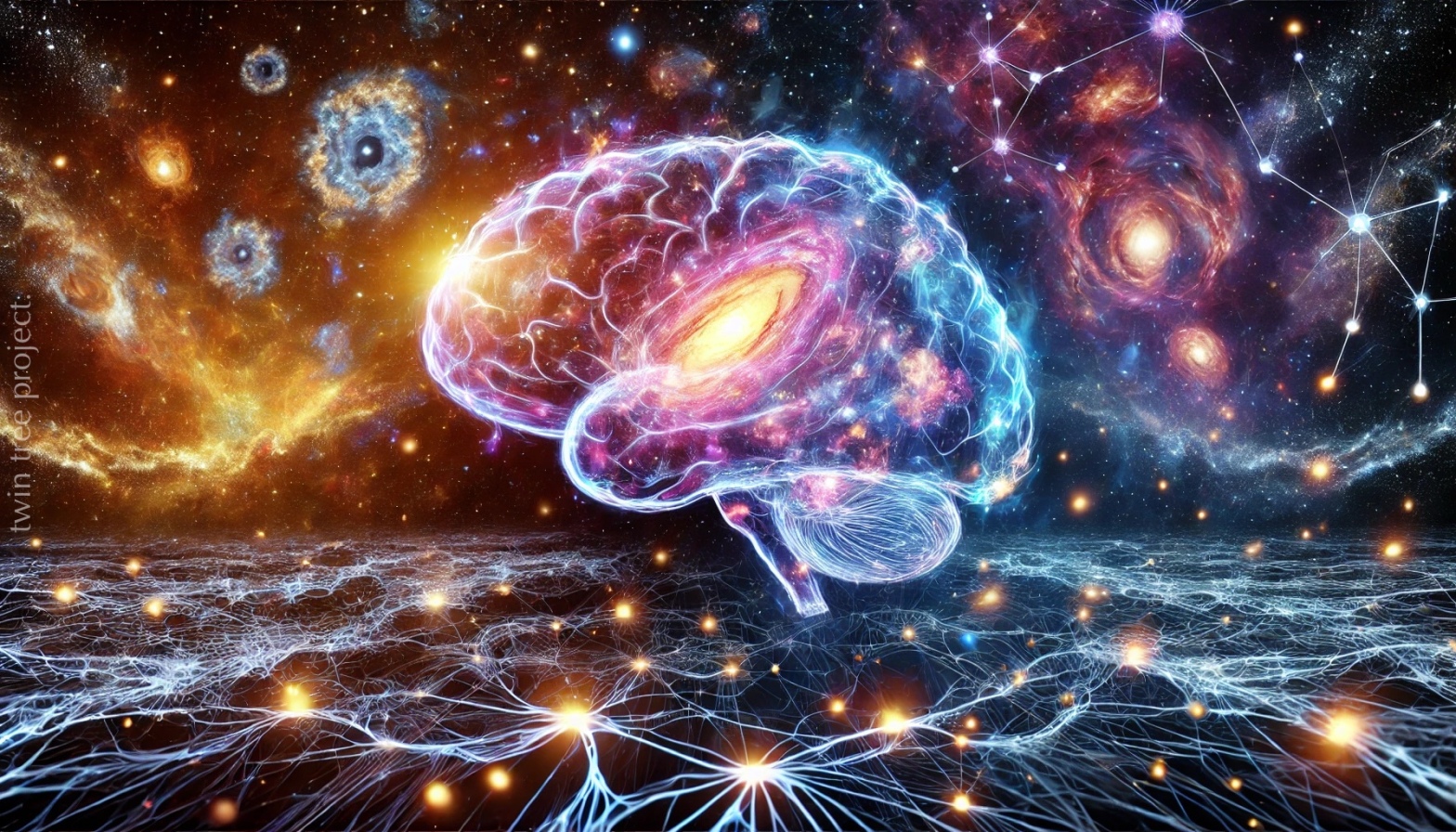
The Cognitive-Theoretic Model of the Universe (CTMU) presents a bold idea: cognition and the universe are not separate, unrelated entities. Instead, they are deeply interconnected, two facets of the same underlying process. This connection lies at the heart of the CTMU and represents its most profound purpose—to bridge the gap between how we think and the reality we inhabit.
This idea challenges conventional ways of thinking about the universe. Traditionally, we’ve been taught to see the universe as an external, objective system—something “out there” to be observed and measured. Meanwhile, cognition has been viewed as an internal, subjective phenomenon confined to the human mind. The CTMU dismantles this divide, suggesting instead that the processes of thought, perception, and reasoning are integral to the very structure of the cosmos.
In this framework, cognition isn’t just something we do—it’s a reflection of the universe’s own informational and logical structure. Our minds don’t merely exist within the universe; they participate in its ongoing creation and organization.
But what does it really mean to say cognition and the universe are linked? How do our thoughts, perceptions, and logic relate to the vastness of the cosmos? These questions form the foundation of this exploration, inviting us to rethink not just the universe, but our place within it.
Cognition as a Reflection of the Universe
In the CTMU framework, cognition isn’t just a process confined to individual minds—it’s a universal phenomenon. Our ability to perceive, reason, and understand mirrors the processes that govern the universe itself. This perspective shifts the way we think about human cognition, positioning it not as a byproduct of evolution or biology, but as a fundamental expression of the universe’s informational and logical nature.
Christopher Langan describes this connection in Introduction to the CTMU:
Cognition is not confined to the human mind but is distributed throughout reality. The universe is inherently self-referential, and human thought is a localized manifestation of its cognitive structure.
Take, for example, the way we use logic to solve problems. The principles of logic—coherence, consistency, causality—aren’t arbitrary tools invented by the human brain. They reflect the structure of reality itself. The same laws of logic that allow us to make sense of our thoughts also govern the behavior of the universe at every level, from the motion of galaxies to the interactions of subatomic particles. In this sense, logic is a bridge between the mind and the cosmos, linking human thought to the larger patterns of existence.
This interconnectedness suggests that the mind acts as a microcosm of the universe. The patterns we observe in our thinking—cause and effect, relationships, and emergent systems—are not isolated phenomena but reflections of the greater whole. Just as the universe organizes itself through principles of information and logic, our minds organize information to create meaning and structure within our subjective experience.
Even the idea of creativity, often thought of as uniquely human, can be seen as a reflection of the universe’s generative processes. The way the universe evolves and generates complexity mirrors the way the human mind creates new ideas, finds patterns, and builds systems of understanding. In this way, cognition is not separate from the universe—it’s an intrinsic part of its self-reflective nature.
By viewing cognition as a reflection of the universe, the CTMU invites us to see ourselves not as detached observers of reality, but as active participants in a deeply interconnected system. Our thoughts and reasoning are not just tools for navigating reality; they are expressions of the universe’s own cognitive processes.
Information as the Universal Bridge
One of the key principles of the CTMU is the idea that the universe is fundamentally informational. Just as cognition is built on the exchange and processing of information (our thoughts, perceptions, and memories), the universe operates on similar principles.
Information is what ties cognition and the universe together. Whether we’re talking about the way neurons transmit signals in the brain, the way DNA encodes genetic instructions, or the way quantum particles interact, the exchange of information underlies all these processes.
This perspective shifts the way we think about reality. Instead of seeing the universe as a collection of inert, physical objects, the CTMU invites us to view it as an interconnected network of information—a living, dynamic system in which cognition and the universe are inseparably intertwined.
Bridging Science, Philosophy, and Spirituality
The CTMU’s purpose isn’t just scientific—it’s deeply philosophical and even spiritual. By recognizing the unity between cognition and the universe, we can begin to see that the way we think is not separate from the larger reality we inhabit.
This idea has profound implications. It suggests that the universe is not random or meaningless but is deeply structured, meaningful, and intentional. It challenges us to rethink the role of human consciousness—not as an isolated, insignificant phenomenon, but as a key piece of the universal puzzle.
From a spiritual perspective, this unity reflects a deeper truth: that the mind and the universe are both part of a divine order. Whether we approach this idea through religious faith, philosophical inquiry, or scientific exploration, the CTMU gives us a framework to see these pursuits not as separate but as complementary ways of seeking truth.
Why This Matters
The purpose of bridging cognition and the universe isn’t just theoretical—it’s practical. By understanding how the universe and our minds are connected, we can begin to approach life with greater wisdom, humility, and purpose.
Wisdom: We can see the principles of the universe reflected in our own thought processes, helping us navigate life with a deeper understanding of cause and effect, interconnection, and balance.
Humility: Recognizing that our minds are part of a greater whole challenges us to set aside ego and approach the world with curiosity and openness.
Purpose: Knowing that we are connected to the universe gives us a sense of belonging, encouraging us to live in alignment with the principles of unity and interconnectivity.
As we continue exploring the CTMU throughout this series, we’ll delve deeper into these ideas and their implications. But for now, consider this: what if the way you think is not separate from the universe but is a reflection of it? How might that change the way you see yourself, others, and the world around you? We’d enjoy hearing your perspective!
 The Twin Tree Project
One thought on “The Purpose of CTMU: Bridging Cognition and the Universe”