We live in a world that “requires” us to perceive ourselves as separate from the systems around us, and the Cognitive Theoretical Model of the Universe (CTMU) challenges this notion at its core. It proposes something both profound and transformational: the universe itself is not only interconnected but inherently cognitive. Cognition, in this sense, is not confined to the human mind. It is instead a universal process, embedded in the structure of reality itself, forming the threads that bind existence together.
In the first week of this series, we introduced the foundational concepts of the CTMU, including its role as a bridge between logic, language, and reality. This week, we delve deeper into specific topics within the CTMU, exploring how its principles reveal the interconnected, cognitive nature of the universe. As Christopher Langan explains:
Reality is a self-processing, self-configuring language, and everything within it is an expression of this universal syntax.
The idea of interconnectivity is not new, but the CTMU frames it in a way that fundamentally changes how we understand our relationship to the universe. It suggests that everything we see, experience, and participate in is part of a single, self-configuring, and self-processing system. This is not just metaphorical; in the CTMU, it is literal. Reality, by definition, is a medium of cognition—a vast network of interlinked systems constantly exchanging information, shaping, and being shaped by one another.
Cognition Beyond the Human Mind
Cognition, traditionally understood as thought or reasoning, is often limited to the domain of humans or animals. But in the CTMU, cognition is redefined as the processing of information and the act of self-reflection within any system. This means that the laws of physics, the growth of a forest, or the interactions of subatomic particles can all be seen as cognitive processes.
Langan writes:
The universe is not only capable of understanding itself; it must do so in order to exist. This reflexive property is what binds it together.
Feedback loops, which regulate everything from weather patterns to biological homeostasis, serve as tangible examples of cognition in action. These processes adapt, respond, and recalibrate based on incoming information—mirroring the way the universe self-adjusts on a grander scale.
Philosopher Alfred North Whitehead offered a similar proposition:
…nature is a structure of evolving processes. The reality is not an external fact but a system of internal relations.
These ideas echo the CTMU’s assertion that reality is inherently cognitive and relational.
The Universe as a Cognitive Medium
What does it mean to say the universe “thinks”? In the CTMU, cognition is not restricted to conscious awareness as we experience it. Instead, cognition is the capacity to process and organize information, and the universe is the ultimate medium for this. Every atom, every interaction, and every law of nature is part of a grand, unified system of cognition.
This cognitive framework suggests that human thought is not separate from the universe but an extension of its underlying nature. “In the CTMU,” Langan explains, “mind and matter are not two distinct substances. Rather, they are different aspects of the same underlying reality—an entity that self-synthesizes through cognition.”
This challenges the traditional duality between mind and matter, revealing them as two sides of the same coin. It also underscores the significance of human cognition as a microcosm of the larger, universal process.
Interconnectivity in Action
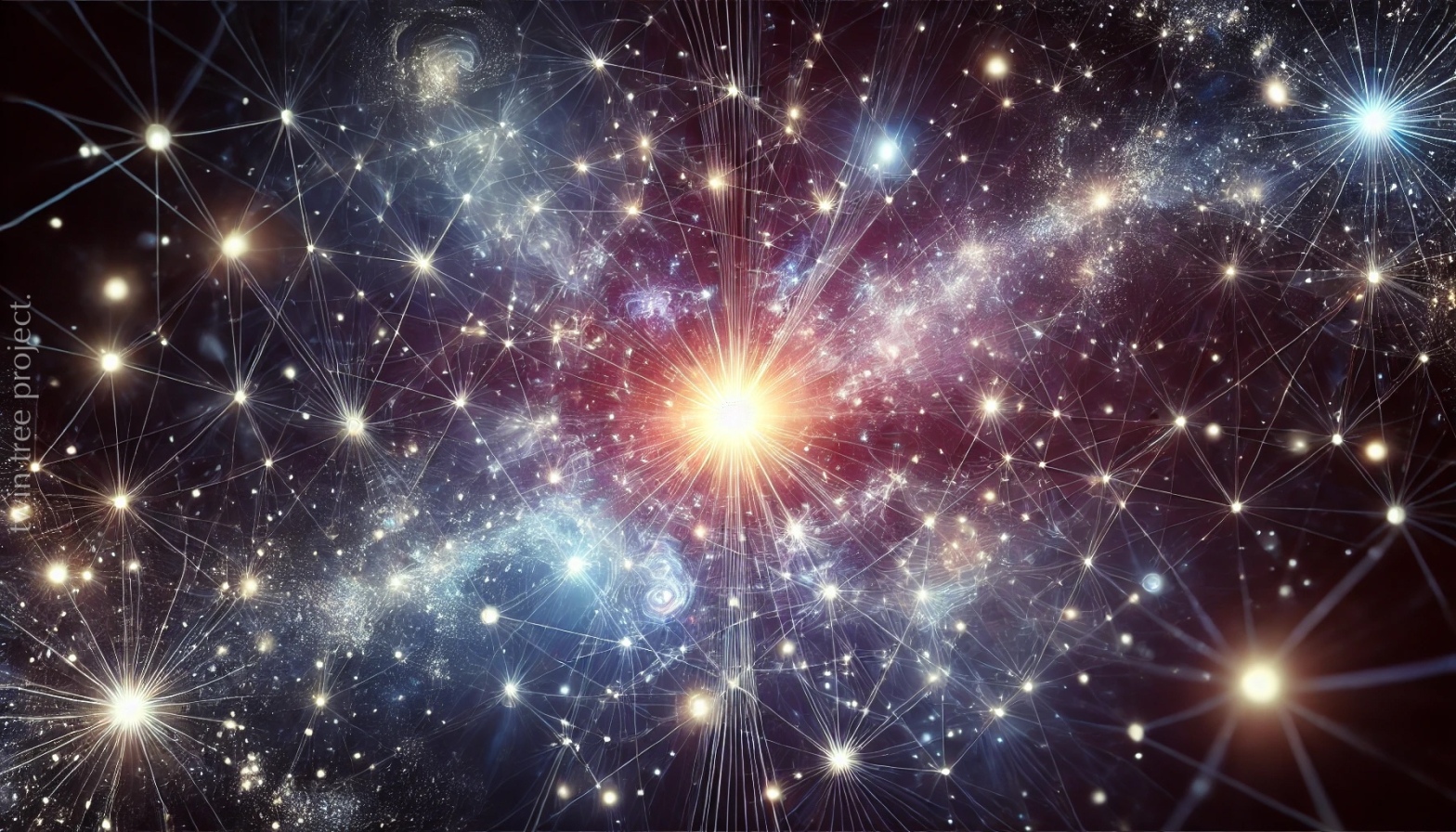
The interconnected nature of cognition means that no event or system exists in isolation. Consider the intricate web of life on Earth. Each species, ecosystem, and natural process is connected to countless others, forming a tapestry of mutual dependence. On a larger scale, the CTMU suggests that even galaxies, stars, and cosmic phenomena are part of a unified, interconnected whole—a system that not only evolves but understands itself through its parts.
As Carl Sagan once noted:
We are a way for the cosmos to know itself.
The CTMU builds on this sentiment by asserting that this knowing is not just an emergent property of life but an intrinsic quality of the universe itself.
Why This Matters
If the universe is cognitive, then we are more than passive observers of existence. We are active participants in a vast, intelligent system. This realization calls us to reflect on our role within the greater whole. How does our individual cognition contribute to the collective processes of the universe?
The CTMU doesn’t just describe reality—it invites us to engage with it in a new way. To see ourselves not as isolated beings but as vital threads in the tapestry of existence. As Langan reminds us:
Every thought, every decision, and every action resonates through the interconnected structure of reality, shaping it in ways both seen and unseen.
Perhaps the greatest takeaway is this: in a cognitive universe, everything matters. Every thought, action, and connection reverberates far beyond what we can perceive, making our role in the grand design both significant and sacred.
 The Twin Tree Project
4 thoughts on “Exploring Interconnectivity: Cognition and the Universe”