
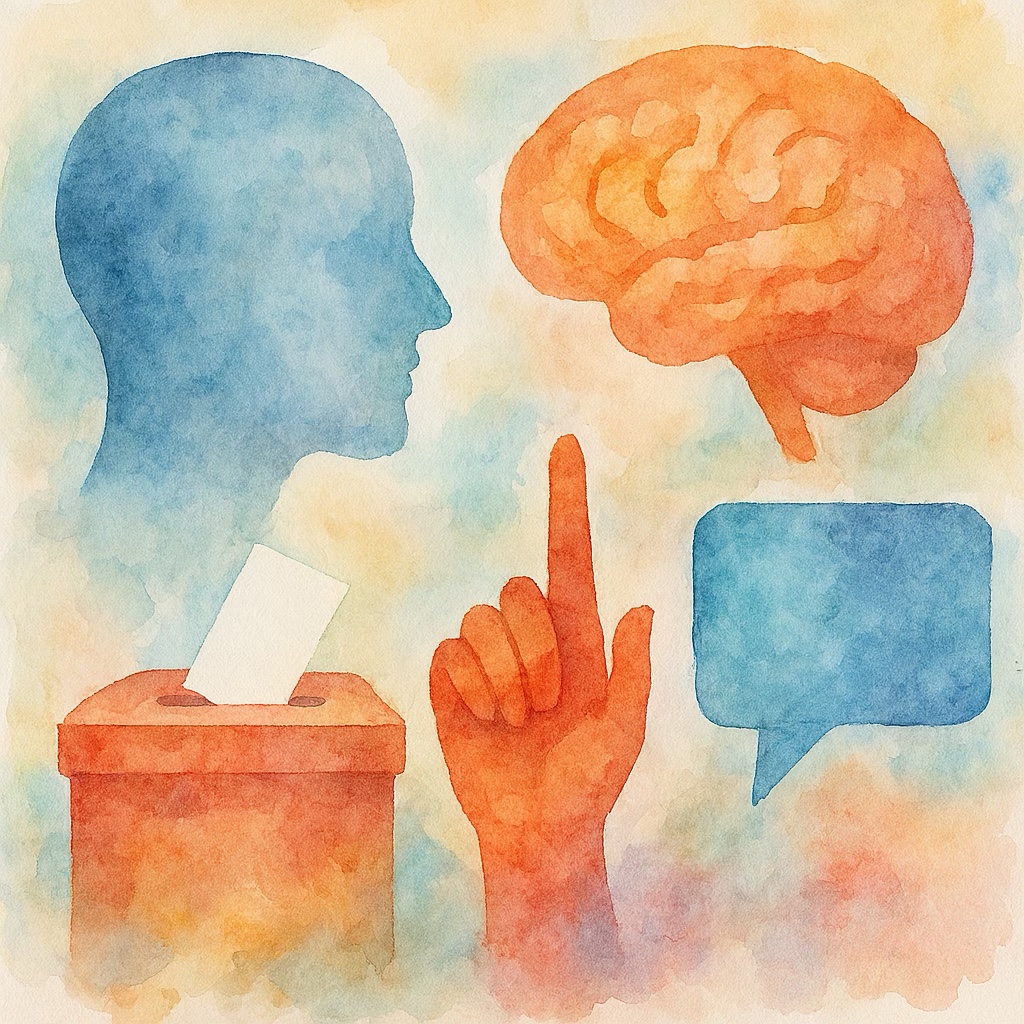
It’s been quite a while since I’ve shared a psychology-related write-up. Recently, I saw a clip of liberal commentary that prompted a realization: even many otherwise balanced, reasonable people don’t fully understand what’s happening in the psyches of those on the radical ends of the political spectrum. And this phenomenon is not confined to one side. It appears in both extreme-left and extreme-right spaces.
In our extremely heated modern political arena, it’s common to encounter behaviors that seem irrational or disproportionate, especially to moderates. That is why the clip I mentioned sparked this reflection. It featured a woman who shaved her head in protest of Donald Trump. She stated she “had to” and that she “couldn’t just let him win.” It wasn’t done for medical reasons or personal preference. It was framed as necessity. Yet it was, of course, a choice. What stood out was not the act itself, but her language. It was the sense of compulsion, as though she were forced into self-alteration by political events.
In another portion of the clip, she tearfully reminisced about videos of Barack Obama and Joe Biden, describing them both as embodiments of kindness, intelligence, and strength. “Perfect presidents.” From a more detached perspective, those descriptions clash with criticisms many hold, not to mention thin the realities, regarding their policy decisions, hypocrisy, and political outcomes. But emotionally, her reaction was not about policy. It was about loss.
As both a retired mental health professional and someone who has experienced profound personal grief, I interpret her response as a form of mourning. Under the surface, she is grieving the collapse of a perceived reality. When deeply held narratives fracture, the emotional experience can mirror bereavement, and lead to intense cognitive dissonance. What is being lost is not just a candidate or party, but a sense of safety, identity, and moral alignment. Cognitive dissonance appears as a sort of prevention of reality being reality, or flat-out denial of it.
Importantly, this reaction is not unique to “the left.” Psychological research consistently shows that these patterns are human, not partisan. That’s an important reality, in itself.
The Role of Emotion in Belief Formation
Political beliefs are rarely formed through detached rational analysis. They are shaped by emotion, usually fear, anger, hope, and/or belonging. Those in positions of power understand this well and regularly frame narratives accordingly, appealing to emotional instincts that often override analytical thought.
People do not simply think their way into ideologies. They feel their way into them. In doing so, they often fail to employ discernment or rational thought, and this is because of a lack of wisdom, not necessarily a lack of intelligence. When information challenges those feelings, the response is rarely calm reconsideration. More often, it is immediate defense.
In the example above, what we likely see is motivated reasoning, or the tendency to interpret information in ways that confirm existing beliefs while dismissing contradictory evidence. This is not clinical delusion, it’s a universal cognitive shortcut designed to preserve psychological comfort.
Cognitive dissonance plays a role as well. When conflicting ideas collide, like “my leaders are virtuous” versus “my leaders may have caused harm,” the discomfort can be intense. Resolving that discomfort often involves doubling down rather than reassessing. The experience can feel like the rug has been pulled out from under one’s worldview.
Anger, in particular, has been shown to intensify group alignment and harden attitudes. Fear can do the same, often under the banner of protection, whether that protection centers on marginalized groups, children, national identity, or cultural stability. The specific focus varies by ideology, but the psychological mechanism is strikingly similar. Beliefs become armored.
Why Facts Often Fail
Neuroscience and neuropsychology help explain why logical argument alone rarely shifts entrenched views. When core political beliefs are challenged, brain regions involved in self-referential thinking and threat detection, including the amygdala, can become more active. Rather than processing the disagreement as a neutral exchange of ideas, the brain may interpret it as a threat to identity.
When that happens, emotional centers can exert stronger influence over reasoning processes. This makes defensive reactions more likely than careful reassessment. Political identity then becomes fused with personal identity, and under those conditions, facts feel like attacks.
Traits such as cognitive inflexibility or high need for closure are not confined to any one political group. They are more pronounced in individuals drawn toward ideological extremes. Echo chambers, particularly on social media, intensify this effect. They reinforce confirmation bias and creating environments where alternative interpretations feel not just wrong, but dangerous.
Across the political spectrum, extreme behaviors emerge when individuals perceive existential threat. These can range from symbolic acts of self-harm or dramatic protest to vandalism, arson, or violence against ideological targets. Whether associated with activist movements on the left or militant expressions on the right, the underlying driver is often the same: a belief that something foundational is under attack.
Ultimately, in a broad view, this is less about collective “insanity” and more about the human stress response amplified by identity-based narratives. When defensive reactions are repeatedly reinforced, when people feel existentially threatened, and when judgment narrows under intense emotional arousal, decision-making can become increasingly unmoored from reality, sometimes with tragic consequences.
Can Minds Change?
It is tempting to conclude that logic is useless. In direct confrontation, it often is. When identity is threatened, defensive entrenchment follows. The so-called “backfire effect” was once thought to be widespread, though more recent research suggests it is less common than initially believed. Corrections can work, but only when they avoid attacking a person’s sense of self.
Change typically occurs when a person feels safe enough to separate belief from identity. That requires rapport, a an understanding of values, and curiosity rather than combat. Questions such as “What led you to that conclusion?” are far more effective than declarations of error.
In my own life, growth has rarely come from being cornered. It has come from sitting with discomfort long enough for truth to settle in without annihilating my sense of self. It is not professional training alone, but lived experience and hard-earned wisdom, that have taught me sustainable transformation is internal. It cannot be imposed through force without resistance.
Closing Thoughts
Political psychology should not be about labeling one side as abnormal. It is about recognizing shared human vulnerability. What appears as neurosis from a distance is often a protective reflex in the face of perceived chaos. Understanding this does not require abandoning discernment. It does not mean accepting harmful ideas. But it does invite patience.
We are all susceptible to bias. We are all capable of entrenchment. The next time you witness a dramatic political reaction, it may help to remember: what you are seeing is not simply “them.” It is a human nervous system bracing against perceived loss. In recognizing that shared wiring, there may be a small opening, not for surrender of truth, but for conversation strong enough to hold it.
 The Twin Tree Project