
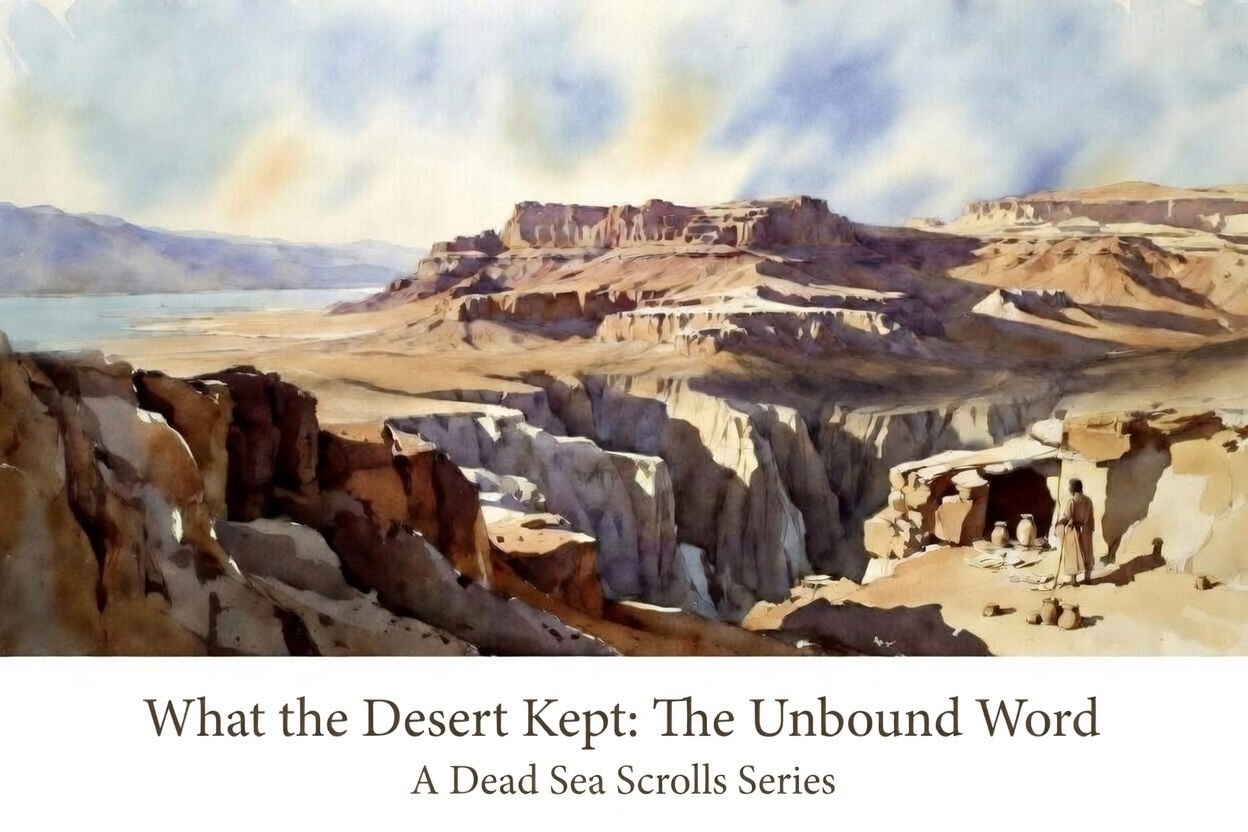
Welcome to What the Desert Kept: The Unbound Word — a six-part series taking a deep dive into the Dead Sea Scrolls. As promised in the Sunday Sessions post on Scripture, canon, and the questions the institutional church often prefers to leave unanswered, this series will explore the Scrolls in depth — their discovery, history, and the Scriptural threads they hold — from the first fragments found to current scholarship. If you haven’t read that post yet, it’s worth starting there. But if you’re already familiar and ready to go further — welcome. Let’s go.
Found in the Desert
The story begins, as so many important ones do, with an ordinary moment that had no idea what it was.
It was the spring of 1947 — possibly the winter, accounts differ slightly — when a young Bedouin shepherd named Muhammad edh-Dhib was tending his flock in the hills northwest of the Dead Sea, near a place called Khirbet Qumran. Depending on which account you read, he was searching for a lost goat, or he simply threw a rock into a cave opening out of curiosity. Either way, he heard something break.
He had no way of knowing, standing at the mouth of that cave in the Judean desert, that the sound echoing back at him would become one of the most significant moments in modern biblical scholarship. Inside that cave were tall clay jars, sealed with lids. Inside those jars, wrapped in deteriorating linen, were scrolls.
He brought them out. He didn’t know what they were. Neither did the people he first showed them to. The scrolls passed through several hands. First, a cobbler and antiquities dealer in Bethlehem named Khalil Iskander Shahin, known as Kando; then to the Syrian Orthodox Archbishop of Jerusalem, Mar Athanasius Samuel, who sensed he was holding something important but wasn’t sure what; and eventually to Professor Eleazar Sukenik of Hebrew University, who recognized their significance almost immediately.
It was Sukenik’s son, archaeologist Yigael Yadin, who would later complete what his father started — but that comes later.
What mattered in that moment was this: someone had just pulled ancient manuscripts out of a desert cave. Manuscripts that would turn out to be roughly two thousand years old. The world, slowly and then all at once, began to pay attention.
The Caves of Qumran
To understand what was found, you have to first understand where it was found — because the place itself is part of the story.
The Judean Desert is not a soft landscape. It is stark and severe, with a terrain of limestone cliffs, eroded plateaus, and deep ravines cut by ancient wadis that run dry most of the year. The air is relentless. The sun is punishing. The Dead Sea sits at its edge like a mirror laid flat against the earth — the lowest point on the planet and so saturated with salt that nothing lives in it. Its surface is a strange, heavy blue that doesn’t look entirely real. It is, in the most literal sense, a wilderness. It’s the definition of the kind of place the Bible describes when it uses that term.
And it is precisely because of this brutal, parching environment that the scrolls survived at all. The same heat and dryness that makes this landscape inhospitable to almost everything living turned out to be nearly perfect for preserving ancient organic materials sealed in clay jars for two thousand years. The desert kept them. That is not a metaphor. That is just what happened.
The cliffs lining the northwestern shore of the Dead Sea are riddled with natural caves. There are hundreds of them, carved by wind, water, and time into the pale limestone. Khirbet Qumran, the ancient ruin site, sits on a narrow marl (a soft, crumbly mix of clay and limestone) terrace between those cliffs and the sea. The community that once lived there, whoever they were, would have had those caves within walking distance. They used them, deliberately.
After Muhammad edh-Dhib’s discovery in what is now called Cave 1, the world moved slowly at first. There was no rush to descend upon the caves. Scholars were skeptical and antiquities dealers were opportunistic. But the Bedouin, who knew this terrain better than any archaeologist, kept looking.
Between 1947 and 1956, scrolls or fragments were identified in eleven of the caves in the Qumran area. Some were found by archaeologists. Many were found first by Bedouin, who were motivated not by scholarship but by the growing realization that these fragments had monetary value on the antiquities market. Because of this, there was often a quiet, unspoken race happening between the academic teams and the local tribespeople who knew every crevice of those cliffs.
Cave 1 was officially excavated in 1949 by archaeologists Roland de Vaux and Gerald Lankester Harding and it gave up seven major scrolls. Among these finds was what would become the most celebrated single manuscript discovery of the entire project: a nearly complete scroll of the book of Isaiah, dating to approximately 125 BC. We’ll come back to that scroll. It deserves its own moment.
Cave 3 produced something entirely unlike anything else found in any of the other caves — the Copper Scroll. Not parchment, not papyrus, but actual sheets of copper. The sheets were inscribed with what appears to be a list of locations where vast quantities of gold, silver, and sacred items are hidden. Whether those locations are literal or symbolic remains one of the enduring mysteries of the entire Scrolls project.
But Cave 4, which was discovered in 1952 and carved directly into the marl terrace just meters from the Qumran ruins, was where the full weight of the discovery became undeniable. Bedouin found it first, and by the time archaeologists arrived, fragments were already moving through the antiquities market. What remained, though, was staggering.
There were approximately fifteen thousand fragments, representing roughly nine hundred separate manuscripts. Nearly every book of the Hebrew Old Testament was present. Sectarian texts, commentaries, hymns, community documents. Cave 4 alone reshaped what scholars thought they knew about Second Temple Judaism. It was that significant.
Cave 11, the last of the significant finds, surfaced in 1956 and yielded the Temple Scroll. This scroll was the longest of all the Dead Sea Scrolls at nearly twenty-eight feet when unrolled. Alongside it was a Psalms scroll that contained additional psalms not found in the canonical Psalter.
Eleven caves. Roughly nine hundred manuscripts. Fragments numbering in the tens of thousands. And sitting in the middle of all of it, those ruins at Khirbet Qumran. They were silent, excavated, still asking questions.
What Was Hidden
Nine hundred manuscripts sounds like an abstraction until you start asking what they actually were. The simplest answer is that they were a library. Not a random collection of scattered documents, but what appears to have been a deliberately preserved body of texts — biblical, communal, and otherwise — representing the full breadth of Jewish religious life in the Second Temple period. The world of the Hebrew Bible. The world into which Jesus was born.
The biblical manuscripts alone were staggering. Represented among the fragments were portions of every book of the Hebrew Old Testament except Esther. Some books appeared in multiple copies. Psalms was present in roughly thirty-six, Deuteronomy in around thirty-three, Isaiah in approximately twenty-two. These manuscripts predated anything scholars had previously worked from by nearly a thousand years.
Alongside the biblical documents were sectarian documents. These were the internal literature of the community itself. The Community Rule laid out how members lived, how they were initiated, how they were disciplined, and what they believed.
The War Scroll described an apocalyptic battle between the Sons of Light and the Sons of Darkness playing out across forty years. The Thanksgiving Hymns read like personal psalms; they were deeply felt, spiritually raw, and possibly written by the community’s own Teacher of Righteousness. The Damascus Document, remarkably, had actually surfaced once before in a Cairo synagogue in 1896, decades before anyone knew Qumran existed.
And then there were the texts that fell outside any recognized canon entirely. Portions of 1 Enoch, the same text quoted directly in the New Testament book of Jude. The book of Jubilees. Tobit. Texts that some early communities treated as scripture and others didn’t, preserved here in the desert alongside everything else.
Taken together, what the collection reveals is that the Judaism of the Second Temple period was not a monolith. It was alive, debating, diverse. These were communities wrestling with Scripture, with purity, with apocalyptic expectation, with what faithfulness actually required. The Qumran community, whoever they were, preserved all of it. Apparently they thought it was worth keeping.
The Research and The Reckoning
Finding the scrolls was one thing. Getting them into the hands of the broader scholarly world was another matter entirely, and that part of the story is considerably less romantic.
After the initial discoveries, a small international team of scholars was assembled under the direction of Roland de Vaux, a Dominican priest and archaeologist based at the École Biblique et Archéologique Française in East Jerusalem. They were given exclusive access to the Cave 4 fragments — the largest and most significant cache of all. The team was small, progress was slow, and access was tightly controlled.
For decades, most of the unpublished scrolls existed in a kind of scholarly limbo: known to exist, impossible to study, held by a handful of researchers who were, by most accounts, simply overwhelmed by the scale of what they were sitting on. By the 1970s and 1980s, frustration in the wider academic community had reached a boiling point. Scholars who weren’t on the team had no access to the original fragments or even to photographs.
Decades had passed, and rumors filled the vacuum. Were texts being suppressed? Was the predominantly Catholic team concealing something that undermined Christian doctrine?
The accusations ranged from reasonable concern to full-blown conspiracy, and the lack of transparency made it nearly impossible to separate one from the other. Hershel Shanks, founder of the Biblical Archaeology Review, became the loudest and most persistent voice demanding open access throughout the 1980s. He wasn’t alone, but he was relentless.
The dam broke in 1991 — twice, almost simultaneously.
The Huntington Library in San Marino, California announced that it possessed a complete set of photographs of all the scrolls and would make them available to any qualified scholar who requested them, regardless of what the official team said. Around the same time, scholars Martin Abegg and Ben Zion Wacholder used a computerized concordance that had been quietly circulating to reconstruct previously unpublished texts.
The monopoly was over. The Israeli Antiquities Authority, which had taken jurisdiction over the scrolls after 1967, followed by opening access to all qualified researchers. What came next was the slow, meticulous work of full publication.
The Discoveries in the Judaean Desert series — forty volumes in total, with Emanuel Tov serving as chief editor — eventually brought the complete collection into print. The Leon Levy Dead Sea Scrolls Digital Library later made high-resolution images of the scrolls available online, accessible to anyone with an internet connection.
There is, however, a postscript to this part of the story… and it’s an uncomfortable one. Beginning around 2002, fragments began appearing on the private antiquities market, and several institutions purchased them believing them to be genuine. Among them was the Museum of the Bible in Washington D.C., which acquired sixteen fragments. In 2020, after forensic testing, all sixteen were confirmed to be modern forgeries.
The investigation into how they were produced and who produced them is ongoing. This is a reminder that where there is something people believe to be sacred and significant, there will always be someone willing to exploit that belief. The scrolls were no exception.
The Community at the Edge of the Desert
The scrolls didn’t hide themselves. Someone carried them into those caves, sealed them in jars, and left them there. The question of who and why is one scholars have been wrestling with since the beginning. While there is a dominant answer, it is not the only one.
The site at Khirbet Qumran, when excavated, revealed the remains of a communal settlement. There was a large cistern system consistent with ritual bathing practices, and a room identified by many scholars as a scriptorium. It was a writing room, complete with inkwells and the remnants of what may have been tables.
There was a communal dining hall. A pottery workshop that produced the same style of jars found in the caves. Animal bone deposits suggesting communal meals. It was, by all appearances, the infrastructure of a deliberately organized religious community, and most scholars believe that community was Essene.
The Essenes were a Jewish sect well documented in ancient sources. The historian Josephus wrote about them at length, as did Pliny the Elder and the Jewish philosopher Philo of Alexandria. They were known for communal living, strict ritual purity, intense scriptural study, an apocalyptic worldview, and a deep antagonism toward the Jerusalem Temple establishment, which they considered corrupt. The Community Rule, found in Cave 1, aligns remarkably closely with what these ancient sources describe.
Their theology was stark and serious. They believed themselves to be the Sons of Light (the true Israel) set apart from a corrupt world and waiting for an imminent end-time reckoning. They had a founding or central figure referred to in the texts only as the Teacher of Righteousness, whose identity remains unknown, and an opponent — the Wicked Priest — likely one of the Hasmonean high priests of Jerusalem.
They studied Scripture obsessively, wrote commentaries interpreting biblical texts as speaking directly to their own situation, and lived by a code of discipline that left little room for ambiguity. They also, apparently, kept everything.
What makes the Qumran library remarkable is not just its age but its breadth. It contained biblical texts, community documents, and extra-canonical writings, all preserved together. This was not an accidental archive. Someone decided all of it was worth keeping.
And then, around 68 AD, the Romans came. The First Jewish-Roman War had begun in 66 AD, and by 68 AD Roman forces were moving through the region. The community at Qumran apparently saw what was coming. Archaeological evidence suggests the settlement was abandoned hurriedly, and the scrolls were sealed in jars and carried into the caves of the surrounding cliffs.
Whether the community members survived, fled, or were killed, the scrolls did not come back out with them. They stayed in those caves, undisturbed, for nearly nineteen hundred years.
Nineteen hundred years, sealed in jars in a desert, while empires rose and fell, while the canon of Scripture was debated and settled, while the Reformation reshaped Christianity, while the modern world took shape — those jars sat in those caves in the dark, holding what someone had thought worth saving.
Until a shepherd threw a rock.
Coming Up in Part Two
As I bring this first installment to a close, you have the history: the desert, the caves, the jars, the scholars, the decades of locked doors and then the breaking open of them. I’ve shared with you, based on everything I’ve read and studied, the story of what was found and how long it took the world to reckon with it.
But for most of us, history doesn’t arrive as “history.” It arrives through people. Through a conversation, a book left on a shelf, a question someone asked that never quite let you go. So, in Part Two, I want to tell you about my father.
He first encountered the Dead Sea Scrolls as a young man studying at Bible college in Tennessee in the early 1970s, long before they were widely discussed, and long before the documentaries and the digital libraries and the public debate. He carried those questions with him for the rest of his life.
When my father died in 2015, he left behind journals and books that I’ve been slowly working through ever since. The scrolls didn’t arrive for me out of the desert. They arrived through him. That’s where we’re going next, and I’m glad you’re coming along for it.
If this post stirred something for you, drop it in the comments. I’d love to know what questions it raised, what you already knew, or what surprised you. See you in Part Two.
 Twin Tree Project