Spirit was on one this morning.
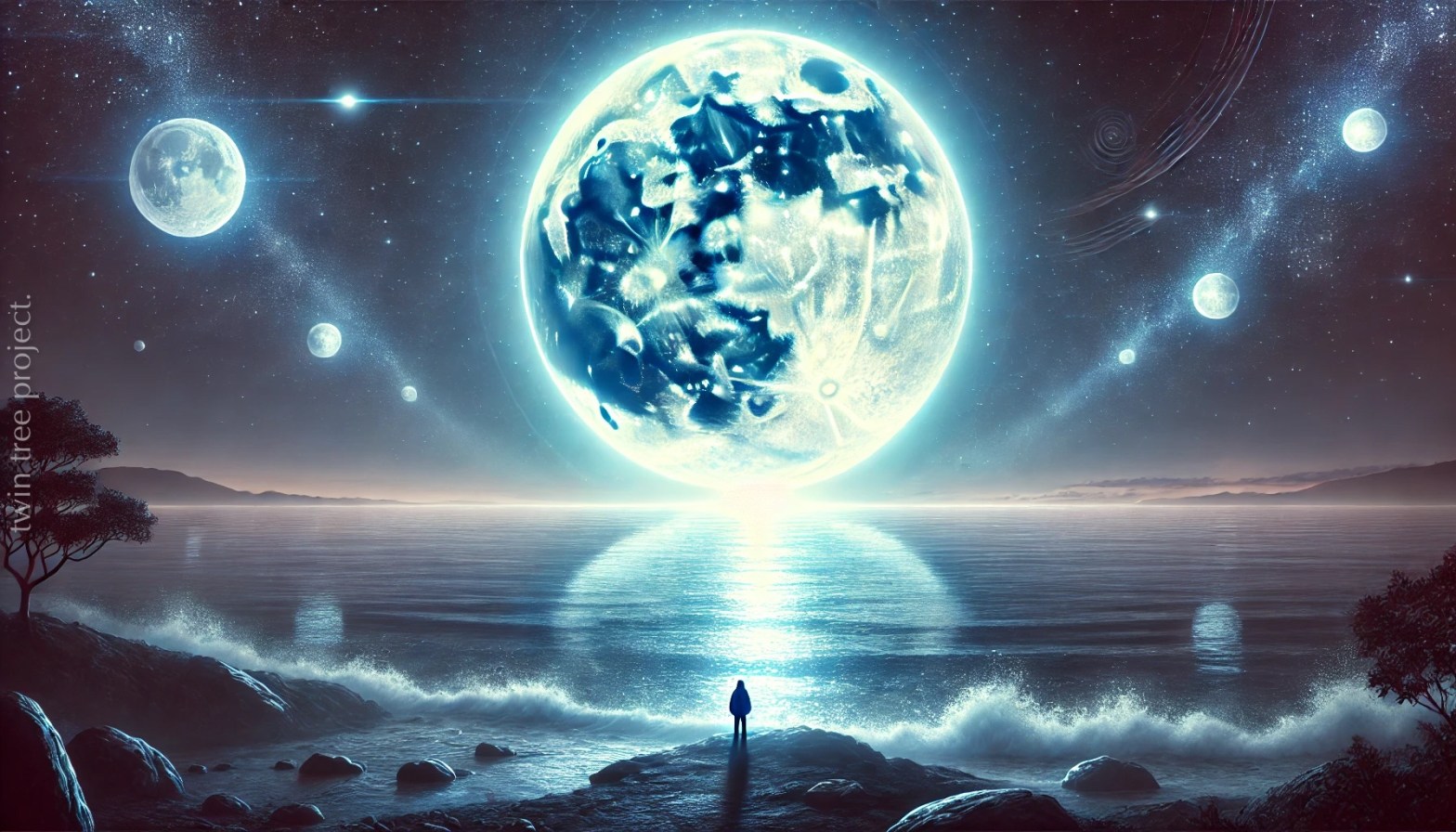
I kept running into sign after sign, message after message, all tying into the moon—not just its quiet beauty in the night sky, but its deep, undeniable influence on the world. During breaks from working on some big projects around the house (which completely knocked the energy out of me), I found myself drawn into reading about the moon. The more I read, the more it felt like something was pulling me toward this reflection.
I’ve always loved the moon. It was something special between my dad and me. He had been fascinated with it since childhood, captivated by the Apollo missions and astronauts who walked its surface. That awe never left him, and he made sure to pass it down to me. Whether from a scientific perspective—the gravitational effects we learn about in school—or the pure, simple magic of a full moon hanging bright in the sky, we all have some connection to it.
We know about the tides, of course. But did you know the moon’s gravitational pull subtly stretches the entire Earth? Not just the oceans, but the very crust of our planet flexes and bends under its influence. The Earth itself breathes in response to the moon’s pull, a tiny but measurable shift.
It doesn’t stop there. The moon affects everything in cycles. Studies show it plays a role in animal behavior—coral reefs spawn in sync with the full moon, and some predators hunt more actively in its light. Even plants seem to follow lunar rhythms, with certain crops growing best when planted under specific moon phases.
So when people say, “Blame it on the moon,” maybe they’re onto something.
It’s easy to dismiss this as poetic thinking, but for once, ancient wisdom and modern science—from the dawn of recorded history and mystical traditions to today’s scientists, ER doctors, and nurses—are in agreement: the moon affects more than just the physical world. It stirs the waters, and we are mostly water. It shifts the tides, and perhaps, it shifts something in us, too.
The Moon in Ancient Wisdom
For as long as humans have looked up at the sky, we have known that the moon is more than just a rock floating above us. It has been a symbol of mystery, intuition, cycles, and transformation in nearly every culture.
In the Bible, the moon isn’t just mentioned as a celestial body—it’s described as a sign:
Then God said, ‘Let there be lights in the vault of the sky to separate the day from the night, and let them serve as signs to mark sacred times, and days, and years.’ Genesis 1:14
From the beginning, scripture acknowledges that the moon is more than decoration. It’s a marker of time, seasons, and spiritual cycles. Psalm 104:19 reinforces this:
He made the moon to mark the seasons; the sun knows its time for setting.
Ancient Jewish festivals followed the lunar calendar, aligning sacred moments with its cycles. The moon was a divine timekeeper, a way for people to align themselves with God’s rhythms.
And this isn’t just a biblical concept. Many cultures recognized the moon’s connection to human emotion and spirituality.
• The word lunatic comes from luna, Latin for moon—reflecting the belief that full moons triggered madness and heightened emotions.
• In Greek mythology, the moon was tied to Artemis, the goddess of the wild, symbolizing raw instinct and untamed forces.
• In Hinduism, Chandra (the moon) governs the mind, emotions, and perception, reflecting the waxing and waning of human consciousness.
• Chinese medicine associates the moon with yin energy—passive, introspective, and deeply connected to intuition.
For centuries, people have felt the pull of the moon on their bodies and souls. But is it just superstition, or is there something real behind it?
The Science Behind the Superstition
Modern science won’t tell you that the moon made you emotional last night. But what it will tell you is that the moon’s influence on Earth is undeniable—so why wouldn’t it affect us, too?
The human body is roughly 60% water. If the moon can move entire oceans, isn’t it reasonable to wonder whether it stirs something in us as well?
While studies on the full moon’s effects on human behavior have been inconclusive, certain patterns keep surfacing:
• Some hospitals and police departments report higher rates of emergency cases and crime during full moons.
• Sleep studies suggest that people have more restless nights around the full moon, taking longer to fall asleep and experiencing lighter sleep cycles.
• Even animals react—some species of fish and birds adjust their behaviors in response to the moon’s brightness.
Why would this be? One theory is evolutionary: for most of human history, full moons meant brighter nights—when predators could see better, and sleep might have been harder. Another theory suggests the moon influences melatonin, the hormone that regulates sleep, subtly shifting our internal rhythms.
And then there’s psychology. Just knowing there’s a full moon can influence behavior. Expectation shapes experience. The moon, then, becomes a self-fulfilling prophecy.
The Moon as a Mirror
But maybe the most powerful way to understand the moon isn’t scientific—it’s symbolic.
The moon doesn’t generate its own light. It reflects the sun.
In a spiritual sense, it is a mirror—just as our emotions, thoughts, and subconscious selves reflect deeper truths within us. The moon reminds us that sometimes, our light is borrowed. We shine not because of our own strength, but because we reflect something greater.
The moon is also a symbol of cycles—of waxing and waning, of fullness and emptiness. It reminds us that there are seasons to all things. Just because something is hidden now doesn’t mean it’s gone forever.
To everything there is a season, and a time for every purpose under heaven. Ecclesiastes 3:1
We are not static beings. We shift, we change, we move through phases—just like the moon.
So maybe the real lesson isn’t to blame the moon, but to listen to what it’s reflecting back to us.
Personal Responsibility vs. Cosmic Influence
At the end of the day, we are responsible for our own choices. The moon may stir the waters, but we decide how to navigate the tide.
Philosophers from the Stoics to modern psychologists have emphasized that while external forces influence us, our true power lies in how we respond. Marcus Aurelius put it best:
You have power over your mind—not outside events. Realize this, and you will find strength.
So even if the moon does make us feel more emotional or restless, we still have a choice in how we handle it. Do we react impulsively, or do we pause, reflect, and realign ourselves?
A Cosmic Perspective
At the end of the day, the moon is a reminder: we are part of something vast and interconnected. Its pull on the Earth is subtle but constant—just like the unseen forces shaping our lives.
Maybe we don’t need to blame it on the moon. But we can certainly pay attention to what it reveals.
So if you’ve been feeling off lately, check the moon phase. Not as an excuse, but as an invitation—to reflect, to observe, and to remember:
Just like the moon, you are always moving through phases.
And just like the tides, you are always being pulled toward something greater.
 Twin Tree Project
Checking in…to say hello. Reaching out across the distance. My prayers to you.
LikeLiked by 1 person
❤️💜 Thank you. I need and welcome them! And, my prayers to you, as well. Stiyu, friend. 🙏🏼
LikeLike