
There’s a term from developmental biology that stuck with me the first time I heard it:
chreode.
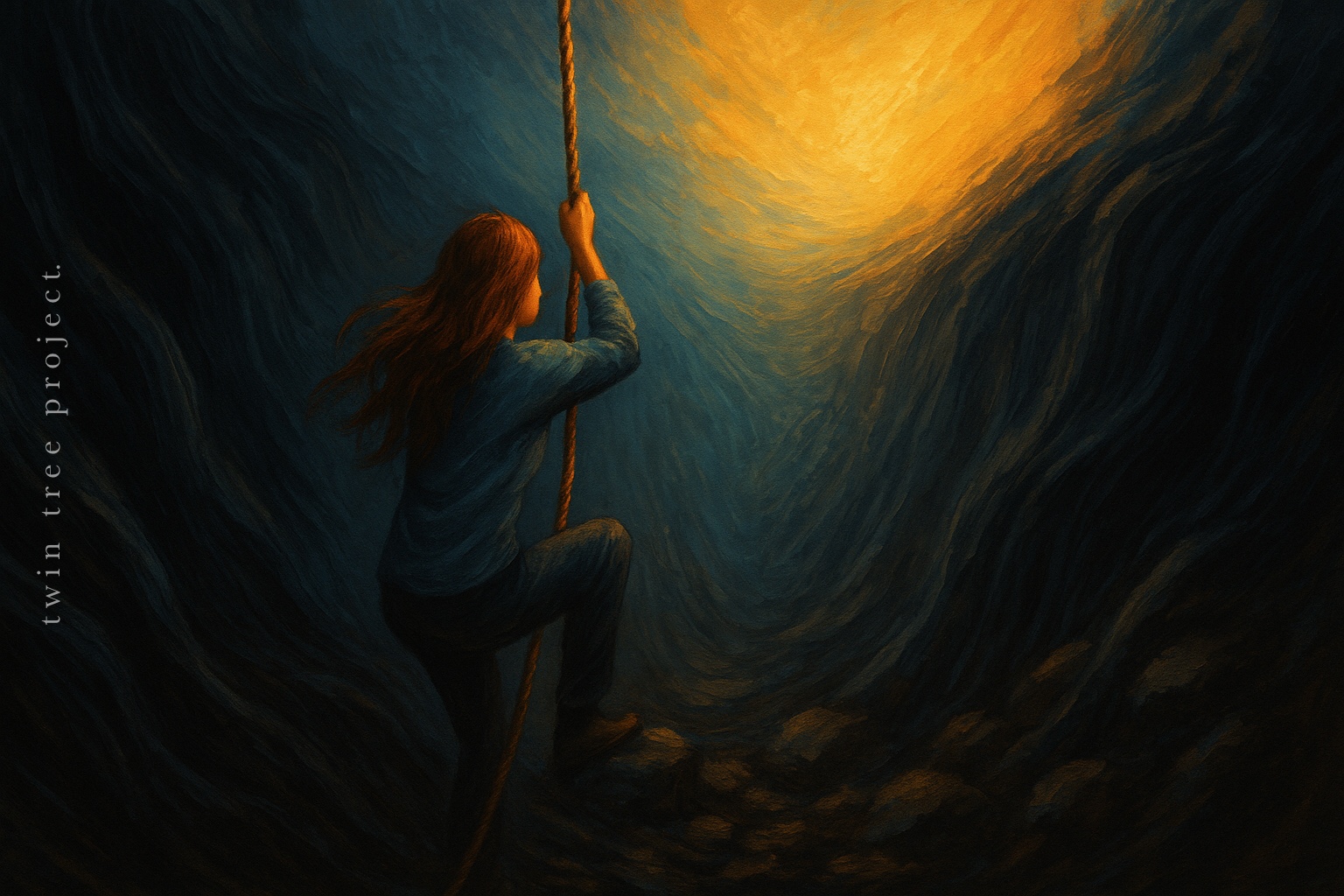
It describes a kind of groove—a well-worn path of least resistance that cells tend to follow during development. Once they start down that track, the path becomes harder to exit. It shapes them. Defines them. Holds them in a kind of patterned gravity.
I didn’t hear the word until years after I’d lived inside my own grooves. But once I understood what it meant, something in me clicked. Because I recognized the pattern immediately. Not in my biology, but in my life.
I’ve lived in more than one chreode.
Grief was the first one that carved itself deep into my being. It started slow—one loss, then another—but over time it became a current I couldn’t swim against. When people say “grief changes you,” they usually mean it makes you sadder, maybe softer. But sometimes it just makes you heavier.
Sometimes, it turns the air into molasses. It makes moving forward feel like a betrayal of what you’ve lost. And if you’re not careful, that heaviness can become home. You stop climbing. You stop questioning the path you’re in. You just let yourself slide.
It was in trying to climb out of the grief chreode that I fell straight into another: the emotional trap of an unhealthy, consuming friendship. What started as connection became entanglement. It mimicked intimacy but created dependence. The lines between compassion, loyalty and survival blurred so subtly, so sweetly and invitingly, that I mistook my own unraveling for transformation.
That chreode wasn’t about affection—it was about abandonment wounds, trauma responses, power imbalances, and the very human longing to feel known and understood. It felt like purpose for a while. Like escape. But it wasn’t. It was just another groove—deep, familiar, and quietly destructive.
I didn’t see how far I’d slipped until it started to cost me parts of myself I couldn’t afford to lose. And somewhere in the middle of all of it, another chreode formed: one shaped by alcohol. Not in the way people think, not in the reckless or indulgent way—it was more subtle than that. More sad than wild.
I wasn’t chasing highs; I was chasing silence. I wasn’t trying to numb everything—I just wanted the noise to stop. The overthinking. The replays. The ache of the memories—of everyone who had died, of everything unsaid, unresolved, and unfinished.
That’s the dangerous part of these grooves: they don’t always start out as choices. Sometimes, they feel like lifelines. But the thing about grooves is that staying in them long enough will convince you they’re the only road left. That this is just who you are now. That healing is for people who didn’t mess up like you did. That it’s too late, or too complicated, or too hard to begin again.
That’s when grace found me.
I didn’t claw my way out of those chreodes by force of will. I didn’t wake up one day healed or strong or wise. I simply got tired. And in that tiredness, I started whispering the kind of prayers that don’t always use words. The kind that are just a quiet, “please help me,” in the dark. The kind that feel like giving up, but are actually a form of surrender.
For me, it was God who met me there. Not with judgment. Not with punishment. Just presence.
Some people call it self-love. Some call it higher power. Some call it recovery. I just call it mercy.
God didn’t lift me out of the groove all at once. But He handed me a rope I hadn’t seen before. Slowly—painfully, clumsily, and somehow beautifully—I began to climb. The words of the verses below, whispered and repeated more times than I can count, became a kind of invisible force field around me. They embodied the steady presence of my new friend—Christ himself.
These words didn’t erase the struggle, but they carried me through it, one word at a time:
He drew me up from the pit of destruction, out of the miry bog, and set my feet upon a rock, making my steps secure. (Psalm 40:2)
And lead us not into temptation, but deliver us from evil: For thine is the kingdom, and the power, and the glory, for ever. Amen. (Matthew 6:13)
So now there is no condemnation for those who belong to Christ Jesus. And because you belong to him, the power of the life-giving Spirit has freed you from the power of sin that leads to death. (Romans 8:1–2)
There’s a shape to escape.
Sometimes it looks like pouring a glass of water instead of the spirits that used to help you disappear.
Sometimes it sounds like a trembling, whispered “goodbye”—the kind you never wanted to say, but somehow found the strength to speak aloud.
Sometimes it feels like crying quietly—internally, whenever it hits you—over what almost destroyed you instead of sobbing loudly in the dark; not because it still holds power but because you finally let the dead rest in peace.
I don’t claim to be perfect. I don’t claim to be fully above the gravity of those old grooves. They still echo sometimes, especially when I’m tired or raw or doubting. But I’ve seen enough distance now to know I’m no longer living in them. I’ve stepped out far enough to look back and say:
“I remember who I was there. I remember why I stayed. But I don’t live there anymore.”
If you’re reading this and feel like you’re stuck in something—whether it’s a pattern, a habit, a relationship, or just a story you can’t seem to rewrite—I want you to know this:
There is a way out. There is life beyond the groove. And you are not too far gone. You’re not broken. You’re not weak. You’re not beyond healing.
You’re just in a pattern that has held you for too long. But patterns can be broken. Grooves can be climbed. And escape—true, sacred, healing escape—is not only possible…
It’s holy.
I’m living proof.
Forget the former things; do not dwell on the past. See, I am doing a new thing! Now it springs up; do you not perceive it? I am making a way in the wilderness and streams in the wasteland. (Isaiah 43:18–19)
 The Twin Tree Project