
Verse of the Day – June 5, 2026
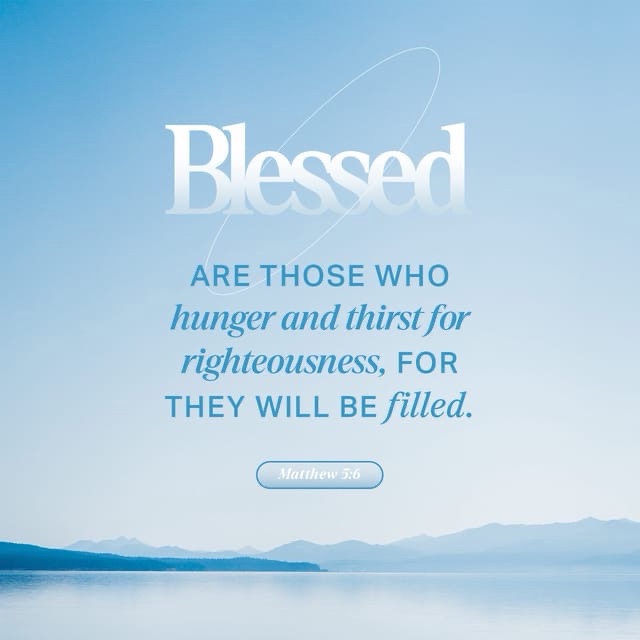
Blessed are those who hunger and thirst for righteousness, for they will be filled. — Matthew 5:6
What’s Happening Here
Four beatitudes in, and the portrait Jesus is painting has a coherence to it that is easy to miss if you read each line in isolation. The poor in spirit know they have nothing. The mourning have stopped pretending that what is broken is not broken. The meek have surrendered their strength to a higher hand. Now we meet the ones who are hungry. Desperately, urgently, physically hungry – and thirsty too – for something the world around them cannot supply.
Jesus is not describing a mild preference for good things. He is describing a person in whom the longing for righteousness has become as visceral and non-negotiable as the body’s need for food and water. The kind of hunger that crowds out distraction. The kind of thirst that makes everything else secondary until it is met.
He calls them blessed. He promises they will be filled.
The Word
Peinōntes, “those who hunger,” and dipsōntes, “those who thirst,” are both present participles. Ongoing. Active. These are not people who once wanted righteousness and found it and moved on. They are people currently in the state of wanting it with everything they have.
In first-century Palestine, hunger and thirst were not comfortable metaphors. They were daily realities for most of the people on that hillside. When Jesus reaches for these images, His listeners do not think of a skipped breakfast. They think of the gnawing, weakening, consuming urgency of a body that needs what it does not have. He is saying: blessed is the person whose longing for righteousness feels like that.
Dikaiosynēn, “righteousness,” is one of the most important words in Matthew’s Gospel and one of the richest. It carries two inseparable dimensions. The first is personal – right standing before God, the interior condition of a life aligned with His character and will. The second is outward – justice, rightness, the ordering of human life and community the way God intends. Matthew does not let you choose one and ignore the other. The hunger Jesus describes is for both: to be right with God and to see things made right in the world.
Chortasthēsontai, “will be filled,” is the same word used when Jesus fed the five thousand and the four thousand. Everyone ate. Everyone was satisfied. No one left the hillside still hungry. The filling He promises here is not partial or provisional. It is complete. The longing will be met in full.
The World Then
The word dikaiosynē would have carried immediate resonance for a Jewish audience steeped in the prophets. Isaiah, Amos, Micah – the whole prophetic tradition was saturated with the call for righteousness and justice as the twin marks of a people faithful to their covenant God. The prophets wept and thundered precisely because they could see the gap between what God required and what Israel was actually doing. Their longing for righteousness was not abstract. It was grief made into proclamation.
Psalm 42 captures the interior dimension of this hunger as well as anything in Scripture. As the deer pants for streams of water, so my soul pants for you, my God. My soul thirsts for God, for the living God. The psalmist is not describing a theological position. He is describing an ache. A need so deep it has taken over the whole person.
Jesus stands in that long tradition and declares the people living in that ache to be the blessed ones – not because the ache is pleasant, but because it is pointed in the right direction. And because the One they are hungry for has come to fill them.
An Echo in History
Augustine of Hippo spent the first thirty-two years of his life trying to fill the hunger in him with everything other than God. Intellectual achievement, sexual pleasure, philosophical systems, social ambition – he moved through them all with real commitment and came away still empty. His Confessions, written around 397 AD, is the most honest account in Christian literature of what it looks like to hunger for righteousness and spend years feeding on everything else first.
The line that has echoed for sixteen centuries opens the book:
You have made us for yourself, O Lord, and our heart is restless until it rests in you.
He did not write that from a place of easy certainty. He wrote it from the other side of a very long, very costly hunger – a hunger he had denied, misdirected, and finally surrendered to. When the filling came, it came completely. What poured out of him afterward fed the church for centuries.
The hunger, it turned out, was never the problem. It was always pointing somewhere true.
The Living Edge
There is a kind of Christianity that has made peace with low-grade spiritual hunger. It says that enough church attendance, enough familiar language, and enough comfortable belonging to keep the restlessness quiet without ever actually being filled is full enough. It is not hostile to God. It is just not particularly desperate for Him either. The thermostat is set to lukewarm and nobody is turning it up.
Jesus is not describing those people as blessed. He is describing the ones who cannot settle. The ones in whom the longing for righteousness – for God, for justice, for things to be made right – has become too loud to manage and too real to politely set aside. The ones who pray like they mean it because they do. The ones who cannot look at what is broken in themselves or in the world and simply move on, because the hunger will not let them.
That kind of hunger is not comfortable to live with. It is also not something to try to quiet. It is the thing Jesus calls blessed. It is the appetite He promises to satisfy.
The person who is full of themselves has no room. The person who is empty and knows it, hungry and will not pretend otherwise, desperate enough to keep asking – that person gets filled.
A Closing Thought
The hunger is not the problem. It is the evidence that you were made for something real, and you have not stopped believing it exists.
Keep wanting it. He said you would be filled.
 Twin Tree Project