
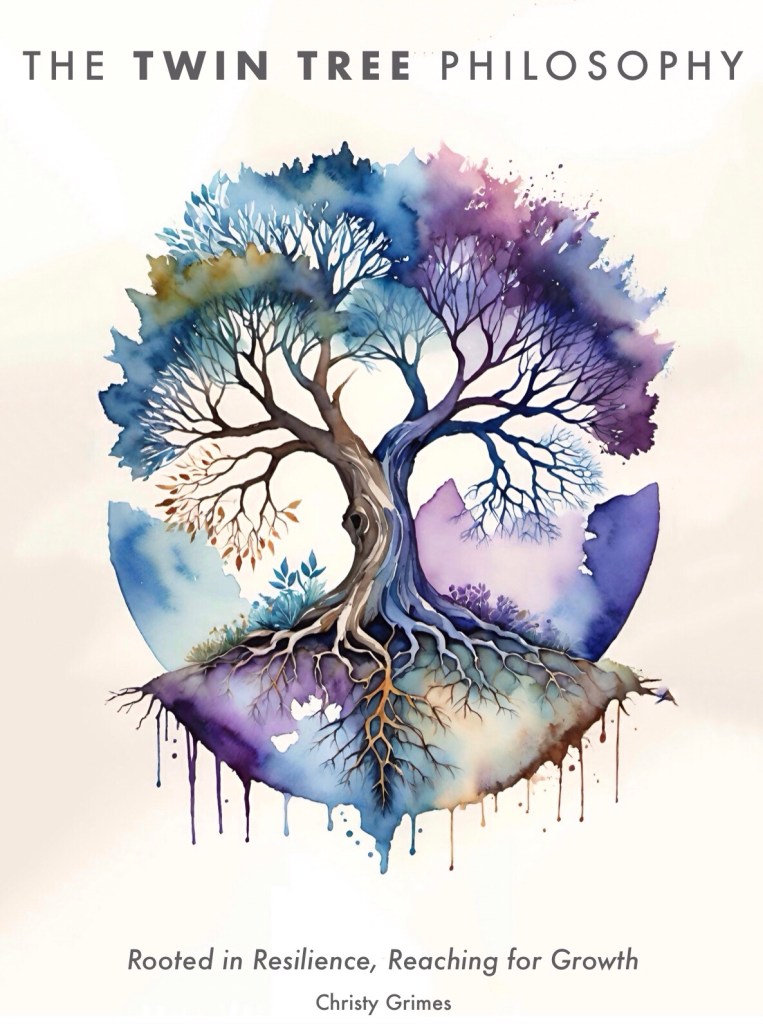
I’m so excited to announce the release of my book, The Twin Tree Philosophy!
This book is the culmination of a deeply personal journey—a philosophy born out of both profound loss and transformative growth. The Twin Tree Philosophy invites readers to find balance between resilience and vulnerability, stability and growth. It’s about living deeply rooted in our values and experiences while always daring to reach toward new possibilities.
To celebrate its release, I’m offering the book as a free download! You can get your copy by clicking the link below.
But first, I want to share a sneak peek of what’s inside. Below is the prologue, Rooted Yet Reaching. It captures the heart of this philosophy and the journey that inspired the book. I hope it resonates with you.
Prologue: Rooted Yet Reaching
The seed for Twin Tree Philosophy was planted during one of the most difficult decades of my life—a time of relentless loss and profound transformation. Over those years, I experienced the passing of nearly everyone who had been my anchor: my father, my best friend, my mother, and other cherished loved ones. These losses came one after another, each wave leaving me more unmoored and searching for a way to steady myself.
The journey began with my father’s unexpected health challenges. At the time, I was still young—filled with curiosity and ambition but unprepared for the depth of pain that lay ahead. His illness was the first crack in the foundation of my carefully constructed life, and when he passed, my world shifted irrevocably. That loss marked the beginning of a decade of caregiving, heartbreak, and soul-deep grief. Yet, amidst the chaos and sorrow, something profound began to take root.
Through these experiences, I found myself searching for a way to reconcile the weight of grief with the need for growth. Life was calling me to be both grounded and expansive, to hold on and let go, to honor the roots that had sustained me while daring to reach for something more. This tension between stability and growth became the foundation of the philosophy I share with you in this book.
But I didn’t arrive at these ideas on my own. Over time, I sought wisdom from a wide array of psychological and philosophical influences. My academic background in psychology introduced me to thinkers like Carl Jung, whose work taught me the value of exploring both the light and shadow within ourselves. Jung’s emphasis on integrating all aspects of the self resonated deeply with my own struggles to hold space for both grief and hope.
Modern thinkers like Brené Brown and Carol Dweck offered further insights, showing me that resilience is not about toughing it out—it’s about embracing vulnerability and cultivating a growth mindset. These teachings helped me see that strength is not found in avoiding challenges but in facing them with authenticity and courage.
I also drew inspiration from spiritual and philosophical traditions. Taoism, with its concept of Yin and Yang, profoundly shaped my understanding of balance. It celebrates opposites as complementary forces, teaching that we can only truly understand strength by embracing vulnerability. Carolyn Myss deepened my appreciation for the interconnectedness of mind, body, and spirit, encouraging me to see my experiences as part of a larger, sacred journey.
And then there was Alan Watts, whose ability to weave Eastern and Western philosophies with humor and clarity profoundly influenced my perspective. Watts’ teachings on the rhythms of life—the ebb and flow, the balance of opposites—helped me embrace life’s inherent uncertainty. He reminded me that the goal isn’t to control life’s tides but to navigate them with grace.
Another major influence on my journey was Stoicism. These teachings—and the clarity they offered during my darkest moments—helped me weave these influences into a cohesive framework. For much of my life, even before I fully recognized it, Stoicism had been my living philosophy—a guide for enduring hardships, making meaning of suffering, and responding to life with reason and self-control. The Stoics teach us that while we cannot control external events, we can always choose how we respond to them. This resonated deeply with me during the years of caregiving and grief, when so much felt beyond my control.
But as much as Stoicism offered me strength and clarity, I also found its principles could be misunderstood. Taken out of context, they can appear to encourage detachment or suppress emotion, when in truth, Stoicism is about engaging with life fully and intentionally, anchored by virtue and guided by reason. In a similar way, Twin Tree Philosophy might also be misunderstood as rigid or static—a simple balancing act between opposing forces. But it’s not that at all. Like Stoicism, Twin Tree Philosophy is dynamic and fluid, calling us to hold space for both the weight of our roots and the reach of our aspirations.
Over time, these insights began to weave together into something unique—something that felt more personal than any one teaching. I saw a balance between inner resilience and outward exploration, between grounding ourselves in who we are and growing toward who we’re becoming.
It was then that the image of the twin trees took root in my mind. These trees, connected yet distinct, became my metaphor for life. The trees were entwined, wrapped around and into each other like strands of a double helix, each supporting the other’s strength and growth. Both were deeply rooted—steady, grounded, reminding me of the values, relationships, and experiences that define me, and simultaneously reaching toward the sky, pushing me to grow, to explore, to be curious about life beyond what I’d known. Together, they represented a philosophy of balance: to live deeply rooted yet always reaching.
Twin Tree Philosophy is not about choosing between resilience and vulnerability or stability and growth. It’s about embracing both as essential parts of a balanced life. It’s an invitation to honor the roots that ground us while daring to reach toward new horizons.
This book is an offering, a guide, and, I hope, a source of encouragement. Wherever you are on your journey, know that you are enough. Whether you feel deeply rooted or untethered, whether you’re reaching boldly or hesitating at the edge of change, this philosophy is here to support you. Together, we’ll explore how to live with intention, finding strength in our roots and courage in our reach.
So let’s begin.
If the prologue resonated with you, I’d love for you to read the rest of the book. It’s available for free download—just click the file linked below to get your copy.
Download Twin Tree Philosophy Now:
This book is my gift to you, and I hope it serves as a guide, a source of encouragement, or simply a companion on your own journey of growth. Thank you for taking the time to explore this philosophy with me.
Happy reading!
 The Twin Tree Project