
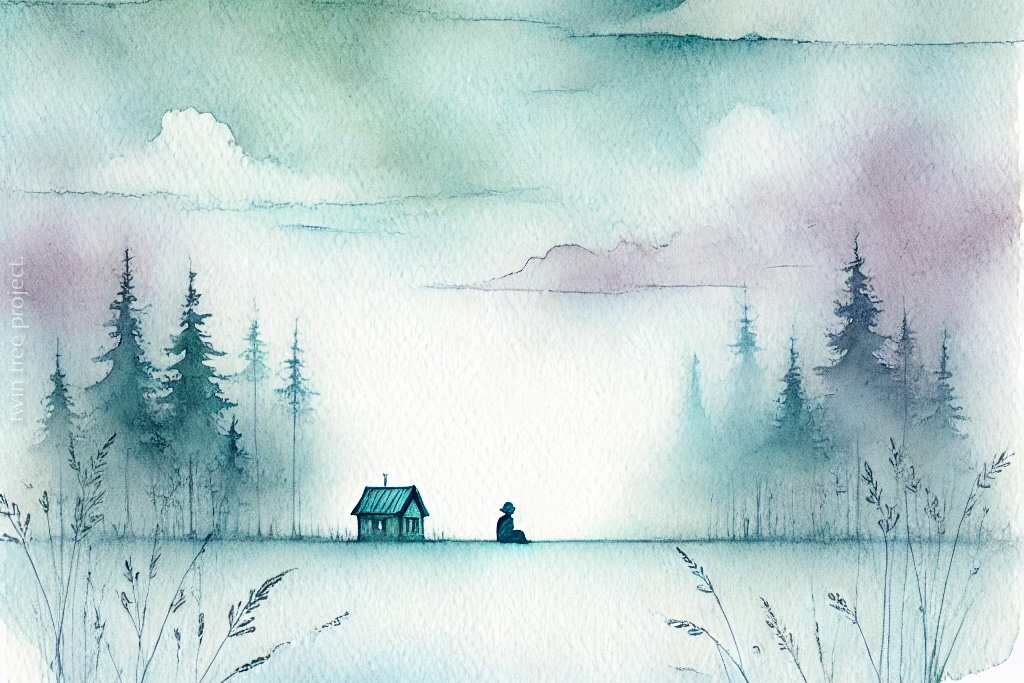
Busyness is not fulfillment, and solitude is not loneliness. We live in a world that celebrates productivity and connectivity, a world that has reversed these truths. Society at large confuses constant activity with purpose and equates being alone with deprivation. This misunderstanding, I believe, lies at the root of much of humanity’s discontent. Yet, the greatest wisdom often emerges not from noise but from stillness. Solitude is not the absence of connection—it is the presence of self.
Many fear being alone, mistaking it for isolation or lack (a topic I’ve touched on in previous articles I’ve authored and shared here), but I’ve learned that solitude is a profound gift. It’s a sacred space to meet oneself fully, without distraction. People like me—those who prefer solitude—are often misjudged as lonely. The truth is, I’m not lonely at all. I know myself, enjoy my own company, and have learned to sit comfortably with my thoughts and my feelings.
Perhaps my upbringing paved the way for this perspective. As an adopted only child of older parents, raised in a rural environment, solitude wasn’t just a preference—it was a default. There were no playdates or busy streets, no bustling neighborhoods. I had to find companionship within, and in doing so, I became my own best friend, outside of my connection with God and nature itself—nature being the greatest teacher for those who see, feel, and think deeply.
We should all connect with nature as often as possible, I believe. In its rhythms and stillness, nature holds profound lessons for anyone willing to observe and listen. It teaches us patience through its cycles, resilience through its storms, and balance through its quiet harmony. In nature, we find a mirror reflecting the truths we often overlook in our hurried lives—a reminder that wisdom and understanding are not rushed but unfold in their own time, like the changing of seasons. Nature shows us that growth requires patience, that storms give way to calm, and that the most enduring wisdom often comes in silence. For a deep seer, feeler, and thinker, nature isn’t just a backdrop; it’s a companion, a guide, and a reflection of the truths we carry within.
This foundation shaped my adult life, where I’ve chosen to embrace a quieter, more hermit-like existence, especially after years of caregiving. It’s not that I dislike people, but that the world’s endless demands have become spiritually exhausting. I’ve found solace in the simplicity and stillness that solitude offers.
That doesn’t mean I’m disconnected—far from it. I’m fortunate to share my life with a partner who shares my love for solitude. Together, we “hermit,” finding joy in the simplicity of being alone, yet together. It’s a profound kind of connection, one built not on constant activity or excessive consumption, but on shared stillness. I’ve also experienced this depth of connection with several loved ones who have recently crossed over. Their absence is felt deeply, but their presence lingers in the wisdom and love they left behind.
What I’ve come to realize is that a quieter, more introverted lifestyle fosters an even deeper sense of connection—not just to myself and others, but also to God. When life slows down, and the noise of the world fades, I feel God’s presence more vividly, as if He has more room to speak in the silence. It’s in this stillness that I also notice how connected others seem to be when they embrace a similar lifestyle. The more we retreat from the frenzy, the more we truly see and feel the sacredness in those around us, and the easier it becomes to honor the divinity within them.
People often assume that being a loner is synonymous with misery, but nothing could be further from the truth. For me, solitude is liberation—a space where I can reflect, recharge, and pursue what I love most: the search for wisdom. It’s not isolation but rather an immersion into the richness of life, a chance to listen deeply to both the world around me and the truths within.
Wisdom: The Heart of Solitude
This love of seeking wisdom has profoundly shaped my life, and it’s also why I left the church. I stepped away from Christianity, the religion I was raised in, and embraced an eclectic set of Christ-conscious beliefs because I felt that Christianity—or at least the version I was raised in—was asking me to do something that, in my heart, I knew God did not want for me: to disregard wisdom and live blindly. Without realizing it, they were asking me to disobey God by employing blind faith—something God specifically warns against in the Bible—while constantly shouting hellfire and damnation at me for being a sinner. The contradiction was impossible to ignore.
Wisdom isn’t an innate trait or an effortless gift. It must be sought, understood, digested, and lived. Phrases like “wisdom is written on our hearts” sound poetic, but they oversimplify a deeply challenging process. Even scripture suggests we must seek and find wisdom; it is not handed to us fully formed.
True wisdom requires effort, nuance, and an openness to complexity. Unfortunately, many people live surface-level lives, clinging to black-and-white thinking. But life is rarely that simple. Most truths are layered, and wisdom lies in exploring those layers—sitting with uncertainty, embracing contradictions, and aligning our actions with the lessons we’ve uncovered.
Take emotional intelligence, for example. My understanding of it didn’t come from books alone, nor was I born with a perfect heart of gold. Even my empathy was forged, as my father called it, in “the crucible of life”—through sickness, death, and grief. These experiences didn’t just teach me lessons; they required me to live those lessons to truly understand them. Or consider how I’ve studied the interplay between physical and emotional realities. At a physical level, boys are boys, and girls are girls—period. Yet emotionally and mentally, the story is far more intricate. Wisdom doesn’t demand choosing between these truths but instead calls for holding both, understanding their coexistence, and appreciating the nuance within them.
True wisdom requires paying close attention to the world around us and allowing ourselves the time and space to process it fully. This is something solitude has taught me, and it’s one of the reasons I treasure it so deeply.
People often ask me how I seem to “just know” things, as if it’s some kind of mysterious or supernatural ability. But it’s not that I simply know—it’s that I’ve learned to pay attention. I take the time to observe and process what I see, hear, feel, and even smell. This isn’t a “gift” in the sense that it’s unique to me. It’s a capability we all have, though many never take the time to cultivate it. Some religious people might call it a gift of the spirit, and perhaps I’m wrong to challenge that perspective. Perhaps not everyone is chosen to experience this depth of awareness. But why wouldn’t we all be? God made us all, didn’t He? Wouldn’t the same Creator who gave us life also give us the ability to truly perceive it? I don’t believe it’s exclusivity that separates those who “know” from those who don’t—it’s simply the willingness to be still, to reflect, and to truly see the world as it is.
This willingness to observe deeply, to sit with questions and wrestle with complexity, is what allows wisdom to take root. Solitude, then, isn’t an escape but a space for transformation. It is a sacred pause where life’s layers become visible. Solitude offers the space to process these complexities. It’s where I digest the lessons life has handed me, turning them into something meaningful.
As I write this, I think of Master Roshi, my late spiritual teacher, and the long conversations we shared about topics like this. If he were alive, I know we’d spend days—perhaps even weeks—immersed in a single conversation, unraveling the nature of wisdom, dissecting its layers, and expanding our understanding. He was one of the few people who could meet me at that depth. His absence is a loss I feel deeply, but I carry his teachings with me, and they continue to guide me.
That, in itself, is an example of wisdom: the ability to live what we’ve learned, to carry forward the gifts of those who have taught us, while recognizing that even they didn’t get everything right—and that as we grow, we must be willing to shed beliefs that have proven they no longer have a solid foundation in our lives.
An Invitation to Reflect
This reflection serves as a prelude to something larger—a post I’m working on about the essence of wisdom. Writing this feels like continuing those cherished conversations with Master Roshi, sharing what I’ve learned, questioning what I don’t yet understand, and inviting others to think deeply with me. And, I do invite you to think deeply with me, and share your thoughts.
Wisdom, I’ve realized, is not about knowing everything. That’s humanly impossible. Instead, it’s about how we approach the unknown—with openness, curiosity, and humility. It’s about embracing solitude as a space for reflection, honoring questions as much as answers, and seeking to live in alignment with the truths we uncover, never yielding in our pursuit and never ceasing to grow..
So, yes. Let this be an invitation: a call to reflect on the role of solitude in our lives, the pursuit of wisdom, and the beauty of living authentically. Wisdom isn’t written on our hearts like a finished manuscript—it’s a journey, a process of seeking, understanding, and embodying. And that journey begins with learning to sit with ourselves, not in loneliness, but in peace.
 Twin Tree Project
I’ve found I can’t be connected in the frenzy. The energy is too scattered. I think it’s meant to be that way. Distract us from the sacred. Distract us from the craven theft of everything. I prefer solitude, and my partner does, too. Sure, sometimes I get lonely. I long for a friend to have deep conversations with. But I’d rather be alone than hurt or used by those still caught in the game. That’s why I’m grateful for you and your words here. Thank you. I love you.
LikeLiked by 1 person