Lately, I’ve been reflecting on how much of our collective energy seems tied up in fear—fear of change, fear of loss, fear of the unknown—and revisiting my understanding of what it means to truly let go. With the recent U.S. election results, emotions are running high, and it’s clear that many are struggling with the discomfort of shifting realities.
I think it’s worth exploring this here, even at the risk of “offending” some. The overly cautious, politically correct dynamic that has been imposed on us doesn’t just stifle free speech—it also limits our ability to think critically and independently. This mindset often reinforces fear, shutting down open dialogue and stalling growth when we need it most.
When faced with change—especially when we don’t feel prepared for it, or when we believe these changes might be “bad” for us—it’s natural to cling to what feels familiar. We hold tight to old ways of living and thinking, even when those ways no longer serve us, because familiarity gives us a sense of safety. But in doing so, we may miss the opportunity to step into something new, something better.
Man cannot discover new oceans unless he has the courage to lose sight of the shore.
André Gide
This isn’t just about politics or elections; it’s about the stories we tell ourselves—stories that shape how we navigate the world, how we relate to others, and how we respond to change. These stories feel personal, but they also weave into the collective. Whether we’re clinging to old ways because they feel factual and secure, or embracing new ideologies because they seem to promise progress, we’re all operating within narratives we believe to be true.
But what if the truth isn’t in the narrative itself? What if the act of letting go isn’t about choosing one side or the other, but about stepping beyond the stories entirely—examining the ways we’ve been conditioned to think, question, and respond?
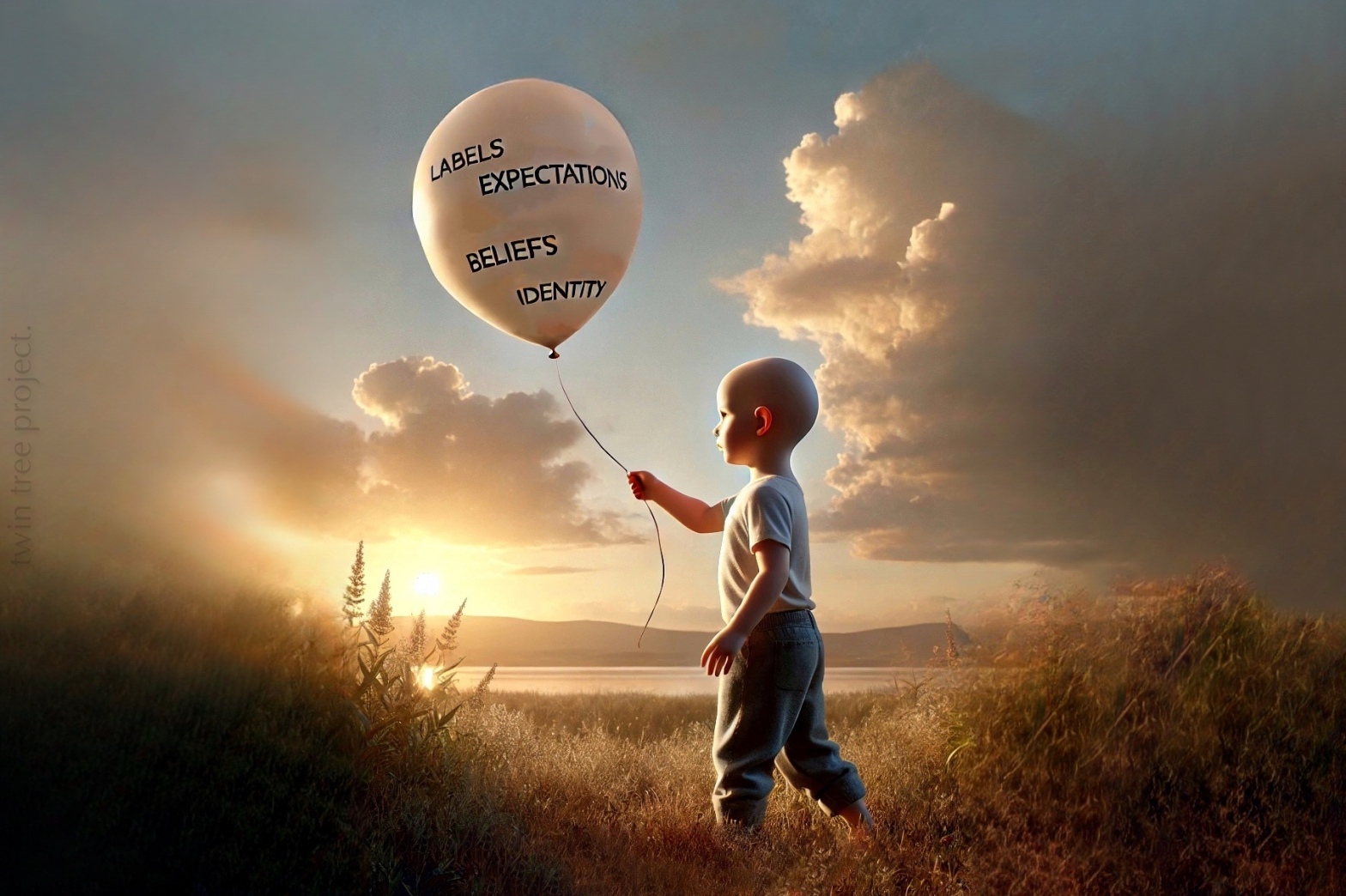
One of the most powerful things we can let go of is our reliance on labels to define ourselves and others. Labels, while convenient, often box us in and create unnecessary division. Philosopher Alan Watts spoke extensively about the limitations of labels, reminding us that language—while a tool for communication—is ultimately symbolic.
A label is not the thing itself; it’s merely an abstraction, a shorthand that can obscure the richness and complexity of what it seeks to describe. Watts often used the analogy of the word “water” to illustrate this point: the word itself cannot quench your thirst, nor can it capture the essence of the substance it represents. In much the same way, labels for people—whether related to gender, identity, or beliefs—can oversimplify and distort the reality of who we are.
This becomes especially apparent in debates around transgender identities—arguably one of the most prominent and emotionally charged issues tied to the societal changes we’re told to expect with an incoming “new” administration—particularly for those inclined to explore the deeper philosophical implications of identity and labels. For many in the trans community, the feeling of misalignment between their internal experience and their assigned label at birth is deeply distressing. This often leads to the desire to redefine their label, to align the external with the internal.
While this process is valid and necessary for many, it’s worth asking: what if the root of this pain isn’t the “wrong” label, but the labels themselves? What if the feeling of disconnection exists because we’ve been conditioned to see our essence—our true selves—through the lens of rigid categories?
When I let go of what I am, I become what I might be.
Lao Tzu
Psychologically, this speaks to the concept of self-concept—how we perceive ourselves based on both internal understanding and external feedback. When external labels don’t align with internal understanding, it creates cognitive dissonance, a state of tension between conflicting beliefs or perceptions. The natural impulse is to resolve this tension, often by changing the external label. But the tension could also be resolved by stepping beyond labels entirely, embracing the idea that no single word or category can encapsulate the fullness of who we are.
From a spiritual perspective, many traditions emphasize the idea that identity transcends form. The Buddhist concept of anatta, or “no-self,” teaches that clinging to fixed identities—whether tied to gender, roles, or other labels—leads to suffering. Similarly, Carl Rogers’ humanistic approach suggests that true self-actualization comes from aligning with one’s authentic self, which exists beyond societal constructs and labels.
In this sense, the very labels meant to help us define and express ourselves might be the source of our disconnection. By focusing on the essence—our unique individuality, our shared humanity, and the deeper truths that transcend categories—we could free ourselves from the limiting frameworks that often divide us. For the trans community and anyone navigating questions of identity, this isn’t about invalidating their journey; rather, it’s about offering a perspective that real liberation might not be in redefining labels, but in realizing that we are so much more than any label could ever capture.
We are not trapped by the name we give ourselves, but by the limits we place on who we are.
Kahlil Gibran
Releasing what no longer serves us opens the door to new possibilities, ones we may not yet see. It’s not about judging why we held on in the first place but about bringing curiosity to that part of ourselves. What did we believe this was giving us? Was it the comfort of the familiar? A sense of worth? The avoidance of change? By understanding the story we’ve told ourselves, we create space for something new to emerge.
This process invites us to shift our perspective. We are both the character living the story and the author crafting it. As the character, we’re immersed in the emotions, the fears, and the uncertainties. But as the author, we step back. We see the bigger picture, the patterns, the opportunities. From this vantage point, we have the power to write something different—not just for ourselves, but for the world we’re building within and around us.
Change can feel unsettling, even when it’s right for us. Familiarity has its own kind of comfort, and stepping into the unknown can feel like stepping off a ledge. But discomfort isn’t inherently bad; it’s a signal that we’re growing. When we pause to ask ourselves, “Is this truly what I need, or is it simply what I’ve known?” we open a doorway. On the other side of that doorway is trust—trust in ourselves, in the unfolding of life, in the balance of things. This trust isn’t forced; it’s built. It grows through small acts of alignment, through honoring our needs, through showing up for ourselves again and again.
For many of us, this journey begins with a single moment of realization. Perhaps we notice that a story we’ve clung to no longer resonates. Perhaps we feel an inner nudge toward something more expansive. This realization doesn’t require us to have all the answers. It asks only for curiosity—for the willingness to explore, to inquire, to ask, “What if there’s another way?”
Letting go often feels like falling. It feels like surrendering control, and in a way, it is. But in that surrender, we discover something unexpected: freedom. The freedom to release the stories that have kept us tethered. The freedom to trust that life continues, even when we stop trying to manage it all. And the freedom to step into a version of ourselves that feels more aligned, more whole.
We delight in the beauty of the butterfly, but rarely admit the changes it has gone through to achieve that beauty.
Maya Angelou
You don’t have to have it all figured out. You don’t have to force yourself to let go before you’re ready. Simply start where you are. Begin with the questions. Begin with curiosity. And as you walk this path, ask yourself: What if the person who gave me these rules, these stories I’ve been living by, maybe got it wrong? This simple question opens doors to clarity and freedom.
In time, you’ll look back and see the space you’ve created for something new to bloom. And you’ll know that letting go was never about losing.
It was always about becoming.
 The Twin Tree Project