
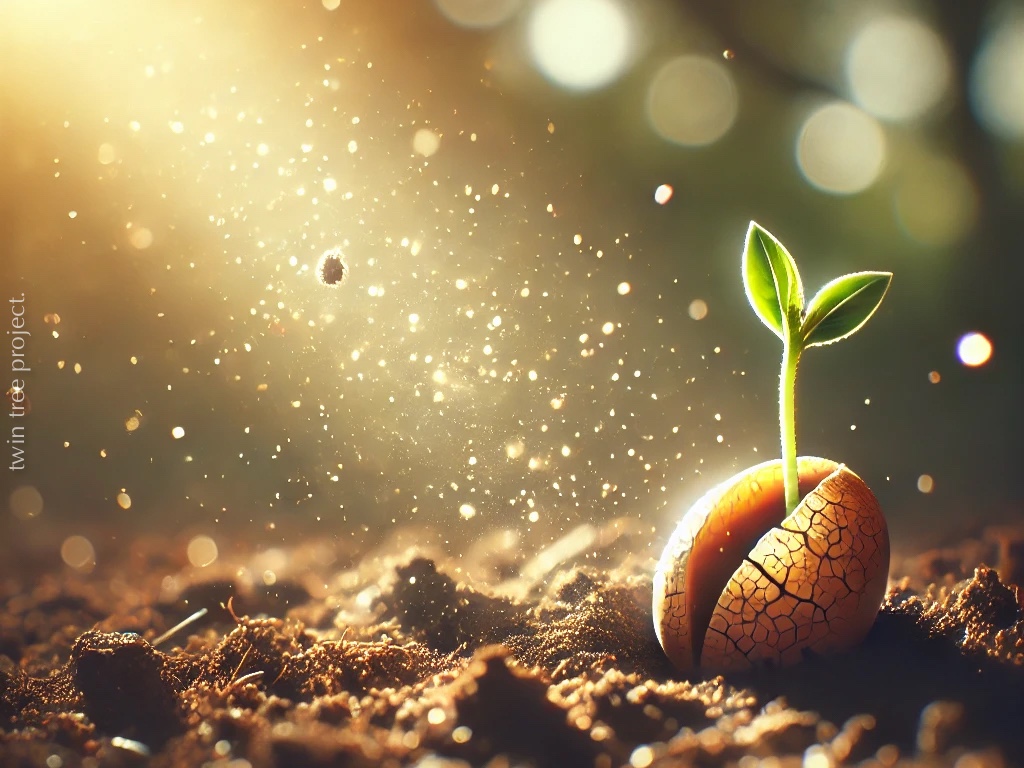
What do you do when your life feels like it’s crumbling into dust, and God seems silent? Sometimes, it feels like He’s letting you rot—but what if that decay is the first step toward new life?
Now, consider this: What if God is not silent at all? What if He’s speaking in a language that requires you to read between the lines—through the pain, the breaking, and the moments that feel like endings?
There are seasons when everything you’ve built, trusted, or clung to begins to fall apart. The relationships you cherished, the routines you relied on, even your sense of self—everything collapses. And as the dust settles, you’re left staring into the emptiness of what used to be.
It can be a terrifying and lonely place, but it’s also a sacred one. Because even when it feels like everything is breaking, God is clearing the ground for something new—something alive, something more aligned with His purpose for you.
Breaking Down to Build Back
I’ve been there.
The journey of surrender didn’t happen overnight. It began with resistance in early 2021, small changes in 2022, and finally, full surrender in 2024.
Just over six months ago, I “suddenly ostracized” myself—or at least, that’s how the people who remained in my life saw it. In reality, it was something far deeper: God was calling me into solitude, guiding me toward a season of quiet transformation. And my only “sin,” in the eyes of the world around me, was answering His call rather than theirs.
It wasn’t easy. The people closest to me didn’t understand why I chose to step back. Many judged me for it. I felt the sting of their misunderstandings, their criticisms, and their silence. But deep down, I knew I was being drawn toward something bigger than their approval: I was being drawn toward Him.
After the long, grueling journey of caregiving for my mother and experiencing her loss, I found myself utterly undone. The person I had been could no longer exist.
Oh, believe me when I tell you that I tried to fight God’s call. For almost two years, beginning in early 2021, I fought it mightily—with alcohol, with the reckless mindset and behavior of a much younger version of myself, with excuses spoon-fed to me by a media culture that profits from numbing our pain and distracting us from our purpose. These distractions sought only to kill my spirit and thicken their wallets, and for a time, I let them fill the void.
By August 2022, after learning that Master Roshi had been diagnosed with cancer and another caregiving journey loomed on the horizon, I knew I had to stop running. I put down the alcohol, limited my exposure to mainstream media, and began taking small steps toward change. But I held onto pieces of my old life—old patterns, old relationships, and old habits that continued to steer me further and further off the path God had laid out for me.
I was trying to walk God’s path while still clinging to the shadows.
It was a constant battle.
For nearly two years after that, I struggled to fully surrender. I thought I could fix things myself, control my life without giving everything to Him. Then, in the spring of 2024, after a particularly painful conflict with a friend, I finally saw the truth: I couldn’t keep one foot in my old life and one foot in the new. I realized I couldn’t walk God’s path halfway.
That night, at 2:30 a.m., I found myself on my knees with my face pressed into the floor, praying a desperate prayer:
“I can’t do it anymore, God. You see me here, at my lowest. I give up. I give it all to You—take it.”
I wept. I begged God to take everything. In that moment, the demons in my mind whispered familiar lies, tempting me to give in to hatred—hatred of the life I had created, hatred turned inward. I was tempted to end it all, to let despair win.
But instead of saying, “It’s too late,” God said, “Finally!”
It wasn’t until June 2024, just a month after that prayer, that the person I had been—the version of me I had clung to for far too long—finally died.
Because here’s the truth: God won’t take what you don’t give Him. He won’t take the wheel until you let go of your need to steer. I had to consent. I had to wave my white flag and say, “Lord, I’m ready for You to drive entirely.”
After those first steps of surrender, I began to see the patterns God was working to break in my life—and why the breaking was necessary for my growth.
Letting Go to Grow
It’s not easy to walk away from the people, habits, and patterns that once defined you. But when we begin to feel—physically or otherwise—a growing discomfort in or around those people, habits, and patterns, that may be God’s loudest message that it’s time to let go.
The breaking process leaves you vulnerable, and it can feel as though the ground beneath you has given way. But that vulnerability is fertile ground for transformation.
Growth often requires letting go of what no longer fits the person God is shaping you to be, of what no longer serves you—or Him.
Not everyone will understand this process. Some may judge it as “too much work,” even though you’re not asking them to walk the same path as you—only to respect yours. Others may dismiss you as a “goody-goody” for embracing a new way of life.
But here’s what I’ve learned: the pain of being misunderstood is part of the journey toward freedom. It’s the cost of saying yes to the person God is calling you to be.
The Science of Transformation and the Divine Pattern of Growth
If you’ve felt this way, you’re not alone. The process of breaking down and rebuilding is not only spiritual but natural—it’s written into the fabric of life itself.
Richard Tedeschi, a psychologist who studies post-traumatic growth, describes how profound personal transformation often comes after significant challenges or loss. In his words, it’s about “finding new meaning in the wake of pain.”
Nature mirrors this process. When leaves fall and decay, they enrich the soil and prepare it for new growth. The rotting isn’t an end; it’s preparation for renewal.
Scripture reminds us that God often works through this cycle of death and rebirth. Jesus tells us in John 12:24:
Very truly I tell you, unless a kernel of wheat falls to the ground and dies, it remains only a single seed. But if it dies, it produces many seeds.
Sometimes, God allows parts of us to die so that we can bear fruit. It may feel like He’s breaking us, but He’s really planting us. And what grows from that planting is something beautiful.
Carl Jung captured this beautifully when he said, “In all chaos, there is a cosmos; in all disorder, a secret order.” Even when life feels like chaos, there’s a divine purpose at work.
Alan Watts, a spiritual philosopher, echoed this truth when he said: “You cannot understand life and its mysteries as long as you try to grasp it. Indeed, you cannot catch hold of it. You must let go.” Letting go—of the old self, the old life, the old relationships—creates the conditions for new life to emerge.
Facing Judgment and Staying the Course
Letting go of old relationships and habits doesn’t mean the world will applaud your transformation. As we’ve touched on, there will be people who feel judged by your decision to step away. Others may dismiss your transformation as a way of “acting better than them.”
But I’ve come to understand that those reactions aren’t really about you. They reflect their own discomfort with change—both yours and theirs.
And that’s okay. Not everyone is meant to walk the same path as you.
The good news is that God doesn’t let us rot to harm us. He lets us rot to remake us.
Isaiah 61:3 reminds us of this truth: God gives us “beauty for ashes, the oil of joy for mourning, the garment of praise for the spirit of heaviness.” He doesn’t just leave us in the ashes of our old lives—He transforms us into something radiant.
Trusting the Process
Friedrich Nietzsche wrote, “You must become a chaos to give birth to a dancing star.” His words reflect the paradox that sometimes we have to let everything fall apart so God can rebuild something more beautiful in its place.
Eckhart Tolle captured this beautifully:
Some changes look negative on the surface but you will soon realize that space is being created in your life for something new to emerge.
So if you’re in a season where it feels like everything is falling apart, take heart. God isn’t done with you.
The rot is not the end—it’s the beginning.
The God who allows the old to decay is the same God who brings forth new life. He is with you in the breaking, and He will be with you in the rebuilding.
What I’ve come to understand through this process is that God has always been guiding me and calling me to the same purpose: to minister to others by sharing my own experiences. This isn’t new—it’s a calling I first recognized in my early 20s. I’ve tried and failed many times since then, even becoming ordained by the UU church over a decade ago. But I repeatedly backslid, more worried about pleasing people than pleasing God.
This blog was born out of all of this—the brokenness, the surrender, and the rebuilding. Just a few months ago, I felt God pushing me to get real about how I ended up where I am. I needed to stop pretending and start sharing. The words I write here aren’t simply things I believe; they are truths forged in the fire of my own journey. They’re the product of experience—raw, painful, and redemptive experiences that have taught me to trust the very truths I am guided to share.
I know how lonely and misunderstood this path can feel. I’ve cried my own tears, and I’ve felt the sting of pouring out my heart only to watch the world move on as if nothing happened. Society doesn’t often pause for the sacred moments of transformation, and it can be deeply painful to feel dismissed in your most vulnerable moments.
But hear me on this: your story matters.
Even when others rush past it, your journey has value. Every time you open your heart, someone out there will find the courage to open theirs. Your story becomes a light for those who are still in the dark, a reminder that they’re not alone.
So keep going. Even when it feels like no one notices. You are doing something important. Your surrender to God is not in vain, and the life He is building in you will be worth every tear, every sacrifice, and every misunderstood moment.
 The Twin Tree Project