Most people don’t know the difference between glass and crystal. They look similar. They come from the same basic materials. You could set them side by side on a shelf and not immediately know which is which.
But the difference in price? Significant… and the reason for that difference is not what most people would guess.
This topic speaks to me because, as I have shared many times in an attempt to help others combat the stigma, I, like many of you, have been called too sensitive my whole life. Too deep. Too much. And I cannot refute these accusations. In fact, I refuse to. I own them as they are. The older I get, the more sensitive I become.
People have never been wrong that I am sensitive. They were just wrong about what that means.
The Chemistry
Glass is formed simply. Silica, heat, and cooling. That’s it. Glass is functional, clear, and useful. It does exactly what it’s meant to do.
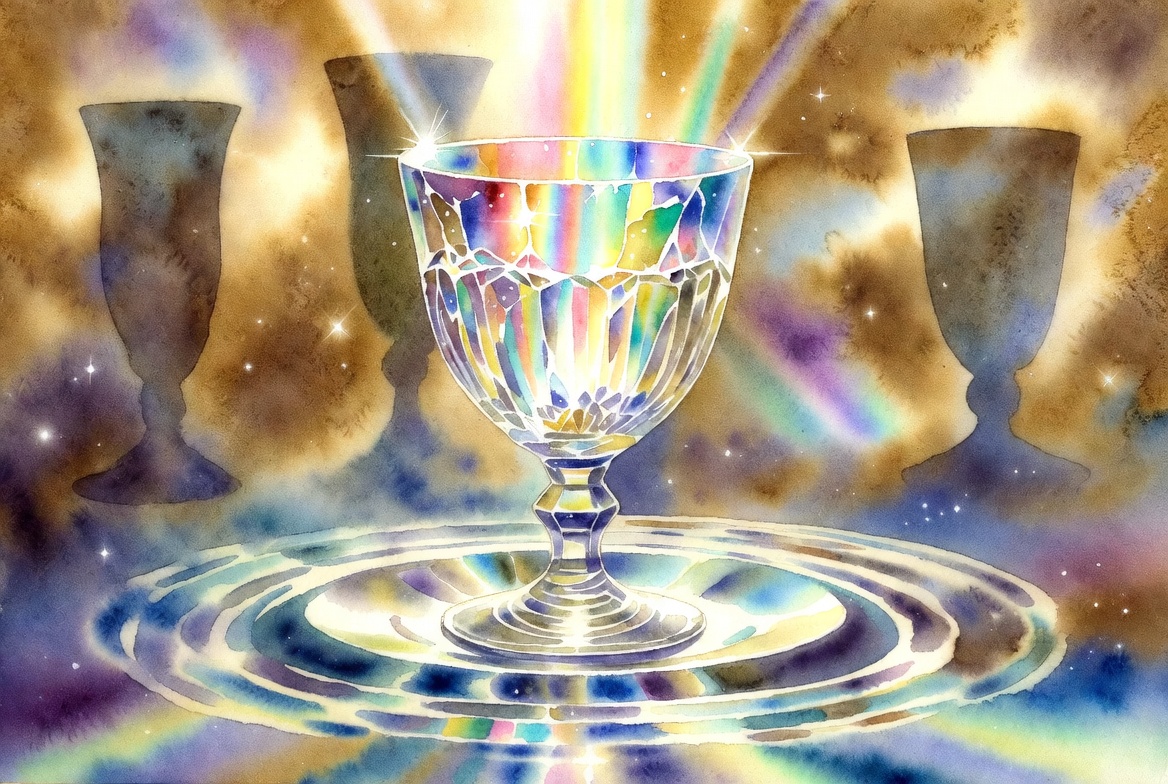
Crystal is something else entirely. Crystal is glass that has been transformed by addition. It begins with silica, and then lead oxide, barium, zinc (depending on the type of crystal being created) are added. These additives don’t just change the structure. They change everything. They change the way light moves through it. They increase the refractive index, which is a way of saying crystal bends light differently than glass does, more brilliantly, more completely. Crystal catches what glass misses.
These additions admittedly weaken the structure, but they enhance its capability, and one of those capabilities is what fuels my preference for crystal over glass despite its fragility. My favorite thing about crystal is its frequency. Its sound.
Strike a piece of glass and it makes a dull thud. Strike crystal and it sings. That ringing tone, unmistakable, clear, resonant, sustained, is the direct result of the very things added to transform it. The density. The molecular structure. The refinement.
Yes, the weakness is real. Crystal will chip where glass would shrug it off. It will shatter where glass would survive. The fragility is not a myth and it is not a small thing. But the fragility and the song come from the same place, the same additions, the same transformation, the same molecular truth. You cannot have one without the other.
The sensitivity is not the weakness. The sensitivity is the song.
This is why crystal costs more. Not because it is tougher. Not because it is easier to live with. Because of what it can do with light. Because of the frequency it carries that glass will never know. Because of what was added, and what that addition made possible, and what it cost to become what it is.
Those of us who are viewed as too sensitive may be inconvenient for many to deal with on an ordinary day. But who do they call when they need real advice? When they need someone to help them pull themselves together? When they need inspiration, or love, or just someone who will actually feel it with them?
They call us.
They call us because our sensitivity may be a lot to handle in calm weather. But when the world gets too heavy or too quiet, we are the ones who carry the song… and, oftentimes, them.
What Gets Added
I did not choose to be wired this way, but what happened to that wiring over the course of my life is what made me crystal.
There is a researcher named Elaine Aron who spent decades studying what she called the Highly Sensitive Person. Roughly 20% of the human population processes sensory and emotional information more deeply than others. It’s neurological. Biological. Not a disorder, not a defect, but a different kind of wiring.
HSPs notice more. They feel more, even tangibly so. They process more. They are more easily overwhelmed, yes, but also more capable of depth, empathy, beauty, and nuance. I was already this before life added anything. This was my silica.
Then the additives came. And then, the heat.
I spent years as a primary caregiver for people I loved deeply, watching them diminish, holding their hands through the slow leaving, and then letting them go. My father, through years of inherited diabetes and disability because of it. My mother, through years of Alzheimer’s, a slow, grueling deterioration until she was gone… long before she was dead. My dearest friends, people who were the architecture of my inner world, through cancer that ate them alive.
Through all of it, some of those situations which overlapped even with themselves, I had to keep living. I had to keep functioning, and keep showing up for my own life at the same time. Not after. During.
What that does to a person is not simple damage. Researchers Richard Tedeschi and Lawrence Calhoun spent years studying survivors of major life crises, grief, illness, trauma, and what they found was unexpected. They called it post-traumatic growth. Not just recovery, but actual transformation. An expansion of capacity, of meaning, of spiritual depth, of personal strength, not in spite of suffering, but through the specific pressure of it.
Crystal is not made by ease. It is made by what gets added under pressure and heat.
I have refined you, though not as silver; I have tested you in the furnace of affliction. (Isaiah 48:10)
That is not a metaphor God uses lightly. Refinement by fire is transformation by ordeal. What comes out is not what went in. And what comes out is worth more.
The Inconvenience of Depth
What people don’t realize about being crystal is that it costs you something socially that glass never has to pay. Glass people are easy to be around. They don’t ask too much of a room. They don’t pick up on the thing nobody said. They don’t feel the shift in energy when something goes unspoken, and they don’t lie awake afterward processing what it meant. They move through the world with a frictionless ease that crystal simply cannot replicate.
Crystal pays for that difference every single day, because when you feel everything more deeply, you also feel the absence of depth more acutely. You feel the hollowness of surface conversation. You feel the drain of spaces where you have to shrink to fit. You feel when someone is using what you carry and giving nothing back, and you feel it clearly, even when you can’t always name it.
For the first 45 years of my life, I ceaselessly poured into people who could not receive it because I knew how it felt to be treated like an inconvenience or a problem and I never wanted to be the reason someone felt that way. But those people couldn’t receive what I poured — not because they were bad people, but because we were made of different materials.
You cannot get a song from glass no matter how gently or how hard you strike it. That is not a flaw in the glass. It is simply the nature of what it is.
What I finally understood, after years of feeling too much, giving too much, and walking away too empty, is that discernment is not coldness. Choosing carefully who gets access to what you carry is not a wound. It is wisdom. It is the natural response of someone who has finally learned the value of what they hold, and who they are.
Not everyone deserves the crystal. Not everyone can hear the song. Most just keep it on the shelf as a decoration, only reaching for it when it is necessary, taking it for granted the rest of the time. The sooner you make peace with that, the less of yourself you will spend trying to make music in rooms that were never built for it.
The Shape of Solitude
There is a version of solitude that is avoidance. Hiding. Isolation born from fear or wound. I know that version. I’ve lived it.
But there is another version entirely. Solitude that is chosen. Protective. Intentional. The kind that says: I know what I carry, I know what it costs me to pour it into spaces that cannot receive it, and I choose not to do that anymore.
Today I have very few close relationships. That is not a wound. That is discernment.
I do not judge or feel negatively about people who do not hear or value the song, but I also do not allow those people to use what I carry and never refill me. I do not spend intimate energy with people who are not spiritually or relationally yoked to me, because it costs me something real, and the return is hollow. Not because they are bad people. Because we are made of different materials.
We also glory in our sufferings, because we know that suffering produces perseverance; perseverance, character; and character, hope. And hope does not put us to shame. (Romans 5:3-5)
That progression is not accidental. Suffering does not produce hope directly. It produces perseverance first, then character, and only then hope. The crystal doesn’t form overnight. But once it forms, it becomes worth more than what it was.
The Song
What I have learned after these formative seasons, and what I hope to help you learn too, is that the point of the song is not to protect it. It’s not to keep it locked safely inside where nothing can touch it. The point is to let it ring.
I spent a long time guarding what I’d become. Speaking carefully. Living quietly. Curating who got access to what I carry. There is wisdom in that. Discernment is not the same as silence, and protecting what is sacred is not the same as hiding it.
But something has shifted. When I started this site, I began speaking my truth out loud. I began living my testimony in the open, not just here but in my everyday life. And I am letting whatever rings out, ring, without apology, without expectation, and without explanation.
Praise be to the God and Father of our Lord Jesus Christ, the Father of compassion and the God of all comfort, who comforts us in all our troubles, so that we can comfort those who are in any trouble with the comfort we ourselves receive from God. (2 Corinthians 1:3-4)
The comfort becomes currency. The wound becomes the gift. The song, the very thing that makes you inconvenient to glass, is precisely what someone else in a dark room is waiting to hear.
The Frequency
This is not a new idea, but an ancient one. It echoes across every tradition, every culture, every century that human beings have tried to make sense of what suffering produces.
Carl Jung called it the wounded healer, the archetype of the person whose own brokenness becomes the source of their capacity to reach others. He also spent a lifetime writing about individuation: the process of becoming fully, wholly yourself. Not the self you perform for the world. The self underneath. And he was clear that it almost always requires breaking open first. The shell has to crack before the real life can emerge.
Viktor Frankl survived the Holocaust. What he carried out of it was not bitterness, though he had every right to it. What he carried was a framework: the human being is not destroyed by pain, but by pain without meaning. Suffering, when it cannot be escaped, can be transformed, and that transformation is what saves us. His entire life’s work rests on what was added to him in the furnace. And what was added made him one of the most important voices of the twentieth century.
Alan Watts wrote that the deepest taboo in Western culture is against knowing who you actually are, the full, unedited, integrated self. We perform ourselves for others and then wonder why we feel hollow. We shrink to fit the room and then resent the room for being small. He believed the self we hide from is the very self we need to become.
Rumi, the thirteenth-century Sufi poet, wrote: “The wound is the place where the light enters you.” He was not talking about glass.
Buddhism teaches that dukkha, suffering, dissatisfaction, the friction of existence, is not something to be escaped but something to be understood. It is the beginning of awakening, not the obstacle to it. The lotus does not grow in clean water. It grows in mud.
Every tradition, in its own language, points toward the same truth: the additions change you. The pressure refines you. What you become on the other side of the furnace is not what you were before, and it is worth more.
I point to all of this to drive home this point:
This is not weakness, it is formation.
Closing Thoughts
For those of us already wired to feel more, process more, and notice more — the formation goes deeper still. The refractive index is higher. The song is clearer. The light bends in ways that glass, functional and useful and unbroken as it is, will simply never know.
I am not too sensitive.
Neither are you.
We have a song.
 Twin Tree Project